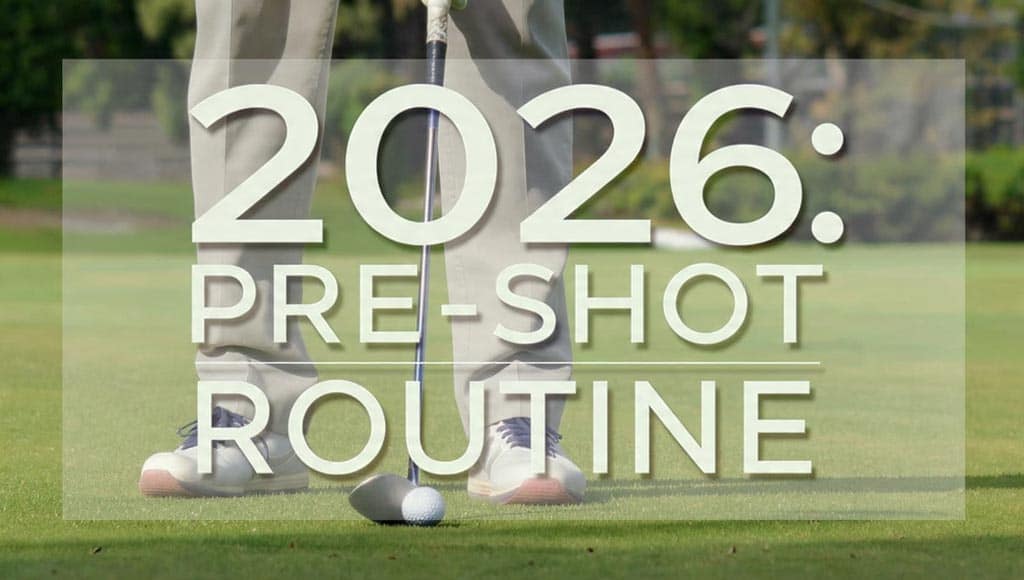
Your Pre-Swing Routine: The Secret to Consistent Golf Shots Every Time
You step up to the ball, feeling good about your swing. Yesterday on the range, you were striping it. But today? That same swing produces a duck hook into the trees. Sound familiar? Here’s what most golfers miss: inconsistency isn’t about your swing mechanics. It’s about what happens if you don’t develop your pre-swing routine.
When you develop your pre-swing routine, everything changes. Suddenly, you don’t have seventeen different swing thoughts bouncing around inside your head. You’re executing a proven process that builds confidence and delivers results, shot after shot.
Why Your Pre-Swing Routine Matters More Than You Think

Tour professionals don’t just walk up and hit the ball. Watch them closely, and you’ll notice something remarkable: they follow the exact same pattern before every single shot. Win or lose, pressure-packed Sunday or casual Tuesday, their routine never changes.
That’s not coincidence. A consistent pre-swing routine creates neural pathways that transform conscious effort into automatic execution. Your body learns to associate specific movements and thoughts with good shots. Over time, this routine becomes your trigger for success.
The Think Box: Where Strategy Meets Commitment
Behind the ball is your “think box” – the strategic headquarters of every shot. This is where you evaluate distance, wind, hazards, and target. You’re processing information and making decisions. Should you hit driver or lay back with a three-wood? Is that bunker really in play?
Take your time here. There’s no rush. Consider using a rangefinder to get precise yardages. Pull out your yardage book or course guide. Visualize the shot shape you want to see.
But here’s the critical part: once you leave the think box and approach the ball, decision time is over. You’re committed. This mental separation prevents indecision from creeping into your swing.
Pre-Swing Thoughts: Keeping It Simple

The biggest mistake golfers make? Trying to think about twelve swing keys while standing over the ball. That’s a recipe for tension and terrible contact.
Instead, develop your pre-swing routine to include just one simple swing thought. Maybe it’s “smooth tempo” or “turn through the ball” or simply “trust it.” Tour pros often use feel-based thoughts rather than mechanical ones. Rory McIlroy has talked about focusing on rhythm. Jordan Spieth emphasizes his breathing.
Your pre-swing thought should be positive, simple, and already ingrained from practice. This isn’t the time to fix your takeaway.
Physical Preparation: The Sequence That Builds Confidence
Your physical routine should be consistent and purposeful. Here’s a proven sequence that works:
Start with a practice swing behind the ball while visualizing your target. Feel the rhythm you want. Many golfers benefit from a weighted training club like the Orange Whip during warmup to groove this tempo.
As you approach the ball, take a deep breath. Tension is the enemy of good golf. Let your shoulders drop slightly as you exhale.
Alignment: The Foundation of Accuracy
Stand behind the ball and pick an intermediate target – a leaf, divot, or discoloration – about two feet in front of your ball on your target line. This makes alignment dramatically easier than trying to aim at a target 250 yards away.
Approach from behind and set your clubface square to your intermediate target first. Then build your stance around the club. Your feet, hips, and shoulders should all aim parallel left of your target line for right-handed golfers (parallel right for lefties).

Feet Position and Stance Width
Your stance width affects your stability and rotation. For most full shots, your feet should be approximately shoulder-width apart at the heels. Driver stance might be slightly wider for stability. Shorter irons and wedges can have a narrower stance to facilitate hip turn.
Position the ball according to club selection: forward in your stance for driver (off your front heel), middle for mid-irons, and slightly back for short irons and wedges.
The Final Waggle and Trigger
Once you’re set, a small waggle or forward press serves as your swing trigger. This keeps you from getting static and tense. Some players look at the target one final time. Others focus on the back of the ball.
Find your trigger and use it every single time. Phil Mickelson does his distinctive forward press. Tiger Woods has his club waggle. You need yours.
Club Selection: Make It Before the Play Box

Here’s a pro tip: never change your mind once you’ve committed to a club and entered your setup. If doubt creeps in, step away completely and restart your routine.
Indecision creates tension. Tension destroys rhythm. If you’re between clubs, take the extra club and swing smooth. You’ll make better contact and probably end up at your target anyway.
Building Your Routine: Practice Makes Permanent
Your pre-swing routine should take between fifteen and thirty seconds once you’re ready to hit. Any longer and you risk overthinking. Any shorter and you’re rushing.
The key is consistency. Use the same routine on the range, on the course, and in pressure situations. Your routine becomes your comfort zone, the one thing you can control when everything else feels chaotic.
Improvement Strategy: The Pre-Swing Routine
Assess & Plan
Behind the ball, check distance, wind, and hazards. Visualize the ideal shot and pick an intermediate target just in front of the ball.
Prepare & Align
Take one smooth practice swing. Approach the ball, aim the clubface at your intermediate target, then set your feet, hips, and shoulders parallel to the target line.
Focus & Execute
Take a deep breath to release tension. Focus on a single swing thought (e.g., “smooth tempo”). Commit to the shot and swing.
If These Articles Help,
Running Golf Course Intel takes real time, real effort, and – yep – real golf balls. If you’ve enjoyed the guides, the strategy breakdowns, or the myth‑busting articles, hitting that Buy Us Golf Balls button is the easiest way to help keep the site online and the content flowing. Every donation, big or small, genuinely fuels the next round of smarter golf insights.
Thanks for helping us keep this thing rolling!
Ready to Take Your Game Further?
Mastering your pre-swing routine is just one piece of shooting lower scores. Want a complete strategy for conquering your home course or that bucket-list destination? Request your Golf Course Intel Strategy Guide for personalized drills, stretches, and a hole-by-hole, shot-by-shot gameplan tailored to your game. Stop leaving strokes on the course and start playing with confidence and purpose.
Your best golf starts before you swing. Make your routine matter, and watch consistency become your new normal.