
The Crown Jewel of the Canyon: An Exhaustive Look at Riviera Country Club
If there is a golf course that perfectly blends Hollywood glamour with a street-fight mentality, it’s Riviera Country Club. Tucked away in the Santa Monica Canyon, “The Riv” isn’t just a pretty face; it’s a strategic masterpiece that has baffled the world’s best players for nearly a century. With the 2026 Genesis Invitational marking the course’s centennial era, and the 2028 Olympics on the horizon, the spotlight is burning brighter than ever on this George Thomas gem.
Riviera is famously the only course where Tiger Woods has played significantly (over 10 times) without recording a victory. He made his PGA Tour debut here as a 16-year-old amateur in 1992, yet the intricate strategies have always eluded his dominance, adding to the course’s mystique as a “puzzle” even the greatest cannot easily solve.

So what does it actually take to score here? It’s not just about hitting it long – though that helps. It’s about navigating the thickest rough on Tour, reading deceptive Poa Annua greens, and making decisions that would make a chess grandmaster sweat. Whether you are a scratch golfer or a weekend warrior dreaming of the canyon, here is your guide to navigating Riviera.
Tee It Up: Choosing Your Ground

One of the biggest mistakes amateurs make at a championship venue like Riviera is biting off more than they can chew. The elevation changes and the heavy marine air can make the course play significantly longer than the scorecard suggests.
- For the TOUR Pro: The tips (Black Tees) now stretch to a formidable 7,383 yards for the 2026 season. With the par-3 4th hole now playing a staggering 273 yards and the 18th stretching to 499 yards, the back tees are strictly for those who carry their driver 290+ yards and possess a high ball flight.
- For the Mid-Handicap Amateur: Do your scorecard a favor and step up to the White Tees (~ 6,500 yards) or the Blue Tees (~ 6,900 yards) if you’re a single digit. The sticky Kikuyu fairways offer almost zero roll, meaning a 400-yard hole effectively plays like 430. Playing from the appropriate tee allows you to actually hit approach shots into these guarded greens rather than scrambling for par from 50 yards short all day.
The Tools of the Trade: Club & Ball Selection
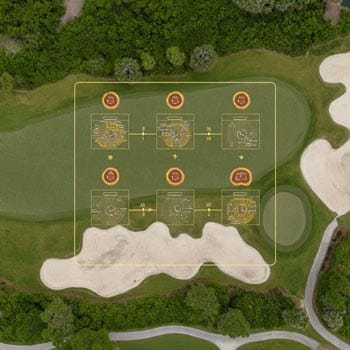
Riviera requires a very specific toolkit. You aren’t playing a links course where you can run the ball up; you are playing “aerial target golf.”
1. The Golf Ball The primary defense at Riviera is the Kikuyu grass. It is spongy, sticky, and grabs the ball immediately upon landing. You need a ball that flies high to maximize carry distance (since you get no roll) and spins aggressively to hold the firm greens.
- Recommendation: The Titleist Pro V1 is the gold standard here. Its penetrating flight cuts through the Pacific breeze, while its drop-and-stop capability is essential for holding the shelf-like greens on holes like the 9th and 10th.
This post contains affiliate links. If you use these links to buy something, I may earn a commission at no extra cost to you. Thanks for your support!
2. The Rangefinder With elevation changes on key holes (like the massive drop on Hole 1 and the uphill climb on Hole 18), judging distance by eye is a recipe for a double bogey. You need a device that accounts for slope.
- Recommendation: The top-of-the-line Bushnell Pro X3+ is ideal for its “Elements” compensation, which factors in temperature, wind and altitude – crucial for the heavy morning air in the canyon.
Strategic Breakdown: The Holes That Define Your Round
To score at Riviera, you have to survive the gauntlet. Here are the pivotal decisions you’ll face.
Hole 1: The Canyon Launch (Par 5)
- The Decision: The tee sits 75 feet above the fairway, creating the most inviting tee shot in golf.
- The Strategy: Grip it and rip it, but favor the right-center. The fairway narrows for the long hitters, and the barranca on the left is a round-wrecker before you’re even out of the gate. If you find the fairway, you have a green light to go for the green in two. It’s the easiest birdie on the course – take advantage of it.
Hole 4: The Redan (Par 3)
- The Decision: Now playing 273 yards, this is a beast.
- The Strategy: This is a “Redan” style hole, meaning it slopes right-to-left. However, the soft Kikuyu apron won’t let you bounce it on like a Scottish links. You have to fly a wood or hybrid high and land it softly on the front right. Par is a massive victory here; do not go hunting for a back-left pin.
Hole 6: The Doughnut (Par 3)
- The Decision: A bunker… in the middle of the green?
- The Strategy: Identify which quadrant the pin is in and aim for the center of that quadrant. Do not get cute. If you end up on the wrong side of the donut bunker, you are looking at a wedge shot from the putting surface (if the rules allow) or a terrifying putt around the sand.
Hole 10: The Ultimate Risk/Reward (Par 4)
- The Decision: 315 yards. Do you drive the green or lay up?
- The Strategy: This is the most debated hole in golf.
- The Aggressive Play: Hit driver at the left edge of the green. You must carry the ball 280+ to clear the bunkers.
- The Smart Play: Hit a 4-iron down the far left fairway. This leaves you a full wedge into the green, which is shaped like a bowling pin and slopes away from you. Statistics show the layup often yields a lower average score for amateurs than a failed drive into the greenside rough.
Hole 15: The Dogleg Right (Par 4)
- The Decision: A 487-yard brute that turns hard right.
- The Strategy: You must hit a fade (left-to-right shot) off the tee. A straight ball will run through the fairway into deep rough, blocking you out. Aim at the left edge of the fairway and let it peel back. If you can’t hit a fade, club down to a 3-wood to stay short of the run-out and accept a long iron approach.
Hole 18: The Grand Finale (Par 4)
- The Decision: A blind tee shot uphill to a fairway you can’t see.
- The Strategy: Trust the line. Aim at the clubhouse on the hill. The fairway slopes heavily left-to-right, so you need to hug the left side to hold the short grass. The approach shot plays into a natural amphitheater; take one extra club to account for the uphill elevation to ensure you clear the “valley of sin” in front of the green.
Final Thoughts: The Kikuyu Factor
The biggest adjustment for any visitor is the grass. Kikuyu grass is sticky.
- Chipping: You cannot bump-and-run. The ball will check immediately. You must fly the ball to the hole.
- Rough: If the ball sits down, do not try to be a hero. The grass will grab the hosel of your club and shut the face, causing a smother hook. Take a lofted wedge, hack it back to the fairway, and rely on your wedge game to save par.
Riviera is a test of patience as much as skill. It tempts you with beauty and punishes you with physics. But armed with the right strategy – and perhaps a new dozen Pro V1s – you can walk off the 18th green with your head held high.

Want to take your game to the next level?
Every course has its secrets, and your game has its unique needs. If you’re ready to stop guessing and start scoring, request your personalized Golf Course Intel Strategy Guide today.
We’ll help you identify personalized drills to tackle specific course challenges, recommend the perfect equipment for your swing speed, and build a hole-by-hole framework that saves you strokes before you even step on the first tee.






0 Comments