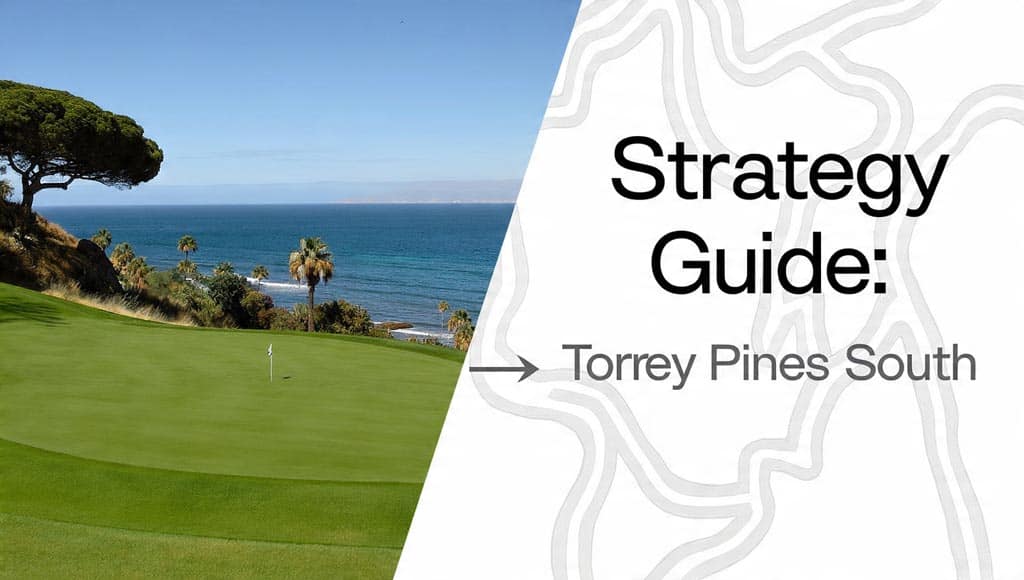
Elite Performance: A Blueprint for Conquering Torrey Pines South
Torrey Pines South isn’t just a golf course; it’s the “Leviathan on the Mesa.” Known for hosting the annual Farmer’s Insurance Open and two U.S. Open Championships (2008 & 2021) while chewing up the world’s best with its 7,800-yard layout and punishing Kikuyu rough, it intimidates even seasoned players. But with the right intel, it is conquerable.
Today, we are analyzing Dave, a 43-year-old golfer with a 15.3 handicap, to demonstrate to him how a personalized strategy can save strokes before he even steps on the first tee.
Player Profile & Prep: Getting Dave Ready
Dave drives the ball 214 yards (swing speed ~93 mph) and hits it straight. His nemesis? Approach shots and Greens in Regulation (GIR: 26.4%). To handle Torrey’s heavy marine air and long approaches, Dave needs a routine that primes his body and mind.
Pre-Round Warm-Up (15 Minutes)

- Dynamic Stretching: Leg swings (front/back, side-to-side) to open hips; Torso twists with a club behind the back; Arm circles to loosen shoulders.
- Range Work: Hit 15 balls starting with wedges, moving to 7-iron, then Driver. Focus on tempo rather than distance.
- Mental Cues: “Smooth transition at the top” (to prevent the push) and “Commit to the target.”
Post-Round Cool Down
- Assessment: Do your performance assessment using the “Good, Bad, Learn” log. Identify one thing done well, the primary cause of your bogeys, and one specific takeaway for your next practice session. This isn’t emotional analysis – it’s objective data collection.
- Health: Hydrate immediately. Perform static stretching (hamstrings and lower back) to counteract the walking fatigue.
The Right Ball for the Job

Equipment matters, especially when facing Torrey Pines’ notorious coastal winds and thick Kikuyu rough. For a player with a 93-mph swing speed who battles a push-slice tendency, the Titleist AVX is the ultimate weapon. Its aerodynamics deliver a low, piercing flight that neutralizes the “ballooning” effect and cuts through that marine layer like butter.
If the AVX feels too firm, the TaylorMade Tour Response (70 compression) offers easier compression at moderate swing speeds while maintaining tour-level spin around the greens. For value-seekers, the Snell Prime 3.0 delivers similar urethane performance at a fraction of the cost.
| Recommendation | Model | Why It Fits Dave |
| Top Pick | Titleist AVX | Excellent piercing flight for coastal winds; softer feel for putting. |
| Alternate 1 | TaylorMade Tour Response | Forgiveness on off-center hits; great greenside control. |
| Alternate 2 | Snell Prime 3.0 | Budget-friendly urethane option with similar performance to majors. |
Course Strategy: Taming the Beast
The Setup:
Based on Dave’s 214-yard driver, the “Driver x 28” formula suggests a course length of ~6,000 yards.
- Recommended Tees: White Tees (6,145 yards). The Yellows (5,300) are too short, while the Greens (6,600) would make par-4s unreachable.
- Course Handicap: 16 (White Tees).
- Expected Score: 88–92.
General Intel:
- Respect the Rough: When you miss the fairway, resist the hero shot. Take a wedge, hack it back to short grass, and rely on your wedge game. Take your medicine.
- Club Up: The heavy air, elevated greens, and uphill approaches mean almost every shot plays 1-2 clubs longer than the yardage suggests. When the number says 5-iron, hit the 5-hybrid.
- Front of Green is King: Most trouble at Torrey runs long or lateral. The front approach is usually open to a run-up shot, so err on the safe side.
Hole-by-Hole Tactical Guide (Selected Holes)

Hole 1 – “Meridian” (Par 4, 409 yards)
- Strategy: A “deceptive handshake.” Aim left-center to open the green angle.
- Dave’s Play: Aim at the left fairway bunker with your driver – you’ll fall safely short. With 195 yards remaining, don’t try the hero shot. Hit a fairway wood to the front-center of the green. The slope runs back-to-front, so being short leaves an easy uphill chip. Target: Bogey.
Hole 3 – “Ocean View” (Par 3, 142 yards)
- The Shot: Downhill towards the ocean. The view is stunning, but the wind eats the drop.
- Dave’s Play: This downhill beauty plays directly into the ocean wind. Despite the elevation drop, it plays true to yardage due to heavy air. Aim center-right – the slope feeds everything left toward the ocean. Missing short-right is your only safe bailout.
Hole 4: Cliffs (Par 4)
- The Danger: Cliffs run the entire left side.
- Dave’s Play: The canyon runs the entire left side. Your natural right-push tendency actually helps here – aim left-center and let it fade back to safety. With 170 left, aim front-right of the green where contours feed the ball toward the hole.
Hole 6 – “Canyon Rim” (Par 5, 449 yards)
- Opportunity: A scoring chance if you stay patient.
- Dave’s Play: A legitimate birdie opportunity! This short par-5 from the whites is your chance to gain a stroke. Don’t get greedy on the second shot – lay up to your favorite wedge distance (~ 100 yards) for a simple pitch into the two-tiered green.
Hole 11 – “Redan” (Par 3, 171 yards)
- The Challenge: Long, downhill, into the wind.
- Dave’s Play: Statistically the hardest par-3 on the course. Downhill but often into stiff wind, it plays like 170-180 yards. Aim front-right and let the famous Redan slope kick your ball left toward the pin. Target: Bogey.
Hole 12 – “Wind Tunnel” (Par 4, 411 yards)
- The Grind: Plays directly into the wind with a pinched fairway.
- Dave’s Play: This hole plays directly into the ocean wind and feels like a par-5. Accept it as such. Don’t force a 3-wood over bunkers – hit a mid-iron to 30 yards short, pitch on, two-putt. Stress-free bogey.
Hole 13 – “The Monster” (Par 5, 486 yards)
- The Hazard: A massive canyon requires a forced carry.
- Dave’s Play: From the white tees, the canyon carry is manageable. Focus on smooth swings. Lay up short of the bunkers on your second, then remember the green sits 30 feet elevated – take an extra club for your approach.
Hole 18 – “Devlin’s Billabong” (Par 5, 473 yards)
- The Finale: Famous pond front-left.
- Dave’s Play: Don’t let the pressure of the finishing hole make you flirt with that pond guarding the front left. Lay up to the right side of the fairway for a simple wedge across the water. The green slopes toward the water, so stay below the hole.
Dave’s Complete Torrey Pines Elite Performance Strategy Guide
Path to Improvement: Breaking Through the Plateau
Dave is a 15.3 handicap, which means he has decent mechanics but lacks consistency in scoring. To lower his handicap toward single digits, the focus must shift from “avoiding disaster” to “controlling the approach.”

1. Approach Shot Dispersion:
Dave loses the most strokes on approach (-0.33 SG / hole). He hits it straight but likely comes up short or wide. The fix: Stop pin hunting. On a course like Torrey with large 6,000 sq. ft. greens, aiming for the “fat” part of the green every time will instantly improve his 26% GIR stat.
2. Scramble Efficiency:
With only 26% GIR, Dave is chipping 13-14 times a round. He needs to master the “bump and run” with an 8-iron or hybrid to navigate the Kikuyu fringes where wedges often get stuck.
3. Distance Management:
At 214 yards off the tee, Dave puts pressure on his long irons. Dedicating one practice session a week to overspeed training or flexibility could unlock 10-15 extra yards, turning 5-iron approaches into 7-irons, significantly tightening dispersion.
If These Articles Help,
Running Golf Course Intel takes real time, real effort, and – yep – real golf balls. If you’ve enjoyed the guides, the strategy breakdowns, or the myth‑busting articles, hitting that Buy Us Golf Balls button is the easiest way to help keep the site online and the content flowing. Every donation, big or small, genuinely fuels the next round of smarter golf insights.
Thanks for helping us keep this thing rolling!
Ready to Conquer Your Course?

Every golfer is unique, and every course demands a specific plan. Dave’s plan for Torrey Pines is built on his specific yardages and tendencies – avoiding his weaknesses and leveraging his straight driving.
Do you want a Golf Course Intel Strategy Guide tailored just for you?
Stop guessing which club to hit or where to aim. Request your personalized guide today and we will provide:
- A custom Warm-Up & Drill routine.
- Ball & Gear recommendations matching your swing speed.
- A hole-by-hole tactical map for your favorite course.