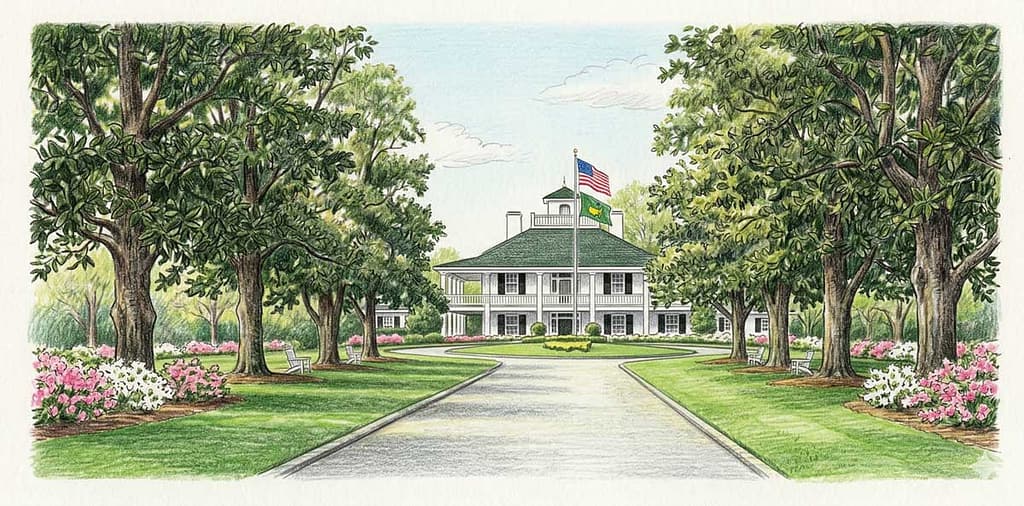
The GCI Deep Dive into Augusta National Golf Course
We’ve all dreamed of driving down Magnolia Lane and teeing it up at the most famous venue in American golf. Today, we are taking an exclusive look at the masterpiece created by Bobby Jones and Alister MacKenzie. From treacherous elevation changes to lightning-fast greens, having a solid Augusta National strategy is the only way to survive.
What Type of Course is Augusta National?
While built on the sprawling site of the former 365-acre Fruitland Nurseries, Augusta National is essentially an inland parkland course heavily inspired by the strategic elements of Scottish links. Co-founders Bobby Jones and Alister MacKenzie championed a brilliant design featuring ultra-wide fairways and virtually no penal rough. Instead of hacking out of tall grass, golfers are challenged by strategic angles, uneven lies, and massive, wildly undulating greens.
The Unofficial Course Slope and Rating
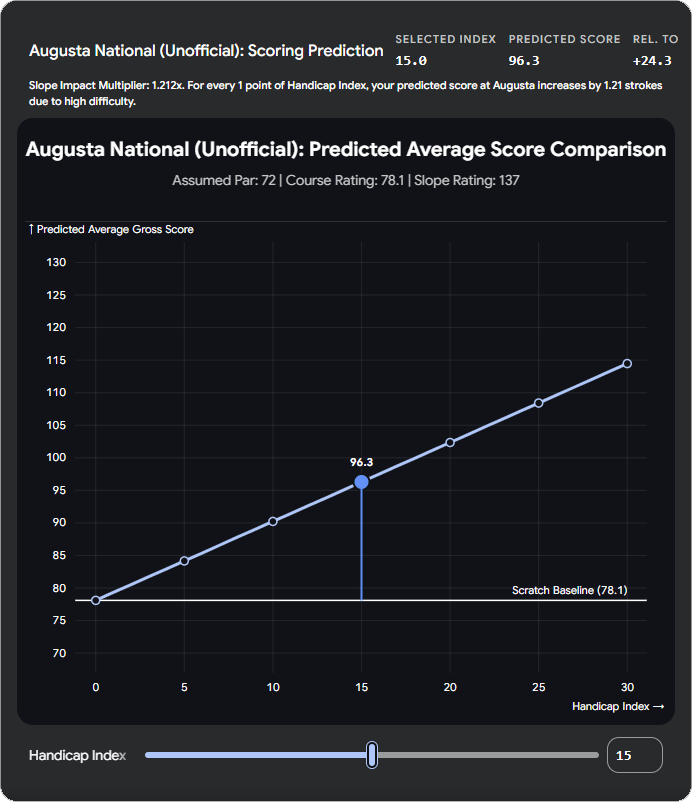
Augusta National is incredibly secretive and doesn’t hold an official USGA rating for its membership. However, during the 1990 tournament, a team of USGA experts surreptitiously evaluated the course. They estimated an unofficial Course Rating of 78.1 and a staggering Slope Rating of 137. That means a scratch golfer would likely shoot six over par on a good day! A 15-handicap player can expect a score in the upper-90s:
Hole-by-Hole Strategic Outline
Elevation changes here are no joke – you will walk about 5.2 miles and climb 135 meters over 18 holes. Let’s break down the yardages (from the Masters tees), elevations, hazards, and a few historic moments for each hole:
- Hole 1 (Tea Olive): 445 yds. Plays steeply uphill. A massive fairway bunker demands a 300-yard carry.
- Memorable shot: Ernie Els infamously suffered a six-putt here to open his 2016 tournament.
- Hole 2 (Pink Dogwood): 585 yds. Plunges 90 feet downhill. A fairway trap and two greenside bunkers pinch the entrance.
- Memorable shot: Louis Oosthuizen holed a 4-iron from 253 yards out for an incredibly rare albatross in 2012.
- Hole 3 (Flowering Peach): 350 yds. An uphill plateau guarded by four fairway bunkers that Jack Nicklaus suggested adding in the 1980s.
- Memorable shot: Charl Schwartzel holed out from 114 yards for a crucial eagle during his 2011 victory.
- Hole 4 (Flowering Crab Apple): 240 yds. A downhill par-3 modeled after St. Andrews’ famous Eden hole.
- Memorable shot: Jeff Sluman recorded the only hole-in-one in Masters history on this hole in 1992.

- Hole 5 (Magnolia): 495 yds. A 30-foot climb to a green inspired by the Road Hole.
- Memorable shot: Jack Nicklaus miraculously holed out for eagle twice on this hole during the 1995 tournament.
- Hole 6 (Juniper): 180 yds. An elevated tee shot to a tiered green with a massive 4.5-foot internal drop.
- Alister MacKenzie loosely based the hole on the “Redan” at North Berwick.
- Memorable shot: Jose Maria Olazabal suffered a triple bogey in 1991 when his putts rolled back down the 4.5-foot drop to his feet.
- Hole 7 (Pampas): 450 yds. Originally bunkerless, Perry Maxwell added five bunkers surrounding this shallow green in the late 1930s.
- Because wide misses lead to certain bogeys amidst the pines, players frequently sacrifice distance and hit fairway woods off the tee to guarantee finding the short grass.
- Hole 8 (Yellow Jasmine): 570 yds. A grueling 72-foot climb from tee to green. Features a bunkerless punchbowl green.
- Memorable shot: Seve Ballesteros and Tom Kite famously recorded back-to-back eagles here during the final round in 1986.
- Hole 9 (Carolina Cherry): 460 yds. Dives into a valley before climbing steeply to a three-tiered green.
- A primary strategic objective is to blast the drive all the way to the bottom of the hill to secure a level lie; failure to do so results in a difficult approach from a severe downslope.
- Memorable shot: Scottie Scheffler essentially secured his 2024 victory here with a brilliant approach to within six inches.
- Hole 10 (Camellia): 495 yds. Features a dizzying 110-foot drop. The green was moved back 75 yards in 1938.
- Memorable shot: Bubba Watson hit a legendary 40-yard hooking wedge from deep in the pine trees to win the 2012 playoff.
Welcome to Amen Corner: Holes 11, 12, and 13 are famously called “Amen Corner.” This iconic moniker was coined by legendary sportswriter Herbert Warren Wind in a 1958 Sports Illustrated article, taking inspiration from the jazz song “Shoutin’ in that Amen Corner” by Mildred Bailey.
This sequence is widely considered one of the most challenging and pivotal sections of the course, often playing a decisive role in determining the outcome of the Masters Tournament.
- Hole 11 (White Dogwood): 520 yds. A downhill brute featuring a fatal pond on the left.
- Memorable shot: Larry Mize broke Greg Norman’s heart with a miraculous 140-foot chip-in during the 1987 playoff.

- Hole 12 (Golden Bell): 155 yds. The smallest green on the course at 4,135 sq ft. Protected by Rae’s Creek.
- Memorable shot: Jordan Spieth suffered a catastrophic quadruple-bogey 7 here in 2016, dunking two balls in the water and losing the tournament.
- Hole 13 (Azalea): 545 yds. A severe right-to-left fairway slope leading to a green guarded by Rae’s Creek.
- Memorable shot: Phil Mickelson authored one of the greatest shots in tournament history here in 2010, threading a 6-iron through the pine trees from the pine straw to set up an eagle.
- Hole 14 (Chinese Fir): 440 yds. The only bunkerless hole, defending itself with reverse camber and a massive 9,880 sq ft green.
- The hole was heavily inspired by the bunkerless 6th hole at St. Andrews.
- Hole 15 (Firethorn): 550 yds. A downhill approach to a shallow green sandwiched between two ponds.
- Memorable shot: Gene Sarazen hit “The Shot Heard ‘Round the World” by holing a 4-wood from the fairway for a double eagle in 1935.
- The front pond was originally a skinny stream, but was dammed into a 20-yard-deep hazard in the 1950s. The right greenside bunker was added in 1957 at the explicit suggestion of Ben Hogan.
- Hole 16 (Redbud): 170 yds. A tiered par-3 redesigned by Robert Trent Jones in 1948.
- Memorable shot: Tiger Woods hit his iconic, swoosh-pausing chip-in from the rough in 2005.
- Hole 17 (Nandina): 440 yds. An uphill approach to a firm green with opposing tilts.
- Memorable shot: Jack Nicklaus sank his famous “Yes, sir!” birdie putt here during his historic 1986 charge.
- The hole is most famous for the “Eisenhower Tree,” a massive pine that stood 175 yards from the tee, routinely blocking the drives of President Dwight D. Eisenhower. Despite Eisenhower’s pleas to remove it, the tree stood until it was destroyed by an ice storm in 2014.
- Hole 18 (Holly): 465 yds. A brutal 59-foot rise to the finishing green. The left fairway bunker is an 11-foot wall of sand.
Golf Ball Selection

Augusta’s greens average around 6,486 square feet, but their severe slopes and shaved run-offs make the “effective” landing areas incredibly small. Thanks to underground SubAir technology, these greens remain firm and fast regardless of the volatile spring weather. To hold these glassy surfaces, you need a high-spin, premium urethane ball.
If you’ve got the swing speed for it (100 mph+), we highly recommend the Titleist Pro V1. It provides the perfect blend of piercing trajectory through swirling winds and unmatched stopping power on firm greens.
Recovery from Errors
Even the pros make mistakes here, and managing your misses is crucial for your Augusta National strategy. Tour caddies map out strict “no thanks” zones on their yardage books – areas where missing the green guarantees a bogey or worse.
For example, missing long on the 1st or 15th is catastrophic due to the steep downhill pitches back toward the water or false fronts. When you inevitably miss, rely on your short game confidence rather than forcing miracle shots. Phil Mickelson always advocated for an aggressive mindset around these chipping areas, knowing that committing to your wedge play is the best way to save par.
If These Articles Help,
Running Golf Course Intel takes real time, real effort, and – yep – real golf balls. If you’ve enjoyed the guides, the strategy breakdowns, or the myth‑busting articles, hitting that Buy Us Golf Balls button is the easiest way to help keep the site online and the content flowing. Every donation, big or small, genuinely fuels the next round of smarter golf insights.
Thanks for helping us keep this thing rolling!
Take Your Game to the Next Level

Ready to play like a master on your own local tracks? It’s time to request your Golf Course Intel Elite Performance Strategy Guide!
Our expert team will help you develop a personalized strategy for playing your favorite courses. We provide a complete course management framework, recommend the perfect golf ball and clubs for your unique game, and show you exactly where your personal “no thanks” zones are. Elevate your game and start shooting lower scores today!
Play Like a Master