
Summary
Improving beginner golf performance relies heavily on strategic decision-making, course management, and proper equipment selection. Golfers benefit from using forgiving game-improvement clubs, choosing low or mid-compression balls matched to swing speed, and selecting tee boxes aligned with average driver distance.
On the course, lower scores result from targeting the center of greens, selecting clubs based on average distances, and making smart recovery shots. Developing consistent pre-shot routines, maintaining emotional control, and engaging in deliberate short-game practice further help players reduce unnecessary strokes.
Welcome to the greatest, most frustrating, and deeply rewarding game on earth. If you’ve recently picked up a golf club, you already know that hitting the ball is only half the battle. The other half? Knowing how to play the game.

Golf is heavily reliant on strategy, course management, and mental fortitude. You do not need a perfect, tour-level swing to break 100, 90, or even 80. You simply need a reliable beginner golf strategy.
This comprehensive guide will walk you through exactly how to think your way around the golf course, save strokes, and have significantly more fun doing it.
1. Understanding Your Golf Clubs: What Each One Is Actually For
Every club in your bag is a tool designed for a specific job. Knowing when to pull which club is foundational to your course management.
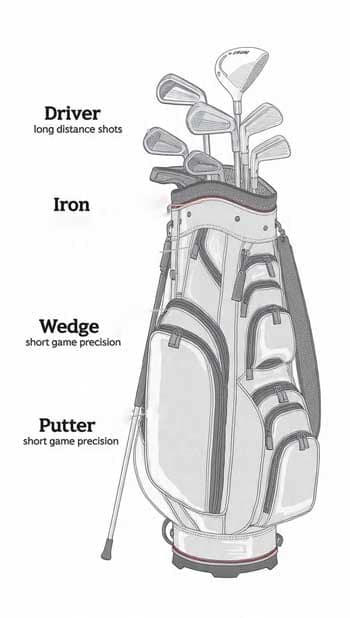
Driver
- Use for: Tee shots on wide holes
- Avoid when: Trouble is tight or confidence is low
- Why it matters: It’s the longest club, but also the least forgiving
Fairway Woods (3W, 5W, 7W)
- Use for: Long shots from fairway or tee
- Best for beginners: 5-wood or 7-wood (higher launch, easier to hit)
Hybrids
- Use for: Replacing long irons (3–5 iron)
- Why beginners love them: Higher launch, more forgiveness, easier from rough
- Recommended: A 4-hybrid is a must-have for new golfers
Irons
- Short irons (8–PW): Approach shots inside 130 yards
- Mid irons (6–7): Controlled shots from 140–170 yards
- Long irons (3–5): Difficult for beginners – replace with hybrids
Wedges
- Pitching Wedge (PW): 100–120 yards. Typically has a loft angle between 43° and 48°.
- Gap Wedge (GW): 80–100 yards. Typically has a loft angle between 48° and 52°.
- Also called “Approach Wedge” or “Attack Wedge” (AW)
- Sand Wedge (SW): Bunkers and 60–80 yards. Typically has a loft angle between 54° and 58°.
- Lob Wedge (LW): Advanced – skip it until you’re consistent.
- Typically has a loft angle between 58° and 64°.
Putter
- The club you will use more than any other.
- When to use it: On the green (and sometimes from the fringe) to roll the ball into the hole.
2. Equipment Check: Game Improvement vs. Blades
As a beginner, golf is hard enough. Your equipment should help you, not punish you. When looking at irons, you will generally see two main categories:
Game Improvement and Super Game Improvement Irons (Cavity Backs)
These clubs feature a hollowed-out back, which redistributes the weight of the club to the perimeter.
- The Benefit: This creates a massive “sweet spot.” If you hit the ball off-center (towards the toe or heel), the club won’t twist in your hands as much, and the ball will still go relatively straight and far.
- Who they are for: Beginners, high-handicappers, and mid-handicappers. They are designed entirely around forgiveness.
- Equipment Tip: If you are looking for a highly forgiving set, check out the Callaway Big Bertha Irons on Amazon.
Blades (Muscle Backs)
These feature a smooth, solid back and a very thin clubhead profile.
- The Benefit: They offer incredible “feel” and allow players to shape shots (curling the ball left or right on command) with precision.
- Who they are for: Low-handicap amateurs and touring professionals. If you hit a blade off-center, the ball will drop out of the sky short of your target, and your hands will feel a harsh stinging sensation. Beginners should steer clear of blades.
3. Golf Ball Selection: It Is Not Just About Brand

Many beginners play whatever golf balls they find in the woods. While free is great, playing the wrong ball can actively hurt your game. The most important factor for a beginner is compression.
Golf balls compress (squish) against the clubface at impact, which creates energy to launch the ball.
Understanding Compression
Compression = how much the ball “squeezes” at impact.
- Low compression (30–60): Best for slower swing speeds
- Mid compression (70–90): Balanced for most golfers
- High compression (100+): For fast swings (105+ mph)
Recommendations by Swing Speed
- Under 85 mph: Low compression balls (e.g., Callaway Supersoft)
- 85–100 mph: Mid compression balls (e.g., Titleist Tour Soft)
- 100+ mph: High compression balls (e.g., Titleist Pro V1)
Beginner Rule of Thumb
Play the same ball every round. Consistency beats price or hype.
4. Setting Up for Success: Tee Selection Criteria
One of the biggest mistakes beginners make happens before they even swing a club: playing from the wrong tees. Playing a course that is too long forces you to hit longer, more difficult clubs into the greens, leading to frustration and high scores.
How to Choose Your Tees: Do not choose your tees based on your gender or your age. Choose them based on how far you hit your driver. A great rule of thumb is to take your average, reliable driver distance and multiply it by 28.
- Driver distance under 180 yards → Play from 4,000–5,000 yards
- Driver distance 180–220 yards → Play from 5,000–5,800 yards
- Driver distance 220–250 yards → Play from 5,800–6,200 yards
- Driver distance 250+ yards → Play from 6,200–6,600 yards
Playing the correct distance allows you to reach par 4s in two shots and par 3s in one, giving you realistic opportunities to score rather than constantly scrambling to save double-bogey.
5. Smart Club Selection Per Shot
One of the quickest ways to lower your score is to stop trying to hit “hero shots.” Beginners often pull the club that will only reach the green if they hit it absolutely perfectly.
The Strategy: Base your club selection on your average hit, not your perfect hit. If you hit your 7-iron 150 yards perfectly once, but normally hit it 135 yards, and you have 150 yards to the pin, do not pull the 7-iron. Pull the 6-iron or 5-iron. Swinging smooth with more club is always better than over-swinging with less club.
Always aim for the middle of the green. Ignore the flagstick, especially if it is tucked near a bunker or water. The center of the green is the smartest, safest target for a beginner.
6. The Mental Game: How Beginners Think Their Way to Lower Scores
Golf is played on a 5-inch course: the space between your ears. You will hit bad shots. You will chunk irons, slice drives, and miss two-foot putts. The difference between shooting a 95 and a 115 is how you react to those mistakes.
- The 10-Yard Rule: Give yourself 10 yards to be mad about a bad shot. Once you cross that imaginary line while walking or driving to your next ball, the anger must be dropped.
- Play Bogey Golf: Do not try to make par on every hole. Mentally add one stroke to every par on the course (Par 4s become Par 5s, etc.). If you play “bogey golf,” you will shoot a 90. Taking the pressure off yourself to make pars leads to relaxed swings and, ironically, more pars.
- The Recovery Shot: When you hit a ball into the trees, your only goal should be getting it back into the fairway. Do not try to thread the needle through a tiny gap in the branches. Pitch it out sideways, take your medicine, and play on. A bogey is fine; a triple-bogey from hitting three trees in a row ruins scorecards.
7. Putting Mistakes Beginners Must Fix
You’ll probably use your putter on every single hole. Improving your putting is the fastest way to drop your handicap.

Common Beginner Mistakes & Fixes:
- Leaving it short: As the saying goes, “100% of short putts don’t go in.” Beginners often decelerate the putter head right before impact out of fear of hitting it too far.
- The Fix: Ensure your follow-through is longer than your backswing. Accelerate through the ball.
- Bad alignment: Thinking you are aiming straight when you are actually aiming right.
- The Fix: Use the line printed on your golf ball to aim directly at your target before you even address the ball.
- Too much wrist action: Putting is a shoulder-rocking motion, not a wrist-flicking motion. Keep your wrists locked and let your larger shoulder muscles do the work for consistency.
8. What and How to Practice: A Beginner’s Essential Drills
Beating 100 drivers in a row at the driving range is not practice; it is a workout. You need purposeful, intentional practice to get better. Try these beginner-friendly drills:
The Towel Drill (For Chipping)
Lay a standard golf towel flat on the practice green, about halfway between you and the hole. Take a few balls and try to land your chips on the towel. This teaches you to pick a specific landing spot rather than just staring at the hole, helping you understand how much the ball rolls out after it lands.
The Clock Drill (For Putting)
Place four tee pegs around a hole on the practice green at 3, 6, 9, and 12 o’clock, each about 3 feet away. Go around the circle and putt them in. Once you make all four, move them back to 4 feet, then 5 feet. This builds incredible confidence for those knee-knocking short putts on the course.
The Alignment Stick Drill (For the Range)
Never hit a ball on the range without laying down a club or an alignment stick at your feet, pointing at your target. This ensures your feet, hips, and shoulders are square.
9. Pre-Round, Pre-Shot, and Post-Round Routines for Beginners

A routine takes your mind off the mechanics of the golf swing and puts you into a state of flow.
Pre-Round Routine: Arrive 45 minutes early. Spend 10 minutes stretching your back, hips, and shoulders. Then take 15 minutes hitting a few balls on the range to warm up (start with wedges, move to mid-irons, hit a few drivers). Finally, use the last 20 minutes on the putting green exclusively to gauge the speed of the greens for that day.
Pre-Shot Routine: Do the exact same thing before every single shot. It might look like this:
- Stand behind the ball and pick a target.
- Take one smooth practice swing brushing the grass.
- Step up to the ball and align your clubface to the target.
- Settle your feet.
- Take one deep breath, look at the target, and swing.
Post-Round Routine: Clean your clubs, stretch out to prevent soreness, and review your round objectively. Identify one area that cost you the most strokes (e.g., “I lost 5 balls off the tee,” or “I three-putted six times”). Make that specific area the focus of your next practice session.
10. Additional Strategy Concepts Beginners Should Learn

Play to Your Strengths
If your 7-iron is your favorite club, use it more often.
Avoid Hero Shots
Punch out, get back in play, and save strokes.
Know Your Distances
Guessing leads to trouble. Measured distances lead to smart decisions.
Manage Expectations
Tour pros miss fairways and greens too. Your goal is to avoid big numbers.
Final Thoughts
Ultimately, better golf comes down to making smarter decisions. Accept your current skill level and play the game you have today, not the game you hope to have next year. Lay up when you need to. Aim for the center of the greens. Keep the ball in play. And most importantly, remember to enjoy the walk.
If These Articles Help,
Running Golf Course Intel takes real time, real effort, and – yep – real golf balls. If you’ve enjoyed the guides, the strategy breakdowns, or the myth‑busting articles, hitting that Buy Us Golf Balls button is the easiest way to help keep the site online and the content flowing. Every donation, big or small, genuinely fuels the next round of smarter golf insights.
Thanks for helping us keep this thing rolling!
Your Next Step: Get a Personalized Fairway Fundamentals Strategy Guide

If you’ve made it this far through our guide, your next step is getting a Golf Course Intel Fairway Fundamentals Strategy Guide specifically tailored to you, your game, and your goals.
It includes:
- Personalized drills based on your swing
- Stretching routines tailored to your mobility
- A recommended golf ball (along with a few alternatives) based on your swing speed
- Club recommendations that match your skill level
- A course management framework designed for beginners
It’s the easiest way to build a smart, strategic foundation that lowers your scores without rebuilding your swing – all for about the cost of dozen golf balls.
Stop guessing on the tee box and start playing smarter golf today!
