A Friendly, Practical Guide to Conquering Hillandale Golf Course
Hillandale Golf Course in Durham, NC isn’t just a local favorite, it’s a living piece of American golf history. First opened in 1911 and redesigned multiple times by legends like Donald Ross, Perry Maxwell, and George Cobb, Hillandale blends classic architecture with modern renovations. The course now features a 50,000‑square‑foot expanded driving range, a 20,000‑square‑foot putting course, and significant upgrades to the drainage infrastructure.
But history aside, Hillandale is also a course that can quietly eat your lunch if you don’t show up with a plan.
This guide breaks down the course’s personality, the agronomic quirks of its Champion Bermuda greens, and the smartest strategies for every hole – all in a friendly, relatable way for golfers of any age or skill level.
Why Hillandale Plays Tougher Than It Looks

Hillandale’s defense isn’t length – it’s trees, elevation, grain, and out‑of‑bounds. The report highlights that the course’s “mature tree canopies, aggressive elevation changes, [and] pervasive out‑of‑bounds boundaries” shape nearly every shot.
A few course‑wide truths:
1. Champion Bermuda Greens Demand Respect
The grain is real – and it matters. As the linked report explains, “light and shiny” means down‑grain (fast), while “dark and matte” means into‑the‑grain (slow).
Pro tip: Always check the grass around the cup – it tells you everything.
2. Elevation Changes Affect Club Selection
Several holes play dramatically uphill or downhill. The report notes that Hillandale’s “sudden, steep vertical transitions” require mathematical adjustments. If you’re between clubs, take the longer one.
3. Penalty Avoidance Is the #1 Scoring Skill
Telemetry shows high‑handicap players lose 3–6 strokes per round to penalties. Hillandale’s unforgiving corridors make that even more costly. Fairway wood > driver on many tees.

Choosing the Right Tees (This Alone Saves 4–6 Strokes)
The report uses the industry‑standard formula: Optimal Yardage = Average Drive × 28
This leads to smart tee recommendations like:
- Mid‑handicap men: White tees (6,026 yards)
- High‑handicap men: Gold tees (5,395 yards)
- High‑handicap women: Light Blue tees (3,677 yards)
Choosing the right tees isn’t ego – it’s strategy.
For more tee‑box guidance, see GolfCourseIntel’s article: 👉 “How Playing the Wrong Tees is Killing Your Game (and How to Fix It)”
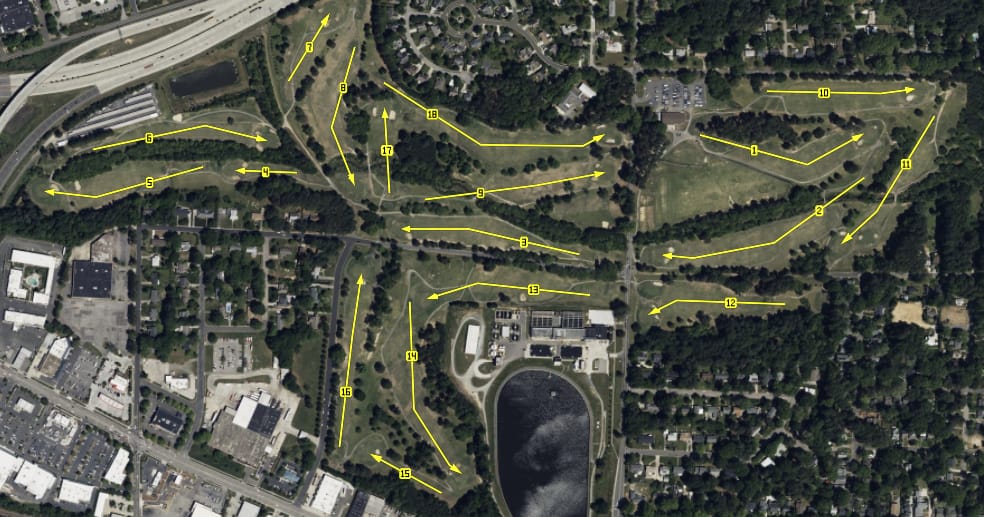
Hole‑by‑Hole Strategy (Quick, Friendly, and Practical)
Below is a condensed version of the detailed strategies in the report – perfect for a pre‑round refresher.
| Hole | Par | Brief | Tip |
|---|---|---|---|
| 1 | 4 | Avoid the left trees. Right‑center fairway is ideal. | Low-handicap: long iron Mid-handicap: hybrid High-handicap: driver (safely) |
| 2 | 5 | Creek right. Favor the left side. | Low-handicap: go for it in two Mid-handicap: lay up to 100 High-handicap: advance with two 7‑irons |
| 3 | 4 | OB left. Play it like a par 5 if needed. | Aim right half of green |
| 4 | 3 | OB hugs the right side. | Everyone aims left! |
| 5 | 4 | Blind, elevated green. | Add 3–5 yards to approach |
| 6 | 4 | Severely pitched green. | Stay below the hole at all costs |
| 7 | 3 | Use the left hillside funnel. | Aim left intentionally |
| 8 | 4 | Turtleback green. | Center of green only – Missing long or short is brutal |
| 9 | 4 | 40‑foot uphill approach. | Add 13–15 yards |
| 10 | 4 | Watch out for the roadway OB to the left. | Fairway wood is a smart choice off the tee |
| 11 | 4 | Birdie chance. | Attack the pin |
| 12 | 4 | Deceptive downhill. Road behind green. | Take enough club – the green is reachable! |
| 13 | 4 | Pinch‑points everywhere. | Choose tee club based on preferred wedge distance |
| 14 | 5 | Reachable for many. | Mid‑handicaps should lay up to 80 yards |
| 15 | 3 | Longest par 3. | Center of green only |
| 16 | 4 | Road left. | Aim right‑center |
| 17 | 3 | Fatigue sets in. | Club up |
| 18 | 5 | Sweeping finish. | Mid‑handicaps: lay up to 100 yards |
How This Strategy Lowers Your Handicap
Hillandale rewards golfers who:
- Avoid penalties
- Keep the ball below the hole
- Choose the right tees
- Play to smart layup zones
- Respect the grain
- Use the terrain (especially on holes 7 and 8)
If These Articles Help,
Running Golf Course Intel takes real time, real effort, and – yep – real golf balls. If you’ve enjoyed the guides, the strategy breakdowns, or the myth‑busting articles, hitting that Buy Us Golf Balls button is the easiest way to help keep the site online and the content flowing. Every donation, big or small, genuinely fuels the next round of smarter golf insights.
Thanks for helping us keep this thing rolling!