
Course Strategy Breakdowns: Outsmart 7 Hidden Design Traps
Golfers lose more strokes to hidden design traps than to swing mechanics – and most don’t even realize it.
Architects bake scoring traps into every layout: angles that look safe but aren’t, greens that reject you, tee boxes that trick you into playing the wrong yardage, and “easy” recovery zones that quietly destroy your next shot.
This breakdown exposes seven hidden design traps that cost everyday golfers ~5–10 strokes per round – and shows you exactly how to beat each one using smarter decisions, not harder swings.
Hidden Design Trap 1: The False Safe Zone
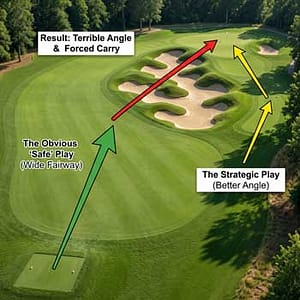
Wide fairways often hide terrible angles. Architects know golfers aim for “the big side,” so they place bunkers, mounds, or green‑tilt features that punish the obvious target.
What it looks like
- A huge landing area that feels inviting
- A green angled away from that side
- A bunker guarding the “natural” approach
- A pin tucked behind trouble you can’t see from the tee
How it steals strokes
You hit the fairway – but you’re dead. No angle, no height, no spin. You’re forced to play a defensive shot.
How to beat it
Aim for the narrower side that gives you the better angle, even if it feels uncomfortable. Strategy beats comfort.
Hidden Design Trap 2: The Disguised Layup Hole
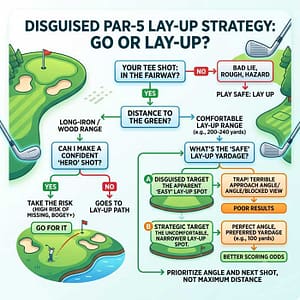
Some par‑5s and long par‑4s are designed to punish greed. They look scoreable but hide hazards at the exact distance most golfers try to reach.
What it looks like
- A reachable par‑5 with water or bunkers at your “hero” distance
- A long par‑4 with a false front that rejects long‑iron approaches
- A landing zone that narrows dramatically
How it steals strokes
You go for it → miss → drop → double bogey.
How to beat it
Play the architect’s game: lay up to your best yardage, not your longest yardage.
Hidden Design Trap 3: The Hidden Miss
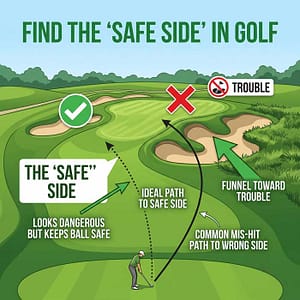
Every hole has a “safe side,” even if it doesn’t look safe. Architects design trouble to funnel balls toward the wrong side.
What it looks like
- One side with thick rough, mounds, or deep bunkers
- The other side with short grass, open angles, or bailout room
- A green that slopes heavily in one direction
How it steals strokes
You miss on the wrong side and suddenly have no shot: you’re short‑sided, you have a downhill lie, a bunker lip, or zero green to work with.
How to beat it
Pick your miss before you pick your target. Aim to the side that gives you the easiest next shot.
Hidden Design Trap 4: The Green That Rejects You
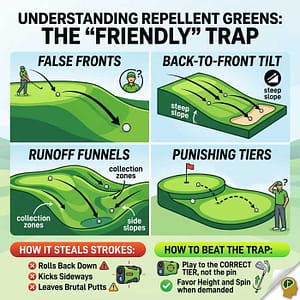
Some greens are designed to look friendly but are built to repel shots unless you land in a very specific zone.
What it looks like
- False fronts
- Back-to-front tilt
- Runoffs that funnel balls away
- Tiers that punish the wrong level
How it steals strokes
You hit a “good shot” that rolls back, kicks sideways, or leaves a brutal two‑putt.
How to beat it
Play to the correct tier, not the pin. Favor height and spin when the green demands it.
Hidden Design Trap 5: The Tee Box
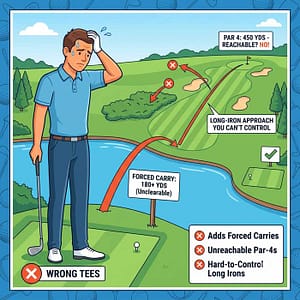
Choosing the wrong tee box adds forced carries, unreachable par‑4s, and long‑iron approaches you can’t control.
What it looks like
- A tee box that adds 600+ yards to the round
- Par‑4s over 420 yards for mid‑handicappers
- Par‑3s requiring hybrids or fairway woods
How it steals strokes
You’re playing a yardage designed for golfers with 105–115 mph driver speed, not the 85–95 mph range most amateurs actually have.
How to beat it
Choose tees based on approach‑shot length, not ego. If you can’t reach most greens in regulation, you’re on the wrong tees.
Hidden Design Trap 6: The Ball‑Choice Penalty

Course conditions amplify ball characteristics. The wrong ball can cost you spin, height, rollout, and control.
What it looks like
- Firm greens that require high‑spin balls
- Windy layouts that punish high‑launch balls
- Tight fairways where low‑spin balls run into trouble
How it steals strokes
You hit the right shot with the wrong ball – and it doesn’t behave.
How to beat it
Match your ball to the course conditions, not the marketing.
Hidden Design Trap 7: The Recovery Mirage
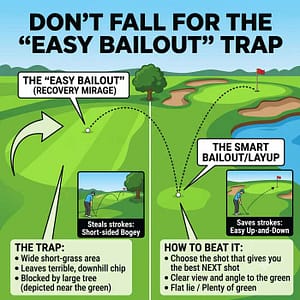
The “easy bailout” is often a trap. Architects place soft‑looking areas that leave terrible angles or impossible up‑and‑downs.
What it looks like
- Wide short‑grass areas that leave downhill chips
- Bailouts that leave you blocked by trees
- Areas that look safe but leave no angle to the green
How it steals strokes
You take the bailout → leave yourself short‑sided → make bogey or worse.
How to beat it
Choose the bailout or lay-up that gives you the best next shot, not the easiest immediate escape.
Tee It Up!
Course design is a silent opponent. When you learn to spot these traps – and play around them – your scores drop fast. You don’t need more swing speed or new clubs. You need better decisions.
This is the heart of Golf Course Intel: smarter golf for real golfers!
If These Articles Help,
Running Golf Course Intel takes real time, real effort, and – yep – real golf balls. If you’ve enjoyed the guides, the strategy breakdowns, or the myth‑busting articles, hitting that Buy Us Golf Balls button is the easiest way to help keep the site online and the content flowing. Every donation, big or small, genuinely fuels the next round of smarter golf insights.
Thanks for helping us keep this thing rolling!





)