Master Your Royal Birkdale Strategy Before The Open Championship
Welcome to your complete Royal Birkdale strategy guide!
Getting a tee time at this world-famous championship venue is a dream come true for many players. Preparing properly will ensure you have a fantastic experience on the links.
Dive into the rich history, optimal tee selections, and specific hole tactics you need to succeed.
A Brief History of a Golfing Masterpiece
Established in 1889, Royal Birkdale moved to its current home among the beautiful Birkdale Hills in 1897 under the guidance of golf professional George Lowe. Fred Hawtree and Open Champion J.H. Taylor completely overhauled the layout in the 1930s. They chose to route the fairways through the flat valleys between the towering dunes, giving players a wonderfully fair test of golf with smooth landing areas. Local architect George E. Tonge added to the magic by designing the brilliant white Art Deco clubhouse in 1935, which still stands as a beacon behind the final green.
Tom Mackenzie and Martin Ebert recently finalized a massive modernization project ahead of the 2026 Open Championship. Their team upgraded the bunkering and introduced exciting new challenges, including a spectacular new par-3 15th hole that plays directly toward the clubhouse. These updates ensure the venue remains an elite challenge for professionals and amateurs alike.
Navigating the Links Environment
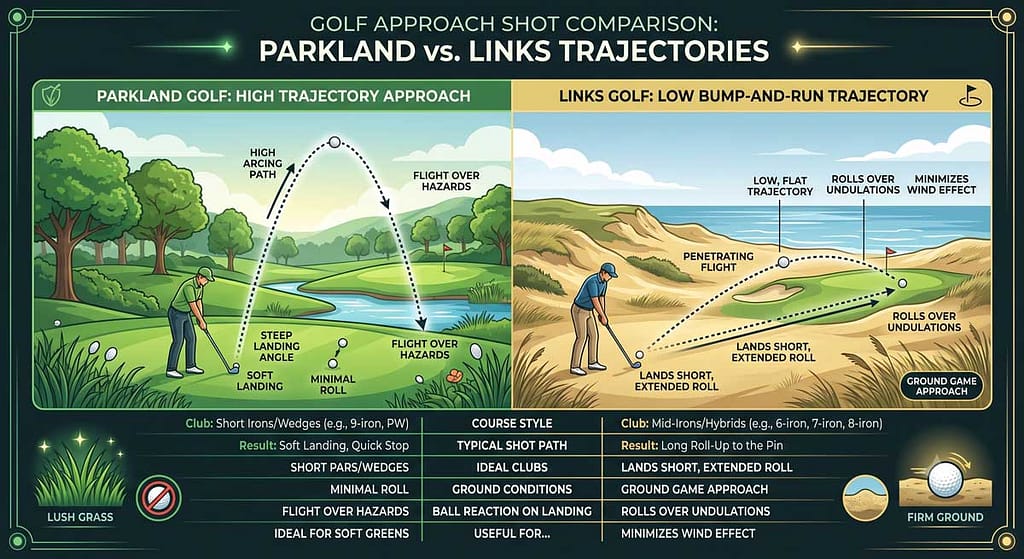
Playing on the coast requires a specific mindset. Sandy soils create firm, fast fairways that demand creative ground-game shots.
- Keeping the ball low beneath the coastal winds will greatly improve your chances of holding the greens.
- Steering clear of the deep revetted pot bunkers is essential for keeping big numbers off your scorecard.
- Learning to accept bad bounces with a positive attitude is a huge part of links golf.
- Your mental resilience will be tested just as much as your physical skills.
If you are preparing for this trip, reading up on Playing a New Golf Course: Your First-Time Strategy Guide can help you build a solid pre-round routine. Hitting the short grass is also critical here, which we cover extensively in Fairways In Regulation: The Secret To Good Golf.
Selecting Your Tees and Calculating Handicaps
Choosing the correct tee box maximizes your enjoyment and helps preserve the pace of play. We have broken down the ideal yardages based on the standard formula of taking your average driver distance and multiplying it by 28.
Review these profiles to find your perfect fit!
Low-Handicap Players
- Male golfers with a 2.0 index hitting the ball about 270 yards should take on the Red Tees (6,736 yards). Playing this layout gives a Course Handicap of 5 based on the 149 Slope and 74.5 Rating.
- Female players with a 4.0 index driving 220 yards will find the Blue Tees (6,205 yards) ideal, resulting in a Course Handicap of 11 using the 148 Slope and 78.2 Rating.
- These distances provide a rigorous test of ball-striking for highly skilled individuals.
Mid-Handicap Players
- Men with a 12.0 index and a 240-yard drive can confidently play the Red Tees with a Course Handicap of 15.
- Women holding a 15.0 index and averaging 190 yards off the tee will love the Gold Tees (5,511 yards). This setup provides a Course Handicap of 21 utilizing the 139 Slope and 74.1 Rating.
- Approaching the course from these markers allows mid-handicappers to rely on their fairway woods and hybrids effectively.
High-Handicap Players
- Male players with a 22.0 index driving roughly 210 yards should move to the Gold Tees, granting a Course Handicap of 22 against the 132 Slope and 68.1 Rating.
- Female golfers with a 26.0 index and a 160-yard drive will have a wonderful time from the Green Tees (4,877 yards), bringing their Course Handicap to 29 with a 133 Slope and 70.0 Rating.
Applying these metrics ensures a great day on the links for everyone in your group.
To keep your game sharp year-round, check out our 2026 Guide to Finishing the Season Strong.
| Player Profile | Handicap Index | Recommended Tee | Course Rating | Slope | Calculated Course Handicap | Playing Handicap |
| Low-Handicap Male | 2.0 | Red | 74.50 | 149 | 5.14 | 5 |
| Mid-Handicap Male | 12.0 | Red (Blue metrics) | 71.80 | 143 | 14.98 | 15 |
| High-Handicap Male | 22.0 | Gold | 68.10 | 132 | 21.80 | 22 |
| Low-Handicap Female | 4.0 | Blue | 78.20 | 148 | 11.44 | 11 |
| Mid-Handicap Female | 15.0 | Gold | 74.10 | 139 | 20.55 | 21 |
| High-Handicap Female | 26.0 | Green | 70.00 | 133 | 28.60 | 29 |
Conquering the Signature Holes
Every hole at this venue offers a unique puzzle to solve. We have selected six standout challenges to help you prepare your Royal Birkdale strategy.
Hole 1 – Par 4
Your round begins with a very demanding dog-leg left. Out-of-bounds runs continuously down the right side. The prevailing wind actively pushes your golf ball toward that boundary. Hitting a 3-wood or hybrid off the tee keeps you short of the heavily revetted fairway bunkers. Aiming for the left-center of the expansive green on your approach will set you up for a solid opening score.

Hole 5 – Par 4
Redesigned for the 2026 Open, this stunning hole presents a classic risk-reward scenario. Newly installed bunkers sit 30 to 40 yards short of the green to deceive your eyes. Laying up with a long iron to the 200-yard mark is the safest play. You will be left with a simple wedge to a receptive green. Make sure to avoid missing long, as a steep run-off awaits behind the putting surface.
Hole 7 – Par 3
This par 3 is the shortest hole on the property and sits incredibly close to the Irish Sea. Fierce crosswinds make club selection difficult. The recently raised green features steep run-offs that feed golf balls into deep pot bunkers. Focus completely on finding the center of the putting surface. Par is an exceptional score here.
Hole 12 – Par 3
Nestled at the base of a towering sandhill, this picturesque hole forms a natural amphitheater. Four deep bunkers guard the narrow entrance. Distance control is paramount because the green features a steep false front. Taking enough club to safely reach the middle or back portion of the kidney-shaped putting surface will prevent a frustrating pitch shot up the slope.
Hole 17 – Par 5
You must thread your drive through a narrow gap between two magnificent sand dunes. Accuracy off the tee opens up a fantastic birdie opportunity on this reachable par 5. Padraig Harrington famously hit a 5-wood to tap-in distance here to secure his 2008 Open victory. Mid- and high-handicap players should lay up strategically on their second shot to set up a comfortable wedge into the heavily contoured green.
Hole 18 – Par 4/5
Walking up the final fairway toward the bright white clubhouse provides an unforgettable thrill. The tee box was recently shifted to the left, creating a dead-straight test with out-of-bounds looming on the right. Laying up short of the deep fairway bunkers at the 240-yard mark is the smartest move for most amateurs. Planning a careful approach into the well-proportioned final green will help you secure a great score in front of the gallery.
Get the Course Strategist Guide for Royal Birkdale
To optimize your performance and gain a competitive edge, download the comprehensive 24-page Royal Birkdale Course Strategist Guide below. This PDF includes hole-by-hole insights, strategic target areas, and data-driven recommendations tailored for this course.
A Final Word on Preparation
Getting ready for a round at this historic links is half the fun. Using a structured Royal Birkdale strategy transforms a difficult challenge into a highly rewarding experience.
Studying the hole layouts, practicing your low trajectory shots, and trusting your calculated course handicap will give you the ultimate edge.
Grab your clubs, embrace the coastal elements, and hit the fairways with confidence!
If These Articles Help,
Running Golf Course Intel takes real time, real effort, and – yep – real golf balls. If you’ve enjoyed the guides, the strategy breakdowns, or the myth‑busting articles, hitting that Buy Us Golf Balls button is the easiest way to help keep the site online and the content flowing. Every donation, big or small, genuinely fuels the next round of smarter golf insights.
Thanks for helping us keep this thing rolling!