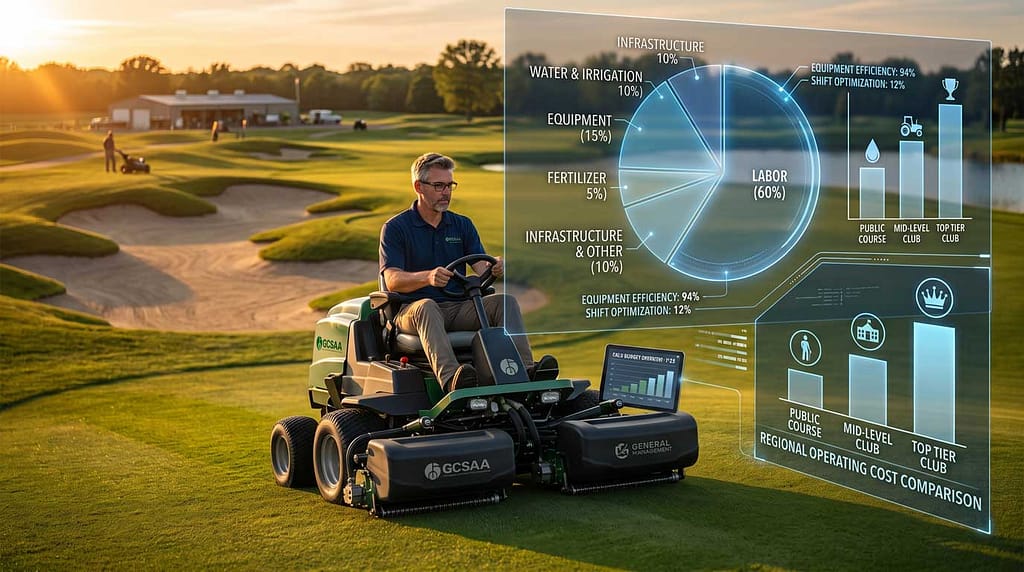
Every player loves stepping onto a freshly striped fairway at dawn. The financial reality behind those emerald stripes involves an annual operating budget resembling a small corporate enterprise.
Maintaining a pristine athletic landscape demands immense funding, intense physical labor, and precise agronomic science. The nationwide average maintenance budget for an 18-hole facility hovers around $1 million annually, representing nearly 23% of total facility revenue. Achieving tournament-level perfection requires a complex orchestration of resources.
Comparing the Tiers: Municipal, Semi-Private, and Private Clubs
Operational costs vary dramatically depending on the facility type, membership expectations, and geographical location:
| Facility Tier | Estimated Annual Budget | Typical Maintenance Staff Size | Key Conditioning Characteristics |
|---|---|---|---|
| Municipal / Public | $400,000 – $620,000 | 12 – 18 Employees | Mechanical bunker raking, infrequent cart path edging, reliance on native rainfall. |
| Mid-Level Semi-Private | $700,000 – $900,000 | 15 – 20 Employees | Enhanced turf chemicals, regular fairway mowing, updated equipment leasing programs. |
| Top-Tier Private Club | $1,000,000 – $2,000,000+ | 18 – 36 Employees | Walk-mowed greens, daily hand-raked bunkers, immaculate landscaping, dedicated closed maintenance days. |
City-run public tracks operate on incredibly tight margins. These courses keep operational costs low by minimizing aesthetic landscaping and utilizing mechanical trap rakes.
Facilities blending public play with private memberships gain increased revenue, allowing for superior turf chemicals and an expanded equipment fleet.
Elite country clubs spare absolutely no expense to achieve visual perfection. A massive grounds crew allows the superintendent to walk-mow putting surfaces daily and edge cart paths every two weeks. Elite venues often schedule a closed maintenance day, providing the agronomy team uninterrupted time to complete essential aeration and topdressing tasks.
Staffing Costs: The Biggest Piece of the Pie
Labor consistently consumes the largest segment of the financial ledger. Nationally, wages account for 50% to 70% of the entire maintenance budget. A high-end private club in the American Southwest might allocate over $900,000 to payroll alone.
A weekend golfer slicing a tee shot might casually complain about thick rough, entirely unaware that maintaining those specific secondary cuts requires 64 man-hours weekly. Finding and retaining experienced groundskeepers remains a severe hurdle for the industry. Golf course superintendents bring deep scientific expertise to the operation, earning an average annual salary of $121,238. Assistant superintendents and specialized equipment technicians also command competitive wages to keep the specialized machinery functioning flawlessly.
The Financial Drain of Bunker Maintenance
A player dunking a golf ball into a deep sand trap feels a brief moment of frustration. The club accountant views that same hazard with enduring financial dread. Bunkers rank as one of the most labor-intensive features on any property. Dedicated crews spend up to 450 hours a week hand-raking surfaces, edging borders, and repairing washouts after severe rainstorms.
Replacing contaminated sand drains the bank account rapidly. Premium angular silica sand costs upwards of $120 per ton, plus heavy transportation fees. Refreshing a single 1,000-square-foot bunker carries a price tag between $3,400 and $6,000. Modern stabilization technologies, including Capillary Concrete and Better Billy Bunkers, require hefty upfront capital. These advanced systems drastically lower long-term labor costs by holding the sand firmly in place during torrential downpours.
Physical Infrastructure, Golf Carts, and Equipment
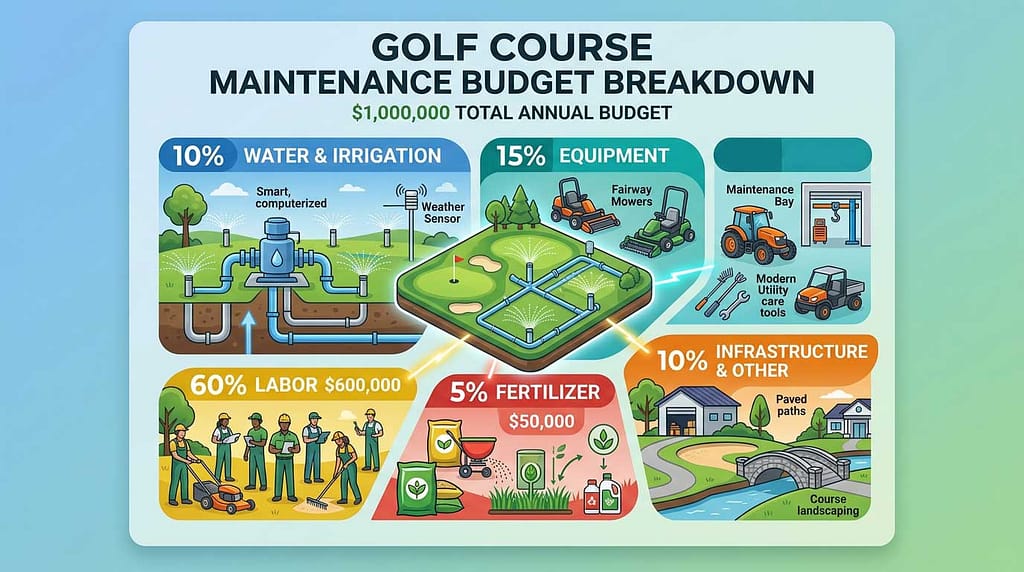
Commercial mowers, specialized tractors, and utility vehicles represent major capital expenditures. A typical equipment fleet is valued well over $500,000. Modern greens mowers command a massive premium, pushing many facilities to lease their everyday machines. Leasing guarantees the latest technology remains in operation, thereby minimizing unexpected mechanical failures.
Superintendents measure equipment lifespan in engine hours to gauge mechanical stress accurately. One engine hour operating at 3,000 RPM equals roughly 85 miles of vehicle wear. Navigating hilly terrain adds significant extra strain to the engines.
Irrigation networks require enormous foundational investments. Pumping stations and sub-surface piping systems range from $500,000 to $1,000,000 to install properly. Maintaining these complex hydraulic systems generates an additional $50,000 in annual service fees.
Similarly, golf cart fleets demand continuous operational oversight. Electric buggies require expensive battery replacements, while gas-powered models need steady mechanical upkeep from the shop technician.
Water Costs: Hydrating the Beast
Keeping the athletic landscape vibrant requires staggering water usage. An 18-hole layout consumes between 20 million and 200 million gallons of water annually, depending entirely on regional weather patterns. Facilities located in arid climates face average water bills approaching $266,000 a year.
Purchasing effluent or recycled water provides a sustainable alternative to tapping municipal drinking supplies. Local utilities actively charge premium rates for this treated wastewater, sometimes reaching $1.79 per 1,000 gallons. Pumping salty brackish water from deep underground wells saves money. Utilizing saline water forces the agronomy team to plant highly specialized, salt-tolerant turfgrass varieties like Seashore Paspalum.
Landscaping and Turf Chemicals
Applying balanced fertilizers and preventative fungicides protects the living turf from devastating localized diseases. Fertilizers make up around 5% of the average budget, while specialized fungicides consume another 4%. Treating a severe Pythium blight outbreak on putting surfaces with premium chemicals requires massive funding.
Over-fertilization causes excessive grass growth, subsequently increasing mowing frequency and driving up labor costs. Smart agronomists utilize balanced fertility plans to reduce thatch buildup and preserve capital. Crafting resilient putting surfaces involves highly specialized agronomy and architectural planning.
Golfers interested in the structural engineering behind flawless greens can read the Designing Dream Greens: Crafting the Ultimate Colorado Mountain Golf Course Experience guide published here. The same strategic turf integration applies to lowland areas, as detailed extensively in GCI Parklands: A Blueprint for a Quintessential Central UK Golf Course.
Extras and Overlooked Expenses
Many invisible expenses keep a golf club functioning smoothly behind the scenes. Constant cart path repairs, heavy tree trimming, and driving range netting replacements require steady attention.
Specialized technologies, such as underground SubAir systems that regulate green moisture and temperature, run approximately $15,000 per hole. Elite private clubs readily absorb these specific costs to ensure flawless tournament conditions.
The True Cost of Perfection
Maintaining a modern golf course blends agricultural science with heavy industrial mechanics. Every perfectly manicured fairway and pristine putting surface represents an intricate dance of budgeting, skilled labor, and machinery. The next time a golfer lines up a crucial putt on a municipal track or an exclusive private green, appreciating the staggering financial machine operating out of sight becomes much easier.
Players looking to optimize their own game without spending millions can benefit from reviewing The Ultimate Beginner Golf Strategy Guide. Excellent strategic planning always complements a beautifully maintained athletic landscape.
If These Articles Help,
Running Golf Course Intel takes real time, real effort, and – yep – real golf balls. If you’ve enjoyed the guides, the strategy breakdowns, or the myth‑busting articles, hitting that Buy Us Golf Balls button is the easiest way to help keep the site online and the content flowing. Every donation, big or small, genuinely fuels the next round of smarter golf insights.
Thanks for helping us keep this thing rolling!






0 Comments