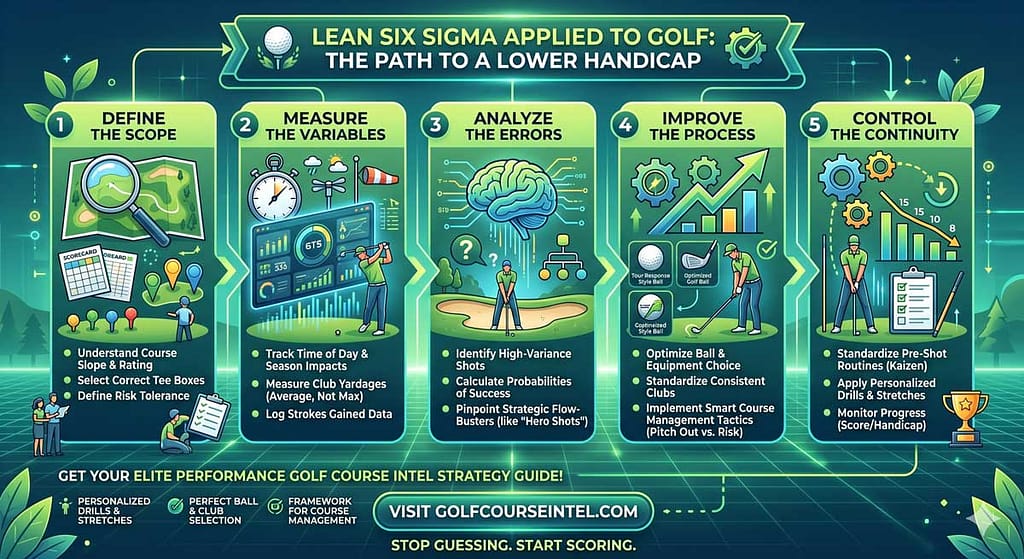
Lean Six Sigma Applied to Golf: How Continuous Improvement Lowers Scores
Let’s face it: golf is a game of mistakes. The player who wins isn’t usually the one who hits the most spectacular shots, but the one whose bad shots are the least punishing.
In the corporate world, Lean Six Sigma is a methodology used to eliminate waste, reduce variance, and optimize performance. When you apply Lean Six Sigma golf strategies to your weekend round, you stop bleeding unnecessary strokes.

DMAIC and Kaizen are cornerstone methodologies of Lean Six Sigma that complement each other beautifully:
- DMAIC – an acronym for Define, Measure, Analyze, Improve, and Control – is a structured, data‑driven process used in Lean Six Sigma to identify problems, quantify performance, uncover root causes, implement targeted solutions, and sustain gains through control systems. It’s ideal for tackling complex, recurring issues that require measurable outcomes.
- Kaizen, a Japanese term meaning “change for the better,” focuses on small, incremental improvements made consistently by everyone involved. While DMAIC provides the framework for solving defined problems, Kaizen builds the culture of daily refinement and proactive learning that keeps performance improving long after the project ends.
Together, they create a disciplined yet flexible approach to excellence – whether in business, manufacturing, or even your golf game.
Below is a golfer‑friendly breakdown of how Lean Six Sigma can transform your game using simple, measurable, and sustainable improvements.
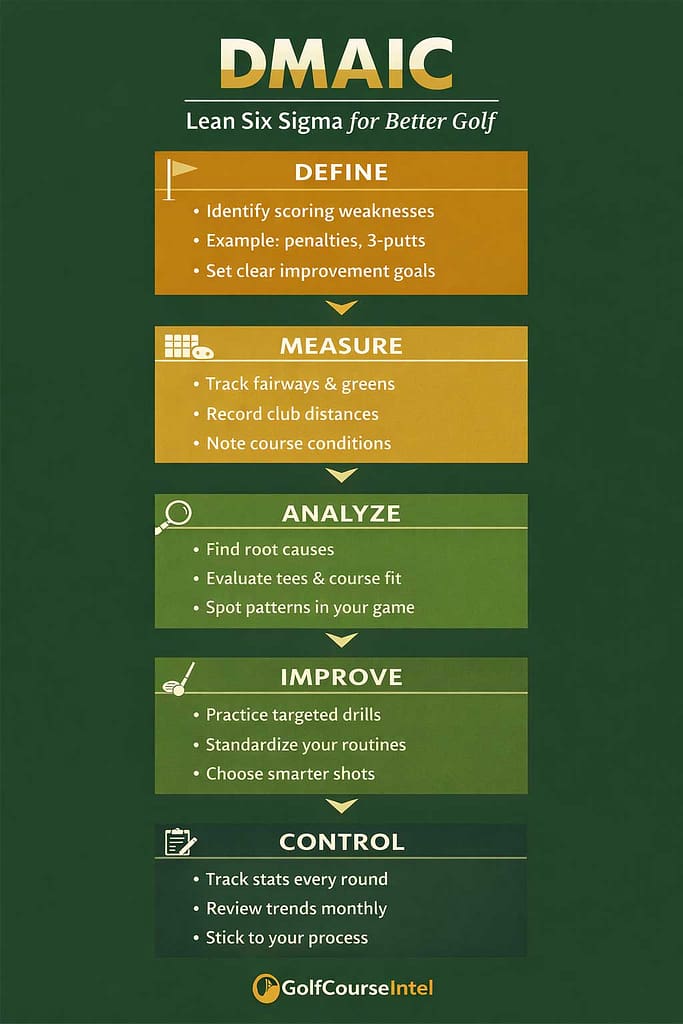
Define: What Problem Are You Actually Solving?
Most golfers chase fixes without defining the real issue. Is your scoring problem lack of distance? Accuracy? Decision‑making? Fatigue? Poor course fit?
Start by identifying your biggest scoring leaks. A few examples:
- Too many penalty strokes
- Poor tee selection
- Wrong club choice under pressure
- Inconsistent pre‑shot routine
- Avoidable three‑putts
- Lack of a structured practice plan
Once you define the problem, you can measure it – and then improve it.
Measure: Collect Data Like a Lean Six Sigma Black Belt
You don’t need spreadsheets or certifications – just awareness and a simple stat tracker. Track:
- Fairways hit
- Greens in regulation
- Up‑and‑down percentage
- Penalty strokes
- Three‑putts
- Club distances (carry vs. total)
You can’t improve what you don’t measure. In Lean Six Sigma, data is king.
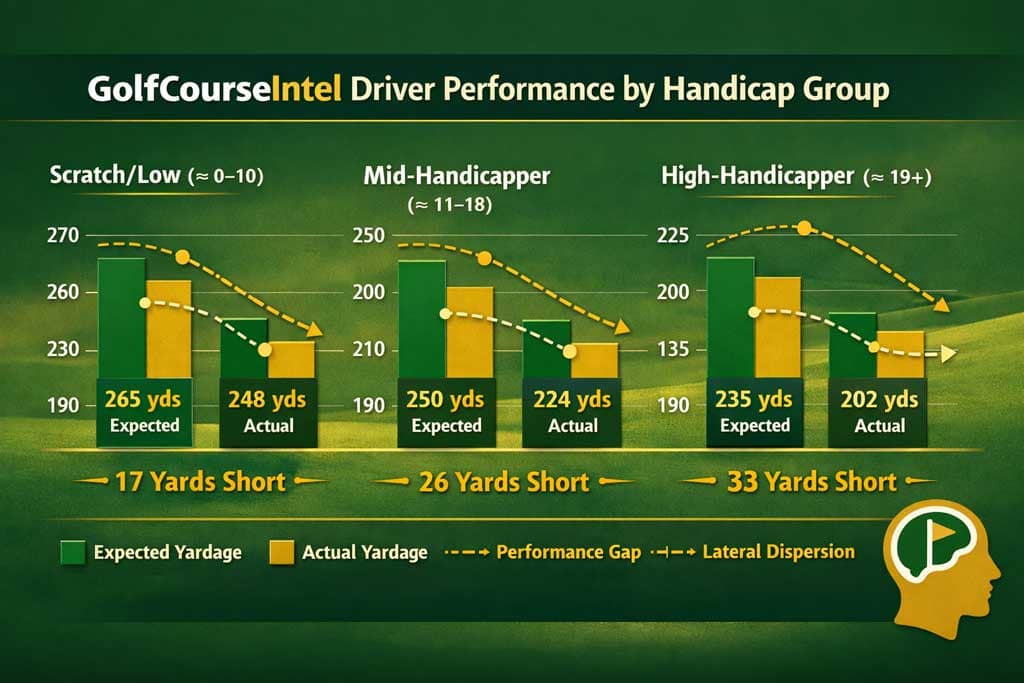
Analyze: Identify the Root Causes of Your Scoring Problems
1. Tee Selection
Lean principle: Remove unnecessary difficulty. Most golfers play tees that are too long, adding strokes through fatigue and long‑iron approaches. Choose tees based on driver carry distance x 28, not ego.
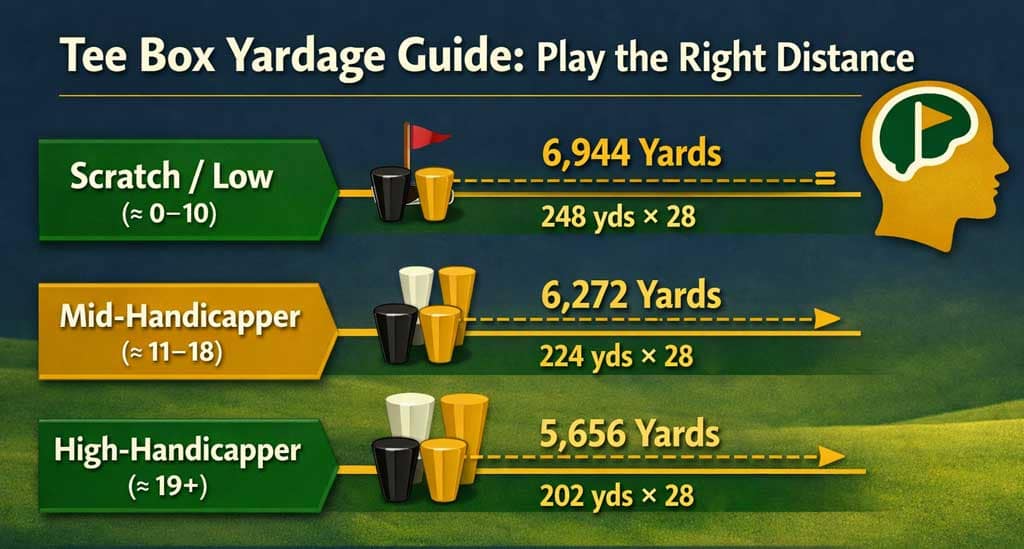
2. Type of Golf Course
Some courses simply don’t fit your game. Tight tree‑lined layouts punish big drivers. Long, soft courses punish short hitters. Links courses punish high‑ball hitters on windy days.
Understanding course fit helps you adjust expectations and strategy.
GolfCourseIntel.com has several articles that help golfers understand their tendencies, including “The Data Behind Course Fit” and “Why Some Courses Destroy You”.
3. Club Selection Per Shot
Variation is the enemy of consistency. Lean Six Sigma teaches you to reduce variation by standardizing processes.
For golf, that means:
- Know your true carry distances
- Choose the club that removes the most risk
- Favor the shot you can repeat, not the hero shot
If you use rangefinders or GPS devices, pair them with a consistent decision‑making routine.
4. Course Slope and Rating
Slope and rating quantify difficulty. Use them to predict how your game will translate to a course.
- High rating = long and demanding
- High slope = penal and punishing
- Low slope = more room for error
This helps you set realistic goals and avoid frustration.
5. Golf Ball Selection
Lean principle: Standardize inputs. Switching balls every round introduces unnecessary variation. Pick one ball and stick with it.
6. Recovery From Errors
Lean Six Sigma emphasizes error-proofing and damage control. In golf, that means:
- Take your medicine
- Get back in position
- Avoid compounding mistakes
A bogey is fine. A triple is a process failure.
7. Time of Day or Season
Environmental variation matters:
- Morning = softer greens, slower speeds
- Afternoon = firmer greens, more rollout
- Winter = less distance
- Summer = more bounce and roll
Adjust expectations and club selection accordingly.
Improve: Build Repeatable Systems That Lower Scores

Once you’ve measured the flaws in your process, it’s time to implement improvements.
Lean Six Sigma thrives on small, incremental gains. Here are golfer‑friendly examples:
- 10‑ball dispersion drill (measure shot pattern)
- Up‑and‑down challenge (track success rate)
- Gate putting drill (reduce face-angle variation)
- Fairway finder tee shot (standardize a safe opening shot)
- 3‑club approach ladder (improve distance control)
Small improvements compound into lower handicaps.
- Golf Ball and Equipment Selection
- Playing whatever ball you found in the woods is introducing uncontrolled variables into your game. You need a consistent tool. For example, if you want tour-level urethane performance without the punishing compression of a pro ball, standardizing on something like the TaylorMade Tour Response optimizes both spin and feel.
- The same goes for your clubs.
- You don’t need to break the bank for peak efficiency. Sourcing certified pre-owned clubs from premium brands offers the best return on investment – giving you advanced technology and warranties without the capital expenditure of brand-new sets.
- Strategic Course Management & Recovery
- Mistakes happen. How you handle them dictates your score. When you miss the fairway, your next move must be classified as a true Recovery shot, not just a standard swing from the rough. If you’re staring down a dogleg right on Hole 18, play the percentages. Pitching out sideways to your favorite yardage is a Lean Six Sigma move; trying to thread a hero shot through a two-foot window is operational waste.
Control: Make Your Improvements Stick
The final step is “Control” – making sure your improvements stick. In Lean manufacturing, this is called Kaizen, or continuous, incremental improvement.
- Track stats every round
- Review trends monthly
- Revisit tee selection and course fit
- Stick to one golf ball
- Maintain your pre‑shot routine
- Keep a simple improvement log
This is how you turn good rounds into consistent scoring.
Bullet‑Point Summary: How Lean Six Sigma Lowers Scores
- Better tee selection reduces fatigue and long‑iron approaches
- Course type awareness improves strategy
- Club selection becomes more predictable
- Slope and rating guide expectations
- Standardized golf ball reduces variation
- Error recovery prevents blow‑up holes
- Time‑of‑day adjustments improve distance control
- Drills and routines create measurable improvement
- Continuous review keeps your game trending downward (in a good way)
When you stack these small, systematic improvements, the results are explosive. Here is how applying an analytical mindset actively destroys your handicap:
If These Articles Help,
Running Golf Course Intel takes real time, real effort, and – yep – real golf balls. If you’ve enjoyed the guides, the strategy breakdowns, or the myth‑busting articles, hitting that Buy Us Golf Balls button is the easiest way to help keep the site online and the content flowing. Every donation, big or small, genuinely fuels the next round of smarter golf insights.
Thanks for helping us keep this thing rolling!
Take Your Game to the Elite Level

Applying Lean Six Sigma to your golf game takes discipline, but you don’t have to analyze the data all by yourself.
Are you ready to stop guessing and start executing? Request an Elite Performance Golf Course Intel Strategy Guide today.
Our personalized guides do the heavy lifting for you – identifying personalized drills and stretches to improve your specific mechanics, recommending the perfect golf ball and golf clubs for your exact swing profile, and providing a comprehensive framework for course management.
Stop leaving strokes out on the course.