Contents
- Introduction: The Dawn of the Algorithmic Fairway
- Revolutionizing the Range: AI in Practice Routines
- Structuring Success: Pre-Round, Pre-Shot, and Post-Round Routines
- Physiological Telemetry: Overall Health Recommendations and Readiness
- The Foundation of Strategy: Tee Selection
- Topographical Intelligence: Adapting to Course Types
- Mastering the Elements: Course Slope, Rating, and Atmospheric Physics
- Algorithmic Equipment Optimization: Golf Ball and Club Selection
- Psychological Resilience: Recovery from Errors and the Mental Game
- Environmental Adaptations: Time of Day, Season, and Shadow Management
- Conclusion: How AI Ultimately Improves Your Score and Handicap
Introduction: The Dawn of the Algorithmic Fairway
For centuries, the sport of golf has been governed by intuition, heuristic advice, and the deeply subjective concept of “feel.” Golfers of all ages and abilities have historically relied on trial and error, piecing together swing thoughts and strategic guesses in an attempt to master one of the most complex athletic endeavors ever invented. However, the modern era of performance optimization has triggered a fundamental paradigm shift. Artificial intelligence (AI) has arrived on the fairway, and it is entirely transforming how players approach the game.

This technological revolution is no longer a localized phenomenon reserved exclusively for the laboratories of elite touring professionals. It has permeated every echelon of the sport, offering profound, accessible implications for male and female golfers of any age or skill level. The democratization of AI technology integrates computer vision, biomechanical tracking, probabilistic decision theory, and physiological telemetry into a cohesive, user-friendly ecosystem specifically designed to lower handicaps and increase the sheer enjoyment of the game.
At its core, artificial intelligence in the context of golf is not a robotic entity executing shots on behalf of the player. Rather, it functions as an incredibly advanced, tireless pattern recognition apparatus. These systems are trained on massive datasets – often encompassing millions of swings and billions of tracked shots – to identify kinematic inefficiencies, optimize equipment matching, and calculate optimal strategic pathways. By analyzing a staggering array of variables spanning turf interaction, atmospheric conditions, and human physiology, these algorithms strip away the cognitive biases and emotional hurdles that frequently plague human decision-making on the golf course.
The overarching consequence of this technological integration is a monumental transition from a reactive methodology to a proactive, predictive model of golf performance. The following comprehensive report deconstructs this technological ecosystem into its constituent pillars. It explores how sophisticated, yet entirely relatable, algorithms currently govern practice routines, recommend pre- and post-round physiological care, optimize environmental adaptations, and ultimately culminate in statistically superior course management.
Revolutionizing the Range: AI in Practice Routines
The bedrock of any effective golf improvement strategy relies heavily on the mechanics of the swing and the quality of practice. Traditionally, swing analysis involved manual video scrubbing, requiring coaches to painstakingly draw two-dimensional lines on a screen to estimate swing planes. For the average amateur practicing alone, feedback was entirely limited to the ball’s flight path, often leading to hours of ingrained bad habits. The advent of AI-driven computer vision has rendered this archaic methodology obsolete, replacing it with instantaneous, highly precise kinematic analysis that operates using nothing more than a smartphone camera.
Two-Dimensional Vision Models and Pose Estimation
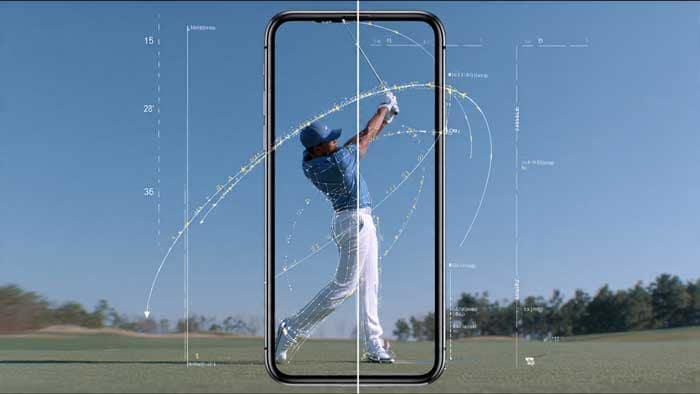
Modern mobile applications utilize advanced pose-estimation algorithms to map the golfer’s body in real time, making elite-level analysis accessible to anyone with a tripod. Platforms such as Greenside AI leverage neural networks trained on hand-curated datasets exceeding 500,000 images to deliver a comprehensive 13-point mechanical analysis in mere seconds, entirely without the need for physical body markers or Wi-Fi connections. This technology evaluates highly specific biomechanical elements, including shoulder plane, hip rotation, and stance alignment, from the address phase all the way through to the finish.
Similarly, the GolfFix application employs AI vision technology to automatically isolate and record the swing sequence, identifying over 45 distinct mechanical flaws. These algorithmic systems categorize common amateur errors – such as early extension, over-the-top transition paths, “fat” shots, and poor impact postures – while simultaneously analyzing swing tempo and rhythm. By segmenting the swing into four precise chronological phases (backswing, top pause, downswing, and follow-through), the AI establishes a baseline rhythm metric. Players can then compare this rhythm against professional datasets, receiving instant feedback on whether their tempo is responsible for their slice or hook.
Another innovative entry into the practice space is Swing Coach, which focuses heavily on auditory feedback. This application films and analyzes every swing in seconds, responding with an AI-generated voice that delivers instant feedback. For a golfer grinding on the driving range, this means they can simply point the camera, swing, and listen to the corrective advice without ever needing to break their stance to check their phone screen. This seamless integration of technology accelerates the learning curve by directly connecting the “feel” of a swing with the “real” mechanical output.
Deep Dive: Choosing the Right Swing Analysis Tool
The market currently offers a spectrum of AI tools, each optimized for different practice workflows. Understanding the nuances of these platforms allows golfers to tailor their practice routines to their specific learning styles.
| Application Platform | Primary Focus and Best Use Case | Key Technological Features | Target Audience |
| Greenside AI | Post-swing mechanical breakdown | 13-point pose estimation, offline processing | Solo practicers seeking instant, highly specific plane feedback. |
| GolfFix | Comprehensive flaw detection and rhythm | Identifies 45+ flaws, 4-part tempo calculation | High-handicappers struggling with consistency and tempo. |
| DeepSwing | AI-driven practice loops and live mirroring | Cross-device mirroring, automated Swing Score dashboard | Data-driven players who want to track mechanical progress over months. |
| Onform | Coach-to-student communication | Voiceovers, 3D skeleton overlays, cloud backup | Players actively working remotely with a human swing instructor. |
| Sportsbox AI | Advanced 3D biomechanical quantification | 2D-to-3D conversion, exact degree/inch measurements | Elite amateurs and professionals requiring granular kinematic data. |
Three-Dimensional Kinematics and Radar Integration
The analytical depth expands exponentially when transitioning from 2D pose estimation to 3D biomechanical measurement. Systems like Sportsbox AI transform a standard 2D mobile video into a complete 3D avatar, calculating complex kinematic metrics in degrees and inches. This capability allows for the precise quantification of pelvic sway, thoracic rotation, and vertical ground reaction forces, moving instruction away from guesswork and toward absolute measurement.
When computer vision is paired with Doppler radar technology, the analytical outputs become highly predictive. Trackman, a staple on the professional tours, utilizes an AI-powered tool named Tracy. This system digests thousands of data points instantaneously to deliver personalized insights. By eliminating subjective assessment, the AI pinpoints the exact inefficiency – such as an improper face-to-path ratio – costing the player distance or accuracy. Furthermore, Trackman’s recent TPS 10.1 update includes AI Motion Analysis Version 2, which automatically detects every position from P1 (address) to P9 (finish) without the coach needing to manually draw a single line.
Platforms such as GolfTEC’s Opti assistant utilize this wealth of data to create structured, real-world scenario training. Rather than hitting 100 consecutive 7-irons at a static target, Opti guides the player through simulated iconic courses, forcing them to adapt to narrow fairways and demanding approach shots. The AI tracks performance, recommends adjustments, and builds true on-course confidence, ensuring that practice routines translate directly to lower scores.
Structuring Success: Pre-Round, Pre-Shot, and Post-Round Routines
A successful round of golf begins long before the first tee shot and extends well after the final putt drops. Artificial intelligence provides a structured, data-driven framework for these critical transition periods, ensuring the golfer is mentally and strategically prepared for the task at hand. Comprehensive resources on optimizing these sequences can be found through platforms offering specialized insights, such as the specific pre-round and pre-shot routines provided by Golf Course Intel.

The Pre-Round Routine: Data-Driven Preparation
The traditional pre-round routine often consists of a rushed bucket of range balls and a cursory glance at the scorecard. AI elevates this process into a strategic briefing. For players utilizing systems like Arccos Caddie, the pre-round phase involves accessing the “Simulated Distances” feature. This tool allows golfers to preview the course they are about to play, mapping out their strategy based on the AI’s knowledge of their specific club distances.
Furthermore, players can download the course data directly to their devices, ensuring seamless operation regardless of cellular connectivity. By setting the intended tee box and reviewing the historical data of their past performances on similar course layouts, players arrive at the first tee with a definitive, mathematically sound game plan. This preparation entirely removes the anxiety of the unknown, replacing it with quiet confidence.
The Pre-Shot Routine: Cognitive Offloading
The pre-shot routine is perhaps the most critical five seconds in golf. It is here that doubt, fear, and indecision frequently sabotage the physical swing. Artificial intelligence intervenes during this phase by acting as a cognitive offloader. When utilizing an AI rangefinder, the player no longer has to internally calculate the compounding variables of a shot.
Instead of standing over the ball wondering if the wind is swirling or if the uphill lie requires one extra club or two, the player simply checks their device. The AI Caddie instantaneously provides an adjusted “Plays Like” distance that factors in real-time wind speed, temperature, humidity, and slope. More importantly, it provides a specific club recommendation based on the player’s actual, historically tracked distances. By outsourcing this complex multivariable mathematics to a digital caddie, the player drastically reduces cognitive fatigue. The mind is freed to focus purely on visualization, breathing, and physical execution.
The Post-Round Routine: Unbiased Debriefing

Following a round, human memory is notoriously flawed. A player might shoot an 85 and incorrectly conclude that their driving was atrocious, simply because they hit one memorable drive out of bounds on the 18th hole. AI shot-tracking systems eliminate this recency bias through the generation of comprehensive post-round reports.
These systems utilize “Strokes Gained” analytics – a statistical framework that compares a player’s performance against a target handicap across every facet of the game. The post-round report might reveal that the player actually drove the ball exceptionally well, but lost three full strokes to their handicap on approach shots between 100 and 125 yards. By receiving this unbiased, data-driven debrief, the golfer knows exactly what to work on during their next practice session, ensuring that no time is wasted on mechanics that are already functioning properly.
Physiological Telemetry: Overall Health Recommendations and Readiness
Golf is a highly asymmetrical, repetitive, and rotational sport that subjects the human body – particularly the lumbar spine, hips, and thoracic region – to immense torque. Consequently, overall health recommendations, injury prevention, and recovery forecasting are absolute necessities for handicap reduction, regardless of age or gender. AI has revolutionized this sector through the rapid proliferation of biometric wearables and dynamic, algorithmic fitness programming.
Wearable Telemetry: Sleep, Strain, and HRV
The physical readiness of a golfer fluctuates daily based on sleep architecture, systemic inflammation, and central nervous system (CNS) fatigue. Wearable devices such as WHOOP, Oura, Garmin, and the Apple Watch utilize continuous biometric monitoring to quantify these once-invisible variables.
WHOOP, an ecosystem heavily favored by elite athletes and dedicated amateurs alike, operates without a screen to minimize distractions. It continuously tracks Heart Rate Variability (HRV), resting heart rate, and respiratory rate to calculate a daily “Recovery Score”. HRV is a critical metric; it measures the microscopic variations in time between heartbeats, serving as a direct indicator of the autonomic nervous system’s balance. If the algorithms indicate a suppressed HRV – suggesting high CNS fatigue – the optimal pre-round or practice routine shifts. A player with a 30% recovery score should avoid aggressive, max-effort driver swings, opting instead for short game work and extended dynamic mobility to prevent acute injury.
Conversely, the Oura Ring specializes in incredibly accurate temperature monitoring and sleep phase analysis, making it ideal for recovery-minded individuals who prefer a discreet piece of jewelry. Garmin devices, while robust in their GPS capabilities, excel in plotting the “Body Battery” against cardiovascular strain, providing real-time feedback on energy reserves. By utilizing these AI-interpreted metrics, golfers can intricately tailor their time on the range and the course, avoiding the systemic overtraining that frequently leads to late-round physical and mental collapses.
Algorithmic Kinesiology: The GolfForever Ecosystem

Bridging the gap between raw physiological data and physical execution requires specialized, golf-centric conditioning. The GolfForever system represents the pinnacle of this integration, utilizing AI-driven assessments to construct hyper-personalized fitness regimens.
Following a brief, five-minute preliminary physical assessment within the application, the algorithm generates a bespoke, 15-minute daily routine focusing on mobility, flexibility, and rotational strength. The genius of the system lies in its dynamic adaptability. As the player’s strength and flexibility indices improve over time, the algorithm progressively overloads the tissue, ensuring continuous adaptation and preventing plateaus.
The structural and performance benefits of such structured programs are profound. Users spanning from their late 30s to their 70s consistently report significant reductions in arthritic stiffness and chronic lower-back pain, alongside measurable increases in clubhead speed and enhanced biomechanical balance. By integrating these AI-curated health tools into daily life, the golfer ensures their biomechanical engine remains durable, drastically reducing the probability of injury and allowing for pain-free, lifelong participation in the sport.
The Foundation of Strategy: Tee Selection
One of the most persistent, yet entirely rectifiable, strategic errors in amateur golf is the incorrect selection of tee boxes. Driven frequently by ego, societal pressure, or tradition rather than mathematical reality, players often select tees that result in aggregate course yardages that vastly exceed their biomechanical capabilities. This mismatch forces players to swing out of their shoes, increases the likelihood of penalty strokes, degrades the pace of play, and fundamentally ruins the enjoyment of the round. As detailed in resources like the article How Playing the Wrong Tees is Killing Your Game (and How to Fix It) guide by Golf Course Intel, playing from the correct yardage is the fastest way to drop scores.
The Ego versus The Data

Artificial intelligence, inherently devoid of ego, exposes the stark reality of amateur driving distances. By analyzing the median driving metrics across millions of rounds recorded by systems like Arccos, data scientists have clearly delineated the massive discrepancy between the tees golfers currently play and the tees they statistically should play.
The USGA and the PGA of America have heavily relied on this immense data pool to formulate the “Best Tees” and “Tee It Forward” initiatives. Comprehensive surveys indicate that 99% of PGA and LPGA professionals agree that golfers have a demonstrably superior experience when playing from appropriately distanced tees. Furthermore, 93% note that it is exceptionally common for amateurs to choose courses too long for their skill set.
AI-Driven Tee Recommendations
By seamlessly overlaying a player’s exact, AI-tracked driver distance with the architectural yardages of a specific course, algorithms can definitively recommend the correct tee box before the player ever sets foot on the property. This simple, data-driven adjustment yields dramatic consequences for the scorecard.
When a player moves forward to a mathematically appropriate tee, they eliminate the necessity of hitting difficult, low-lofted fairway woods into well-defended greens on par 4s. Instead, they are afforded the opportunity to utilize scoring irons and wedges, fundamentally altering the probability matrix of the approach shot. Reports highlight instances where players, utilizing strategy guides that enforce disciplined, data-backed tee box selection, have gained up to 10 strokes over a mere two-month period. Furthermore, AI algorithms utilized in back-end course management – such as dynamic pricing and tee-sheet software – monitor the flow of players, demonstrating that appropriate tee selection vastly improves the overall pace of play, ensuring a smoother experience for the entire facility.
Topographical Intelligence: Adapting to Course Types
The architectural philosophy and geographical location behind a golf course dictate the strategic approach required to navigate it successfully. Artificial intelligence categorizes courses into distinct typologies – primarily Links, Parkland, Heathland, and Desert – each demanding specific adaptations in ball flight, spin control, and club selection.
Decoding Links and Parkland Dynamics
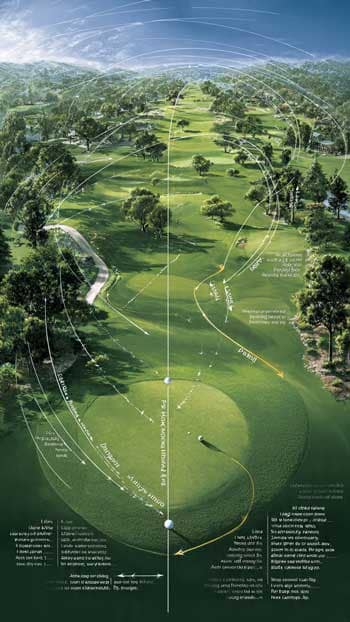
Links courses, originating in the coastal regions of Scotland and Ireland (such as St. Andrews or Royal Troon), are characterized by sandy, rapidly draining soil, deep revetted bunkering, undulating fairways, and a distinct lack of arboreal protection. The naturally firm turf and unpredictable coastal winds necessitate a ground-based strategic approach. When algorithmic strategy tools evaluate a links environment, they mathematically prioritize lower-trajectory shots that maximize fairway rollout and minimize exposure to high-altitude wind vectors.
Conversely, Parkland courses, which represent the most common type of facility in North America (typified by Augusta National), feature heavily manicured, lush fairways flanked by dense tree lines. The soil retains significantly more moisture, resulting in softer landing conditions. AI systems interpreting parkland topography will recommend an aerial assault, favoring higher-lofted clubs that exploit the receptive nature of the soft greens, knowing that the ball will stop relatively close to its pitch mark.
Heathland and Desert Variations
Heathland courses, found predominantly in Britain, offer a hybrid experience. They utilize the sandy, well-draining soil of a links course but are located inland, featuring heather, gorse, and light tree cover. AI systems navigating heathland courses must balance the firm turf rollout with strict penalty avoidance, as landing in thick heather mathematically guarantees a dropped shot.
Desert courses, popularized in the American Southwest, present an entirely different architectural challenge. Built on arid, sandy terrain, these courses feature lush target zones surrounded by unforgiving desert waste areas. AI strategic recommendations on a desert course prioritize strict carry optimization. The algorithm understands that missing the fairway results in an unpredictable lie on hardpan sand or rock, thus heavily penalizing high-dispersion clubs.
| Course Typology | Defining Characteristics | Turf Condition | Algorithmic Strategic Priority |
| Links | Coastal winds, fescue, deep bunkers | Firm, fast, sandy | Low trajectory, ground-game rollout, extreme wind vector mitigation. |
| Parkland | Dense trees, inland, water hazards | Soft, lush, loamy | High trajectory, precise carry distances, aerial green approach. |
| Heathland | Inland sandy soil, heather, gorse | Firm, well-draining | Hybrid strategy, elevated dispersion penalty avoidance in native areas. |
| Desert | Arid landscape, isolated turf zones | Lush targets, hardpan rough | Strict carry optimization, extreme penalty zone avoidance. |
Mastering the Elements: Course Slope, Rating, and Atmospheric Physics
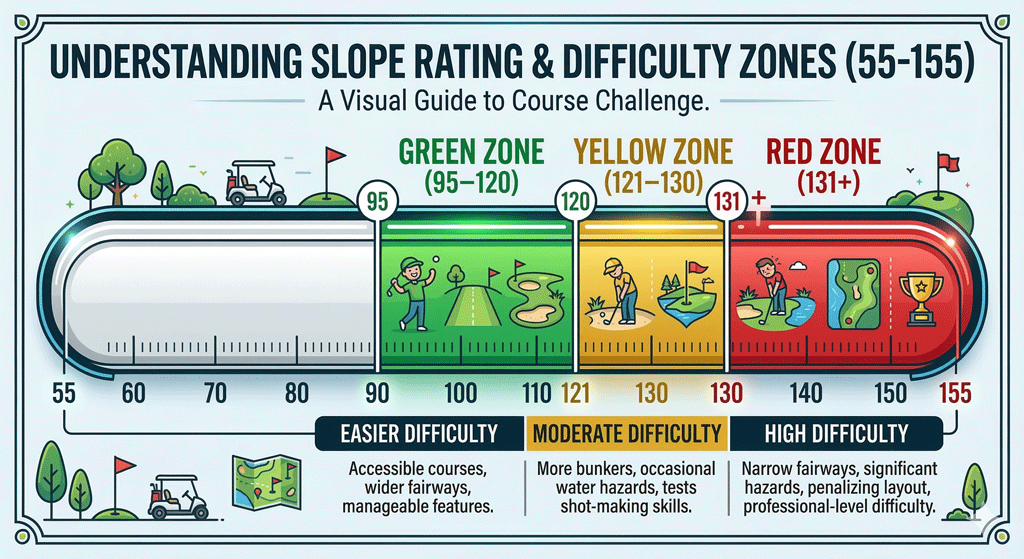
A perfectly executed golf swing will yield wildly different results depending on the atmospheric conditions and topographical slope surrounding the ball. The human capacity to accurately calculate the cascading effects of temperature, humidity, altitude, elevation changes, and wind vectors is highly limited, often resulting in approach shots that fall disastrously short or fly the green entirely. Artificial intelligence excels in these exact multivariable physics calculations, transforming raw meteorological data into actionable, stroke-saving strategy.
The Arccos AI Rangefinder and “Plays Like” Distances
The introduction of the AI-powered rangefinder has fundamentally altered how golfers assess approach shots. The Arccos Caddie application, for example, is the world’s first AI-powered GPS system capable of calculating true “Plays Like” distances by factoring in real-time environmental variables.
When a golfer uses the app, the interface presents the raw GPS yardage to the pin in white numbers. However, adjacent to this is the highly coveted “Arccos Number” in green. This green number is the result of the AI synthesizing localized temperature, barometric pressure, humidity, real-time wind speed, wind direction, and expected gusts. Furthermore, it accounts for the precise topographical slope—whether the shot is severely uphill or downhill.
If a player is facing a 150-yard raw GPS shot, but the target is 10 yards uphill, into an 8 mph headwind, and the temperature is a dense 50 degrees Fahrenheit, the AI instantaneously calculates that the true physiological requirement equates to a 172-yard shot. This level of precision, previously reserved for elite tour caddies who required several minutes to perform the math, is now available to the amateur in less than a second.
The Impact of Altitude and Air Density
Altitude plays a uniquely vital role in aerodynamic resistance. High-elevation environments feature significantly lower air density, which reduces the drag force acting on the golf ball, resulting in flatter trajectories and extended carry distances. Advanced AI rangefinders personalize the altitude calculation based specifically on the differential between the player’s home course and their current location.
This micro-calibration ensures that a player who resides at sea level but travels to a mountainous resort course does not suffer through a frustrating round of airmailing every green. The AI understands the player’s baseline sea-level yardages and mathematically scales them up to match the thin mountain air.
Algorithmic Equipment Optimization: Golf Ball and Club Selection

Even flawless mechanics and perfect environmental calculations are rendered inefficient if the equipment in the player’s hands does not align with their unique kinematic signature. Artificial intelligence has deeply infiltrated both the manufacturing and fitting processes, utilizing massive datasets to engineer unparalleled forgiveness and optimize launch parameters. To maximize the value of this data, players often turn to tailored advice, such as customized golf ball and golf club recommendations provided by comprehensive analysis services.
Dynamic Golf Ball Selection
The golf ball is the only piece of equipment utilized on every single shot, from the tee box to the bottom of the cup. Yet, its selection is frequently dictated by brand loyalty, marketing campaigns, or whichever ball happens to be on sale. AI changes this dynamic entirely.
Applications such as iGolfball utilize artificial intelligence to conduct forensic analyses of player performance metrics juxtaposed against specific course characteristics. By aggregating and processing data from over 50 open-source aerodynamic studies, the algorithm identifies the optimum golf ball to match a player’s specific swing speed, desired spin rate, and launch angle. Major manufacturers like Callaway have similarly deployed AI selector tools on their websites to route consumers toward the optimal urethane or ionomer cover based on precise data inputs, guaranteeing that energy transfer at impact is maximized.
Predictive Club Selection per Shot

On the course, deciding which club to pull is a daily struggle. Advanced AI frameworks reframe a round of golf as a complex probability matrix, wherein every shot is a variable capable of being mathematically optimized. These rule-based classification models digest the distance, terrain gradients, wind strength, and the quality of the lie.
This is where hardware tracking systems like Arccos Caddie and Shot Scope become invaluable. Both systems utilize sensors attached to the butt end of the golf clubs to autonomously map the exact GPS coordinates of every shot taken.
- Arccos Caddie: Operates on a subscription model and pairs directly with a smartphone or wearable Link device. It boasts a staggering dataset exceeding 1.5 billion tracked shots. Because it knows exactly how far a player actually hits their 7-iron (rather than how far they think they hit it), the AI provides real-time club recommendations during the round. If the AI detects a historical tendency to miss right with a 5-wood, and the current hole features a water hazard on the right, it will proactively suggest a safer layup with an iron.
- Shot Scope: Appeals to players looking for a one-time purchase without subscription fees. Utilizing an all-in-one GPS watch, it tracks shots and provides highly detailed post-round strokes gained data. While it lacks the real-time AI club recommendations of Arccos, its performance dashboard offers incredible insights into long-term club performance and dispersion mapping.
| Feature Comparison | Arccos Caddie | Shot Scope |
| Pricing Model | Hardware purchase + Annual Subscription | One-time Hardware purchase, No Subscription |
| Tracking Method | Sensors + Phone/Caddie Link | Sensors + GPS Watch (No phone required) |
| Real-Time Strategy | AI-powered club recommendations, Wind/Slope adjustments | GPS distances, Hazard mapping |
| Putting Tracking | Automatic (requires minor editing) | Manual confirmation required via watch |
| Best Suited For | Golfers desiring real-time AI coaching and predictive analytics. | Golfers desiring detailed post-round data without recurring fees. |
Psychological Resilience: Recovery from Errors and the Mental Game
While data provides the optimal strategic pathway, physical execution remains entirely dependent on a highly volatile variable: the human brain. The sheer volume of variables in a round of golf frequently induces an overwhelming cognitive state known as the “paradox of choice”. When presented with too many swing thoughts, target options, and club choices, the central nervous system falters, leading to muscle tension, second-guessing, and catastrophic error.
Cognitive Unloading via Algorithmic Trust
The primary psychological benefit of utilizing AI in course strategy is the massive reduction in cognitive load. When an AI Caddie processes the slope, temperature, wind, and historical dispersion to provide a definitive yardage and club recommendation, the golfer is absolved of the analytical burden. The player can shift their neurological focus from decision-making to execution. By trusting the mathematical certainty of the algorithm, the player eliminates the hesitation and doubt that typically precede a poorly struck shot.
Real-Time Psychological Interventions
Beyond strategic offloading, targeted AI applications now offer direct neurological and psychological support. The mental game is widely considered the ultimate frontier in golf improvement. As Jack Nicklaus famously stated, golf is “99.9% a mental game.” Applications such as Imagine Golf focus entirely on this aspect, providing daily, highly condensed 3-minute audio lessons detailing visualization techniques, routine formulation, and emotional regulation.
More specifically, the Mind Caddie platform utilizes an AI interface to provide real-time psychological triage. Based on thousands of hours of proprietary coaching data, the AI delivers actionable interventions when a player experiences “first-tee nerves” or mid-round frustration. If a player suffers a catastrophic hole – a “blow-up” that threatens to spiral and ruin the subsequent back nine – the AI provides targeted breathing and cognitive reframing exercises to reset the psychological baseline. The integration of these digital psychological protocols ensures that the mechanical and strategic advantages provided by other AI tools are not squandered by emotional volatility.
Environmental Adaptations: Time of Day, Season, and Shadow Management
Golf is played on a living, breathing, and constantly changing playing field. The time of year, the time of day, and the varying seasonal conditions drastically alter how the game must be played. Artificial intelligence helps players adapt to these subtle but impactful variations.

Seasonal Transitions and Air Density
The first rounds of the season in early spring always feel vastly different than mid-summer golf. Cooler temperatures change the physical reality of the game. Cooler air is denser, which means the golf ball faces higher aerodynamic resistance and does not travel as far. In addition, human muscles are tighter, and swing speeds are rarely at their peak rhythm. The combination of cooler air and early-season timing can easily cost a player several yards on every club.
Furthermore, softer, wetter turf from winter moisture affects how the ball reacts upon landing. Drives do not roll out, and approach shots stop immediately. AI tracking systems log these seasonal differences. When a player logs a round in March, the AI notes the reduced distances and automatically adjusts the club recommendations, preventing the player from constantly coming up short and falling into deep greenside bunkers.
Grass Growth Patterns and Time Efficiency

The type of grass on a course changes with the seasons, greatly affecting play. Cool-season grasses (like bentgrass) thrive in spring and fall, offering tight lies, while warm-season grasses (like Bermuda) dominate the summer and go dormant in the winter. AI algorithms monitor these shifts, adjusting predictions based on how the ball will interact with the specific seasonal turf.
Additionally, managing time on the course is critical. Golf is a long game, and fatigue – both physical and mental – sets in as the day progresses. The angle of the sun changes, creating long shadows in the late afternoon that can distort a player’s depth perception and green reading abilities. Platforms like Draw More Circles focus heavily on time efficiency and data-driven practice optimization, ensuring that a player’s physical and mental energy reserves are managed correctly so they do not collapse during the final crucial holes.
Conclusion: How AI Ultimately Improves Your Score and Handicap
The question of whether artificial intelligence can lower a golfer’s handicap is unequivocally answered in the affirmative by the aggregation of massive datasets. The modern golfer is no longer required to rely on guesswork or generic, one-size-fits-all instruction. By integrating the various facets of AI technology, players experience a compounding positive effect on their overall performance.
Here is exactly how the integration of AI tools ultimately lowers scores and shreds handicaps:
- Accelerated Mechanical Improvement: By utilizing AI computer vision, players receive instant, precise feedback on kinematic flaws, allowing them to fix an “over-the-top” swing path in real-time rather than ingraining bad habits on the range.
- Optimized Physical Readiness: Wearable AI tracks HRV and sleep, ensuring players adjust their pre-round routines to prevent injury and peak physically exactly when they step onto the first tee.
- Smarter Tee Selection: AI distance mapping removes ego from the equation, placing players on the mathematically correct tee box, which instantly increases greens in regulation and speeds up the pace of play.
- Exact Yardage Calculations: AI rangefinders calculate the compounding effects of wind, temperature, humidity, and slope, ensuring players pull the right club and drastically reducing shots that land short in penalty areas.
- Predictive Club Strategy: By learning a player’s true dispersion patterns, AI caddies recommend mathematically safe landing zones, preventing compound errors and eliminating “blow-up” holes.
- Perfect Equipment Synergy: AI forensic analysis guarantees that the golf ball and clubface are perfectly matched to the player’s specific swing speed and launch angle, maximizing energy transfer and distance.
- Enhanced Psychological Resilience: By outsourcing complex math to an algorithm, players reduce their cognitive load, freeing up mental energy to focus on visualization, execution, and recovering gracefully from inevitable poor shots.

Artificial intelligence serves not as a replacement for the golfer, but as the ultimate, tireless optimization engine. It refines the physical machine, calculates the optimal atmospheric trajectory, and insulates the mind against the psychological rigors of the game. For anyone looking to play better golf, the data is clear: the future of the fairway is algorithmic.
If These Articles Help,
Running Golf Course Intel takes real time, real effort, and – yep – real golf balls. If you’ve enjoyed the guides, the strategy breakdowns, or the myth‑busting articles, hitting that Buy Us Golf Balls button is the easiest way to help keep the site online and the content flowing. Every donation, big or small, genuinely fuels the next round of smarter golf insights.
Thanks for helping us keep this thing rolling!
