
Your GCI Links Course, With Strategies for Every Handicap

Every golfer loves the thrill of teeing it up on a historic coastal layout. The salty breeze, the rolling terrain, and the sound of crashing waves create an unforgettable atmosphere. The GCI Golf Links offers exactly that pristine experience. Resting on the rugged Northumbrian coast overlooking the North Sea, the property borders the beautiful ruins of Dunstanburgh Castle.
During the Golden Age of golf architecture, fictional Scottish designer Alistair MacKendrick routed these eighteen holes directly through ancient hlincas – an Old English term for the rising, sandy coastal ridges formed over millennia. The layout demands serious respect. Firm turf conditions, deep pot bunkers, and thick gorse bushes require a brilliant ground game. We are going to explore exactly how to navigate these challenges, keeping your golf ball in play and your scorecard happy.
Proper Tee Selection for the Mid-Handicapper
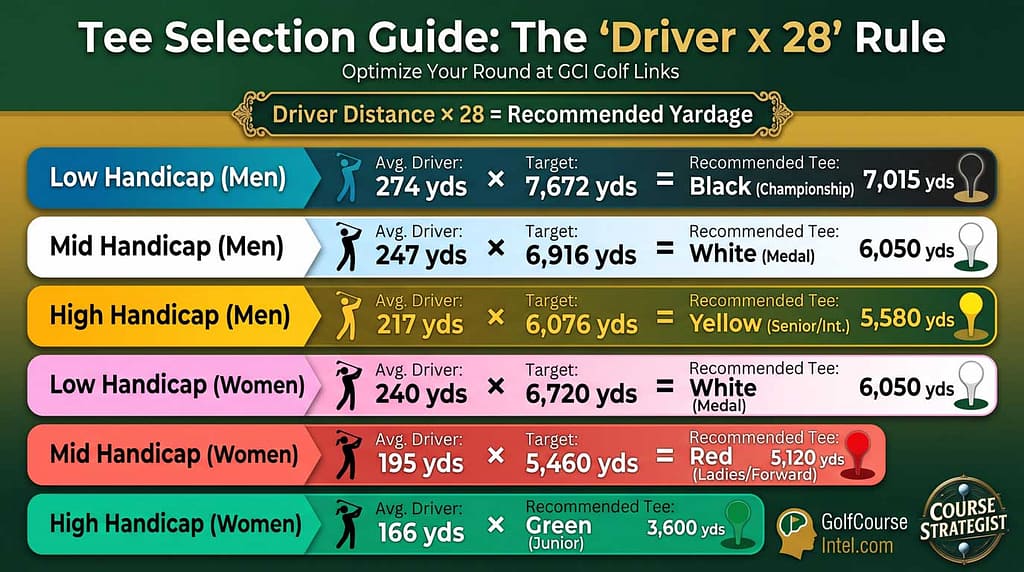
Setting yourself up for success begins before you even take a practice swing. Choosing the correct tee box completely transforms your round, ensuring you hit the approach clubs the architect originally intended. A highly reliable mathematical tool for this is the “Driver Distance × 28” formula. You simply multiply your average well-struck drive by 28 to find your ideal course yardage.
Mid-handicap male players generally average about 247 yards off the tee. The math suggests a maximum course length of 6,916 yards, but choosing the White (Medal) tees at 6,050 yards is an incredibly comfortable and strategic choice, based on expected rollouts and carries – resist the temptation to ego-up and play from the tips!
Mid-handicap female players, averaging 195 yards with the driver, will find the Red (Ladies/Forward) tees at 5,120 yards to be the perfect fit. Sticking to these distances keeps those punishing long-iron approaches to a minimum.
Hole-by-Hole Highlights and Course Management
This guide features hole-by-hole strategies for every handicap, heavily referenced from the existing published course guides available on GolfCourseIntel.com. Let’s look closely at a few pivotal holes where smart course management is an absolute necessity for the mid-handicapper.
Hole 2: The Plateau
This beautiful Par 4 doglegs right, playing to a green perched on an elevated plateau that slopes severely from back to front.
- Mid-Handicap Strategy: Aim your tee shot at the furthest visible point on the left side of the fairway. The natural slope will graciously feed your ball down to the right-center. On the approach, club up to a 6-iron to accommodate the elevation change. Securing a spot below the hole guarantees a manageable uphill putt.
Hole 5: The Shelf
Playing directly into the wind, this brutal Par 4 features a narrow fairway dropping off to out-of-bounds on the right. Deep pot bunkers guard the left, and the domed green actively rejects weak shots.
- Mid-Handicap Strategy: Use a 3-wood off the tee to maximize accuracy and keep the ball safely on the left side. Treat this hole exactly like a Par 5. Lay up short of the green, leaving a comfortable wedge distance. Pitching softly onto the dome helps the ball stay on the putting surface for a stress-free look at bogey or par.
Hole 14: The Wrecker
Earning its title as the most difficult hole on the course, this Par 4 doglegs right beside a massive dune into a harsh crosswind. Thick gorse lines the left atop the dune complex, deep pot bunkers guard the right, and an ancient stone wall marks out-of-bounds halfway up the left fairway.
- Mid-Handicap Strategy: Play your drive right of the massive dune to safely find the fairway. The crosswind makes a long iron approach incredibly risky, so play a mid-iron to lay up to 80 yards. A simple wedge from there allows you to target the lower tier of the green safely.

Dialing Up the Aggression
Sometimes the match is on the line, and you need to manufacture a spark. If you want to play a more aggressive strategy to improve your score, Hole 10 (The Turn) offers a fantastic opportunity.
This Par 4 doglegs left and typically plays with a strong tailwind. The conservative play is an iron safely to the corner. An aggressive player can confidently pull the driver and take a line directly over the cluster of pot bunkers. A well-struck drive carrying the hazards leaves a minimal pitch into the wide green, bringing a highly rewarding birdie or eagle into the picture. Committing fully to the swing is essential to pull off this heroic shot.
Projected Scores and the Final Word
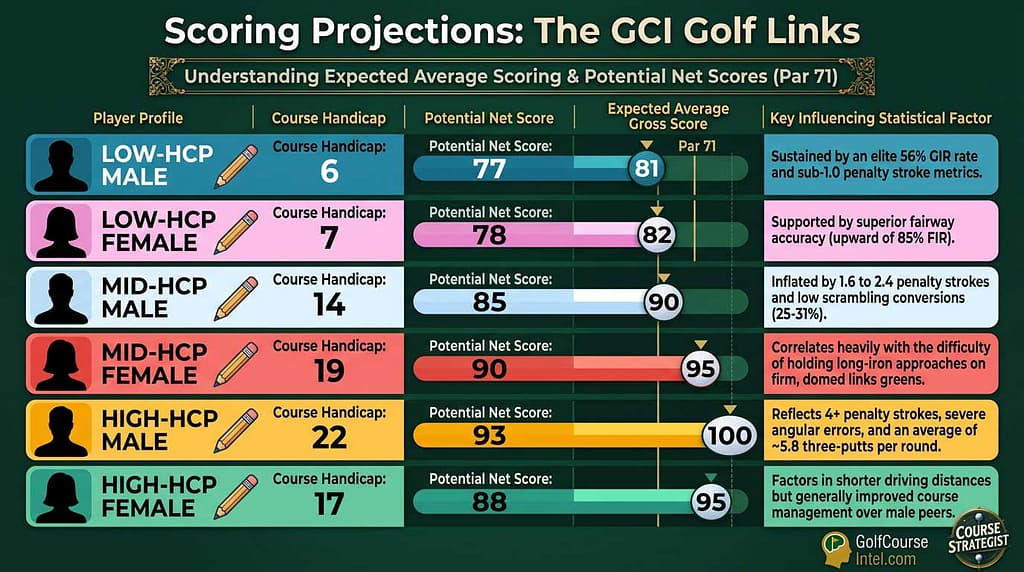
Aligning your expectations with statistical reality ensures you have a wonderful time on the coast. Your handicap index represents your potential, while your average score will typically sit a few strokes higher.
A low-handicap male player can expect to shoot around an 81 here, relying on elite greens-in-regulation stats to hold the score together. A mid-handicap female player will likely post a 95, managing the challenges of long approaches into firm, domed greens. High-handicap golfers should anticipate scores near 100, relying on conservative layup strategies to minimize penalties and three-putts.
Mastering links golf requires patience, creativity, and a solid game plan. Grab your clubs, trust your strategy, and enjoy every single bounce the terrain gives you.
Want to take your course management to the next level?
A complete Strategy Guide / Caddie Book for this layout is available at BuyMeACoffee.com, featuring a wonderful “pay what you think is fair” price tag (starting cost: $0). You can easily download it to use as a trusted course management template for playing most links-style golf courses. It serves as a perfect example of the premium Caddie Books we offer.
You may also order a highly detailed, personalized Elite Performance Strategy Guide using your specific distances and stats to get a full strategy blueprint for any course you want to take on! Check it all out right here:
If These Articles Help,
Running Golf Course Intel takes real time, real effort, and – yep – real golf balls. If you’ve enjoyed the guides, the strategy breakdowns, or the myth‑busting articles, hitting that Buy Us Golf Balls button is the easiest way to help keep the site online and the content flowing. Every donation, big or small, genuinely fuels the next round of smarter golf insights.
Thanks for helping us keep this thing rolling!






0 Comments