Conquering Pebble Beach: A Strategy Guide for a Mid-Handicapper
Every golfer dreams of standing on the first tee at Pebble Beach. The history, the cliffs, the crashing Pacific – it is the ultimate bucket list round. But for the average amateur, the “Greatest Meeting of Land and Sea” can quickly turn into a scorecard disaster without the right plan.
Recently, we completed an Elite Performance Strategy Guide for Dave, a 15-handicap golfer with a 93-mph swing speed and a tendency to push the ball to the right. Dave didn’t need to drive it like a pro to score well; he just needed a blueprint to manage his game. Here is a look inside his personalized guide to conquering Pebble.
Dave has already made a few other stops at Torrey Pines and TPC Scottsdale – check out our recommendations for him to succeed at those iconic courses!
The Body: Pre-Round, Pre-Swing & Post-Round
Success at Pebble starts before the first swing. For Dave, a 43-year-old playing in cool coastal air, we prioritized neuromuscular activation over static stretching.
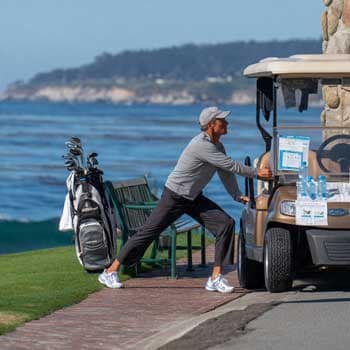
The Warm-Up (20 Minutes) We prescribed a dynamic routine to wake up the glutes and protect the lower back:
- Thermogenic Activation: A brisk walk or light jog followed by arm circles and wrist “figure-8s” to prep the joints.
- Dynamic Mobility: Leg swings to open the hips and torso twists with a club to mimic swing torque.
- Range Priming: We used a “Wedge Ladder” for contact, followed by “Driver Activation” where Dave visualizes the first tee shot at full speed.
The Pre-Swing Routine To combat Dave’s “straight push,” his mental cues focus on alignment. He aims left of his target, checks for a “stronger” grip (2-3 knuckles visible on his lead hand), and moves the ball forward one inch to allow the clubface time to square up. His swing thought? “Belt buckle to target” to ensure full rotation.
Post-Round Recovery Recovery is vital for multi-day trips. Dave’s protocol includes immediate hydration and static stretching – specifically quad holds and seated hamstring reaches – to release tension before the next round.
The Gear: Finding the Perfect Ball

Equipment calibration is the easiest way to lower your score. Dave has a moderate swing speed (93 mph) and needs help holding Pebble’s tiny greens.
We recommended the TaylorMade Tour Response.
- Why? Its 70-compression core allows Dave to fully compress the ball for maximum distance, unlike harder tour balls that might feel “clicky”.
- The Cover: The 100% cast urethane cover provides the elite spin needed to stop shots on Pebble’s firm, small targets.
The Arena: Pebble Beach Overview
Pebble Beach isn’t just beautiful; it’s deceptive. The greens average just 3,500 square feet – the smallest on the PGA TOUR – placing a premium on iron play. The “marine layer” (heavy sea air) knocks about 10% off your distance, meaning a 150-yard shot often plays closer to 135.
General Strategy Rules:
- The Ocean Break: Putts almost always break toward the water.
- Club Up: Between the heavy air and uphill shots, take one more club than you think.
- Aim Small, Miss Short: The greens slope back-to-front. Being long leaves a terrifying downhill putt.
Hole-by-Hole: The Strategic Highlights
Here is how we recommended Dave navigate the most iconic holes using his custom “White Tee” strategy (6,116 yards).
Hole 1: The Gentle Handshake (Par 4)
- The Trap: Hitting driver. The fairway runs out into trouble at 225 yards.
- The Play: A smooth 3-wood or 5-wood. Aim left-center; a slight push puts Dave in the middle.
Hole 2: The Barranca (Par 5)
- The Trap: Trying to be a hero over the ditch (barranca) on the second shot.
- The Play: Mandatory layup. Dave hits a 6-iron short of the trouble, leaving a simple wedge approach.
Hole 4: The Gauntlet Begins (Par 4)
- The Trap: The ocean on the right. Driver brings a cross-bunker into play.
- The Play: A 5-hybrid off the tee leaves a full wedge into the tiny, sloped green. It’s safer and smarter.
Hole 6: The Uphill Climb (Par 5)
- The Trap: The fairway slopes severely right toward the ocean.
- The Play: Aim at the left rough line. The slope will feed the ball back to the fairway. The second shot is blind and steep – trust a hybrid to get it up the hill.
Hole 7: The Short One (Par 3)
- The Trap: Wind. A mere 106 yards can play drastically different depending on the breeze.
- The Play: A smooth pitching wedge or gap wedge. Dave visualizes a 90-yard shot to keep spin under control and aims for the center, ignoring the flag.
Hole 8: The Chasm (Par 4)
- The Trap: The approach shot is arguably the most intimidating in golf.
- The Play: Hitting a driver is essential here to get close to the cliff’s edge. For the approach, aim at the left side of the green – anything short or right is swimming.
Hole 9: The Slope (Par 4)
- The Trap: A severe right-to-left fairway slope that feeds everything into the ocean.
- The Play: Aim way left (at the rough). If Dave is out of position, he lays up to 50 yards rather than risking a 3-wood from a sidehill lie.
Hole 17: The Hourglass (Par 3)
- The Trap: Pin hunting. The green is shaped like a dumbbell.
- The Play: Aim for the “middle mass” of the green. A par here is a net birdie for a 15-handicap.
Hole 18: The Finish (Par 5)
- The Trap: The ocean left.
- The Play: Aim at the large tree in the middle of the fairway. Dave’s natural push makes the right rough the “safe” miss. It’s a three-shot hole: Drive, 5-iron layup, Wedge on. Enjoy the walk!
The Projected Outcome & Path to Improvement

So, what does the data predict for Dave’s round at Pebble?
The Projection: 92–95 Based on Dave’s handicap and the course rating, his target score is a 90. However, our model projects a score between 92 and 95.
- The Challenge: The small, complex Poa annua greens typically cost mid-handicappers 3 to 5 extra strokes in putts and chips compared to their home course.
- The Win: While the greens are tough, sticking to the layup strategy on the hardest holes (8, 9, and 10) eliminates the “blow-up” holes (triples and quads), keeping the round respectable.
Recommendations for the Next Level To break 90 or even challenge 85, we gave Dave three specific adjustments to implement:
- Flip the Switch on “Green Light” Holes: While we advised caution on the cliffs, holes 2, 4, and 6 are prime scoring opportunities. Dave should attack these pins with his wedges to build a buffer against the tougher bogeys.
- The “Ocean Hole” Protocol: On holes where the ocean is on the right (Dave’s danger zone), we recommended a tactical change: Tee the ball up on the far right side of the tee box and aim at the left rough line. This maximizes the angle for his natural push to land safely in the fairway.
- The Windy Day Audible: If the wind picks up, we recommended Dave carry a sleeve of Titleist AVX balls. Their lower spin profile helps reduce the curvature of his push, helping the ball hold its line against the ocean breeze better than his standard ball.
Dave’s Complete Elite Performance Report is linked below:
If These Articles Help,
Running Golf Course Intel takes real time, real effort, and – yep – real golf balls. If you’ve enjoyed the guides, the strategy breakdowns, or the myth‑busting articles, hitting that Buy Us Golf Balls button is the easiest way to help keep the site online and the content flowing. Every donation, big or small, genuinely fuels the next round of smarter golf insights.
Thanks for helping us keep this thing rolling!
Get Your Own Golf Course Intel Strategy Guide
Dave’s plan for Pebble Beach wasn’t magic – it was math and management tailored to his game. You don’t need to be a scratch golfer to play like a pro strategist.
Are you ready to lower your scores? Request your Golf Course Intel Strategy Guide today. We will analyze your game to provide:
- Personalized Drills & Stretches: Custom fitness routines to activate your swing.
- Gear Optimization: Recommendations for the perfect golf ball and clubs for your speed.
- Course Management Framework: A hole-by-hole blueprint for your target course to help you avoid the big numbers.
Golf Course Owners and Managers:
Give your patrons a competitive edge at their favorite local track! Request a bespoke, highly detailed guide for your course to share in your pro shop or online, with members, guests, and the public.
Contact us for a quote: