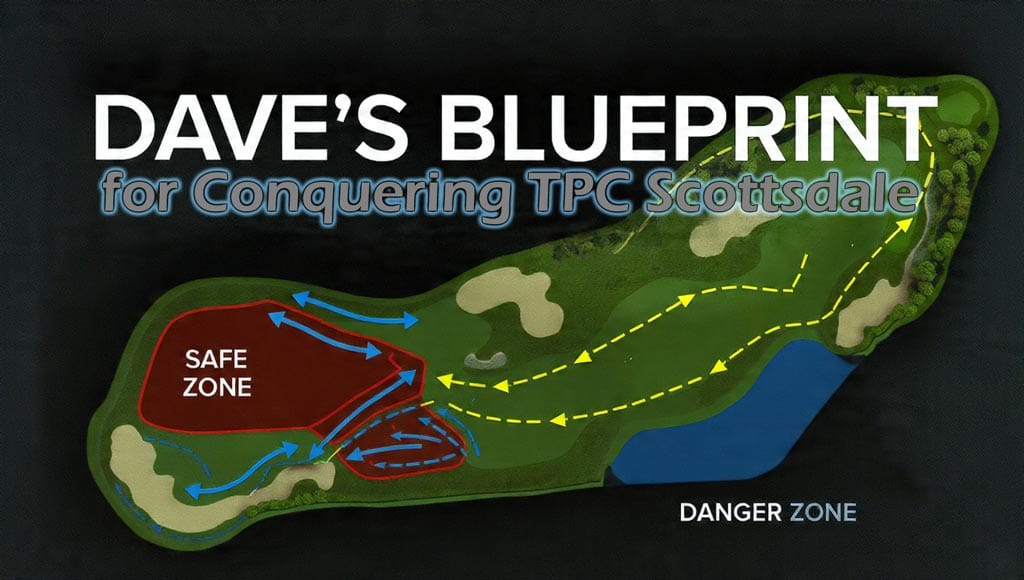
How Dave is Going to Conquer TPC Scottsdale (And How You Can Too)
Meet Dave. He’s 43, holds a 15.3 handicap, and hits his driver about 214 yards. Like many of us, Dave battles a “two-way miss” anxiety, though his natural tendency is a straight ball that occasionally pushes right. He has the physical tools to break 90 consistently, yet he’s losing nearly 18 strokes a round compared to a scratch golfer – mostly on approach shots and around the green.
Dave plays some awesome courses – check out his Elite Performance Guide for taking on Torrey Pines

We built Dave a comprehensive Elite Performance Strategy Guide to tackle the legendary Stadium Course at TPC Scottsdale. Whether you’re playing a bucket-list course or just your local muni, the data-driven strategies we used for Dave can help you lower your scores, too.
Elevation and Ball Flight Physics
The Stadium Course sits at an average elevation of 1,530 feet above sea level. This altitude has a tangible effect on ball flight aerodynamics.
- Distance Gain: The thinner air density results in a distance gain of approximately 2.6% compared to sea level. For a drive of 300 yards, this equates to roughly 7.5 to 8 extra yards.
- Spin Reduction: The altitude also slightly reduces the lift and drag on the ball, leading to a flatter trajectory and potentially less curvature on shot shaping. We recommended that Dave adjust his yardage estimates accordingly, often clubbing down on approaches.
Climate and Wind
The course is situated on the valley floor, making it susceptible to swirling winds coming off the McDowell Mountains. During the tournament (winter), temperatures can range from near freezing in the morning to the low 70s in the afternoon. This temperature variance significantly impacts compression and carry distance – a ball struck at 8:00 AM will fly significantly shorter than one struck at 2:00 PM.
The Prep: Wins Are Created Before the First Tee
Most mid-handicappers lose strokes before they even put a tee in the ground. For a 43-year-old golfer like Dave, mobility and mental prep are non-negotiable.
The “Anti-Desk” Warm-Up To counteract the stiffness of a work week, we prescribed a dynamic routine focusing on rotation rather than static holding:
- Leg Swings & Torso Twists: Loosens hip flexors and the thoracic spine for a full turn.
- Squats with Club Overhead: Engages the core and opens the hips.
- The 15-Ball Range Script: Dave isn’t there to fix his swing; he’s there to find his rhythm. He hits 5 wedges for tempo, 5 mid-irons visualizing his target, and 5 “fairway finder” drives at 80% effort.
Swing Thoughts for the “Push”: Dave’s miss is a push right. To fix this without a total swing overhaul, we gave him three simple cues:
- “Low and Slow”: A smooth takeaway prevents a jerky transition.
- “Release Left”: Feeling the toe of the club pass the heel helps square the face, neutralizing the push.
- “Finish the Swing”: Committing to a full rotation prevents the “steering” that often leads to blocks.

The Gear: Why the Ball Matters
With a swing speed of roughly 93 mph, Dave doesn’t need a high-compression rock. He needs help around the greens. We recommended the Callaway Chrome Tour or the TaylorMade Tour Response. Both offer a urethane cover, which provides the “grab” Dave needs to fix his short game (where he loses -0.24 strokes per hole), while maintaining distance off the tee.
TPC Scottsdale: A Blueprint for Conquering the Stadium Course
The Stadium Course is designed to bait your ego. It screams, “Hit it hard!” but whispers, “I dare you.” For a 15-handicap like Dave playing the White Tees (6,110 yards), the strategy is simple: Boring Golf Wins.
Here an abbreviated version of the hole-by-hole game plan we created for Dave to navigate the desert heat and altitude (approx. 2.6% distance gain).
The Front 9 offers a strong opening with diverse challenges
- Hole 2: The Visual Trick (Par 4) The tee shot here is intimidating, with bunkers guarding the right side. The design begs you to challenge them. Don’t. We instructed Dave to aim at the left edge of the fairway. His natural push will bring the ball back to center. If he hits it straight? He’s safe on the left.
- Hole 3: The Discipline Test (Par 5) This is a scoring opportunity, but only if you respect the desert. A massive waste area cuts the fairway. While pros fly it, Dave’s play is a mandatory layup with a 6-iron or hybrid short of the hazard. It takes eagle out of play, but it guarantees a wedge in hand for a par putt.
- Hole 5: The Split Fairway (Par 4) This is the “slicer’s nightmare.” We told Dave to ignore the aggressive left fairway pad which requires a 250-yard carry. The right fairway is 34 yards wide and safe. It plays uphill, so he needs to club up on the approach to avoid the false front.
The Back 9 features signature, challenging holes like the iconic, coliseum-style 16th
- Hole 11: The Killer (Par 4) Water runs the entire left side, and the fairway slopes toward it. This is where Dave’s “push” tendency is a superpower. He must aim at the right rough line. If he hits it straight, he’s fine. If he pushes it, he’s in the waste area (playable). Aiming down the middle here is a death sentence.
- Hole 15: Risk vs. Reward (Par 5) The island green tempts everyone. But for a player hitting a 3-wood 186 yards, the water carry is a gamble with poor odds. The strategy? Lay up. Hit a 6-iron to a comfortable wedge yardage. A boring par here beats a watery double-bogey every time.
- Hole 16: The Coliseum (Par 3) The only hazard here is the noise in your head. It’s just a 118-yard shot. We told Dave to trust his 8-iron, ignore the grandstands, and aim for the center of the green. Two putts for par gets you out alive.
- Hole 17: The Drivable Temptation (Par 4) At 255 yards, Dave could get close with a perfect drive. But water lurks left and long. The “Smart Play” is a 5-wood/hybrid to stay short of the trouble. The “Fun Play” is a driver aimed way right – dry and safe if he misses.
- Hole 18: The Finisher (Par 4) Water left, “Church Pew” bunkers right. The drive requires commitment. Dave needs to aim right-center. If he pushes into the bunkers, he pitches out. If he pulls into the water, the round ends on a sour note.
Post-Round: Recovery & Review
After the round, Dave’s job isn’t done.
- The Audit: Review the scorecard. Where did the double bogeys happen? Was it a bad swing or a bad decision (like aiming at a pin tucked behind a bunker)?
- The Body: Hydrate immediately (desert golf dehydrates you fast). Perform seated hamstring stretches and “figure-4” glute stretches to undo the tension in the lower back.
Summary
Dave has the potential to break 90 not by hitting the ball further, but by playing smarter. By utilizing his natural shot shape (the push) as a safety valve against water hazards and choosing a ball that helps his short game, he stops fighting the course and starts managing it.
If These Articles Help,
Running Golf Course Intel takes real time, real effort, and – yep – real golf balls. If you’ve enjoyed the guides, the strategy breakdowns, or the myth‑busting articles, hitting that Buy Us Golf Balls button is the easiest way to help keep the site online and the content flowing. Every donation, big or small, genuinely fuels the next round of smarter golf insights.
Thanks for helping us keep this thing rolling!
Need a Strategy Guide for Your Game?
Are you tired of guessing which club to hit or losing strokes to poor course management? Request your own Golf Course Intel Strategy Guide. We’ll analyze your handicap and swing tendencies to identify the perfect equipment, create a personalized warm-up routine, and build a hole-by-hole roadmap for your favorite course. Stop playing against the course and start conquering it.