
Welcome to Copperhead: The Bogey Golfer’s Survival Guide
If you’re hovering around an 18-handicap, you already know the game is a beautiful mix of brilliant shots and frustrating blunders. Playing a PGA Tour venue like the Copperhead Course at Innisbrook Resort in Palm Harbor, Florida, can be incredibly intimidating. Unlike the typical flat, swampy Florida resort courses, Copperhead features rolling hills, towering pines, and a distinct Carolina feel.
But you don’t need to be a scratch golfer to enjoy this track. By playing smart, leaving your ego in the clubhouse, and following a solid game plan, you can successfully navigate the infamous “Snake Pit” and walk away with a scorecard you can be proud of. Let’s dive into the history, the strategy, and a selected hole-by-hole breakdown tailored specifically to help you shoot in the 80s!
A Brief History of Copperhead

The Copperhead Course was designed by legendary golf course architect Larry Packard and officially opened for play in 1974. Packard loved the property so much that he made Innisbrook his permanent home, living there until he passed away at the age of 101! His design philosophy focused on strategic shot placement rather than penal, artificial hazards, famously utilizing double doglegs to force players to think multiple shots ahead.
The course has hosted a PGA Tour event since 2000 (originally the Tampa Bay Classic) and is now the home of the Valspar Championship. In 2015, the course underwent a massive restoration. Every green was rebuilt to its original 1974 dimensions, bunkers were reshaped to Packard’s original specifications, and the drainage was upgraded, ensuring the course remains a pristine, modern challenge.
Course Scorecard, Ratings, and Slopes
Playing to a Par 71, Copperhead features an unusual layout of five par-3s, nine par-4s, and four par-5s.
Course Rating and Slope Data
| Tee Box | Total Yardage | Men’s Rating / Slope | Women’s Rating / Slope |
| Black | 7,209 | 75.6 / 144 | N/A |
| Green | 6,624 | 73.0 / 138 | N/A |
| White | 6,243 | 71.2 / 134 | 76.6 / 143 |
| Gold | 5,676 | 69.0 / 131 | 74.2 / 139 |
| Combo | 5,312 | 67.6 / 127 | 72.3 / 133 |
| Red | 4,851 | 65.1 / 123 | 69.1 / 129 |
Front Nine Scorecard
| Hole | Name | Par | Black | Green | White | Gold | Red | Men’s HCP |
| 1 | Innisbrook’s View | 5 | 560 | 528 | 521 | 456 | 456 | 5 |
| 2 | Second Thoughts | 4 | 413 | 371 | 359 | 331 | 291 | 11 |
| 3 | Narrow Neck | 4 | 442 | 407 | 386 | 362 | 291 | 7 |
| 4 | Bunkered | 3 | 188 | 163 | 140 | 134 | 95 | 17 |
| 5 | Longview | 5 | 607 | 570 | 526 | 458 | 388 | 1 |
| 6 | Sidewinder | 4 | 452 | 422 | 406 | 357 | 304 | 3 |
| 7 | Hidden Gem | 4 | 410 | 373 | 345 | 335 | 273 | 13 |
| 8 | Drop Off | 3 | 232 | 201 | 176 | 145 | 124 | 15 |
| 9 | Hide Away | 4 | 420 | 392 | 378 | 343 | 294 | 9 |
| OUT | 36 | 3724 | 3427 | 3237 | 2921 | 2516 |
Back Nine Scorecard
| Hole | Name | Par | Black | Green | White | Gold | Red | Men’s HCP |
| 10 | The Descent | 4 | 441 | 410 | 374 | 343 | 295 | 8 |
| 11 | O’s Alley | 5 | 567 | 525 | 514 | 435 | 372 | 6 |
| 12 | Bridge Hole | 4 | 373 | 357 | 343 | 343 | 315 | 12 |
| 13 | Forced Carry | 3 | 199 | 179 | 148 | 144 | 102 | 18 |
| 14 | Packard’s Double Dogleg | 5 | 590 | 561 | 532 | 505 | 448 | 2 |
| 15 | Snake Bite | 3 | 208 | 182 | 172 | 160 | 130 | 14 |
| 16 | Moccasin | 4 | 458 | 412 | 376 | 336 | 294 | 4 |
| 17 | The Rattler | 3 | 206 | 181 | 171 | 161 | 118 | 16 |
| 18 | The Copperhead | 4 | 443 | 390 | 376 | 328 | 261 | 10 |
| IN | 35 | 3485 | 3197 | 3006 | 2755 | 2335 | ||
| TOT | 71 | 7209 | 6624 | 6243 | 5676 | 4851 |
Strategic Game Plan: The 18-Handicap Approach
To conquer this track and break 90, you must focus on course management. Bogey is often a great score out here. Here are our top strategies:

- Tee Selection (The USGA Formula): Do not play the tips! Playing the correct tees is the single fastest way to improve your day. The USGA recommends finding your ideal course yardage by using one of two formulas: either multiply your average driver distance by 28, or multiply your average 7-iron distance by 46.67. For a typical 18-handicap male hitting a driver 215 yards, that translates to about 6,020 yards. This puts you perfectly on the White Tees (6,243 yards) or the Gold Tees (5,676 yards).
- Club Selection Per Shot: Copperhead is incredibly tight with heavily protected corners. The driver can get an 18-handicap into a lot of trouble. If a hole is tight or features a sharp dogleg, pull out a hybrid or a 5-wood. Your primary goal is finding the short grass.
- Recovery From Errors: When (not if) you hit a ball into the trees or the thick 3.75-inch ryegrass rough, take your medicine! Do not try to hit a 150-yard hero slice around a pine tree over water. Pitch it sideways back into the fairway. Taking a bogey instead of a triple-bogey is how an 18-handicapper breaks 90.
- Golf Ball Selection: The greens here are firm, fast (running at a 12.0 on the Stimpmeter), and highly elevated. You need a premium urethane ball that offers forgiveness off the tee but still provides short-game spin. We highly recommend playing the TaylorMade TP5 for its softer 5-layer construction, or the Titleist Pro V1 for unparalleled greenside control. Note that a GCI Fairway Fundamentals + Golf Ball Guide can recommend the best ball your swing speed and other stats.
- Distance Measuring & Elevation: Copperhead has a total ascent of 91 meters throughout the round. Judging the wind and elevation is critical. Having a top-tier rangefinder with slope capabilities, like the Bushnell Golf Tour V6 Shift Laser Rangefinder, or a dedicated GPS watch like the Garmin Approach S62 Golf Watch will accurately adjust your yardages for these massive elevation shifts, saving you 2-3 strokes a round.
Featured Hole-by-Hole Outline
Here’s a detailed look at 7 of the most critical holes on the property, including Larry Packard’s masterpiece and the dreaded Snake Pit. For an 18-handicap, remember: play for the center of the greens and respect the hazards!
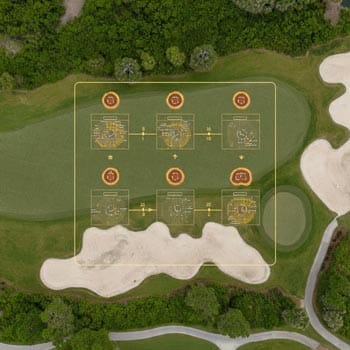
- Hole 1: Innisbrook’s View (Par 5)
- Elevation: Massive 50-foot downhill drop from the tee to the fairway.
- Green Size & Features: Moderately sized, sneakily pitched from back to front, making downhill putts terrifyingly fast.
- Hazards: Dense pine corridors frame a sweeping dogleg right.
- 18-HDCP Strategy: Enjoy the downhill drive, but play it as a true 3-shot hole. Keep your approach below the hole to avoid a 3-putt on the slippery green.
- Hole 4: Bunkered (Par 3)
- Elevation: Relatively flat, but visually intimidating.
- Green Size & Features: Heavily compartmentalized putting surface.
- Hazards: The putting surface is entirely isolated by massive sand complexes.
- 18-HDCP Strategy: Ignore where the pin is located. Aim directly for the fat center of the green. Missing in the deep bunkers guarantees a bogey or worse.
- Hole 12: Bridge Hole (Par 4)
- Elevation: Flat terrain leading to a green complex with minimal elevation shifts.
- Green Size & Features: A relatively benign putting surface offering favorable putting lines.
- Hazards: An intersecting water hazard completely cuts off the fairway roughly 150 yards from the green.
- 18-HDCP Strategy: This is a forced layup. Hit whatever club goes exactly 200 yards off the tee to stay dry, leaving a comfortable mid-iron to the green.
- Hole 14: Packard’s Double Dogleg (Par 5)
- Elevation: Fairway weaves through rolling hills to a slightly elevated green complex.
- Green Size & Features: The green features a pronounced back-to-front slope on the right quadrant.
- Hazards: A true double-dogleg snaking left off the tee and back right for the approach.
- 18-HDCP Strategy: Do not cut the corners! Play point-to-point. A pond guards the right side of the layup zone (80 to 100 yards from the green), so favor the left side on your second shot.
- Hole 16: Moccasin (Par 4) – Start of the Snake Pit
- Elevation: Downhill tee shot into a valley, followed by a blind, elevated approach.
- Green Size & Features: Slightly elevated above the fairway, creating extreme depth-perception distortion.
- Hazards: A terrifyingly narrow corridor bounded by trees on the left and a lagoon on the right.
- 18-HDCP Strategy: The lagoon stretches to about 180 yards from the green. Hit a fairway wood off the tee for control, and take an extra club on your approach to compensate for the uphill elevation.
- Hole 17: The Rattler (Par 3) – The Snake Pit
- Elevation: Slightly uphill trajectory from tee to green.
- Green Size & Features: Exceptionally deep but incredibly narrow at the front, ballooning out significantly in the back.
- Hazards: Completely surrounded by deep sand traps.
- 18-HDCP Strategy: If the pin is tucked in the narrow front, ignore it entirely. Aim for the wider back-half of the green and be completely content with a two-putt bogey.
- Hole 18: The Copperhead (Par 4) – The Snake Pit
- Elevation: A downhill tee shot followed by a steeply uphill approach shot.
- Green Size & Features: A heavily contoured surface set within a natural amphitheater, often blind from the fairway.
- Hazards: A severely angled fairway bend guarded by a maze of deep bunkers.
- 18-HDCP Strategy: You must avoid the fairway bunkers off the tee. Lay back if needed. The approach plays severely uphill, so take 1 to 2 extra clubs to ensure you clear the deep right-side bunker guarding the front edge.
General Course Notes
- Weather: Located near the Gulf of Mexico, the course is subject to swirling coastal winds that funnel unpredictably through the tall pine canopies. Check the treetops, not just the ground wind.
- Green Characteristics: The TifEagle Bermudagrass greens are overseeded with Poa Trivialis. They run at a blistering 12.0 on the Stimpmeter. Keeping the ball below the hole is mandatory.
- Bunker Details: Revitalized in 2015, the 74 bunkers are deep and filled with firm G-Angle sand. You need to use the bounce of your wedge aggressively to escape.
If These Articles Help,
Running Golf Course Intel takes real time, real effort, and – yep – real golf balls. If you’ve enjoyed the guides, the strategy breakdowns, or the myth‑busting articles, hitting that Buy Us Golf Balls button is the easiest way to help keep the site online and the content flowing. Every donation, big or small, genuinely fuels the next round of smarter golf insights.
Thanks for helping us keep this thing rolling!

Take Your Game to the Next Level!
Want to dominate your local track just like you are going to tackle Copperhead? Get your exclusive Golf Course Intel Strategy Guide! This personalized guide will help you identify custom drills and stretches, recommend the perfect golf balls and clubs tailored to your swing speed and 18-handicap game, and provide a master framework for course management specific to the courses you play.
Stop guessing and start scoring.