
Conquering Quail Hollow: Strategies for Every Handicap
If you have ever watched the world’s best players battle it out on television and thought, “I wonder how I would shoot out there,” Quail Hollow Club is the ultimate testing ground. Nestled in Charlotte, North Carolina, this course is a brilliant mix of Southern charm and absolute strategic terror.
Whether you are looking to test your limits or just hoping to survive the famed “Green Mile,” navigating this layout requires more than just a good swing. It requires discipline. Let’s dive into the ultimate Quail Hollow golf strategy for every skill level.
A Brief History of a Championship Behemoth
Before you tee it up, it helps to know what you are up against. Quail Hollow’s original 18-hole routing was crafted by golf course architect George Cobb and opened for play in 1961. Over the years, the course has seen significant evolution to keep up with modern technology. Arnold Palmer made several tweaks in the 1980s, but the course you see today is largely the masterful (punishing) work of Tom Fazio. Fazio renovated the course in 1997, 2003, and executed a massive 90-day overhaul in 2016 to prepare the venue for the 2017 PGA Championship.
One of the most significant changes was the transition to Champion G-12 Bermuda grass on the greens, which play incredibly fast and firm. The club has a rich tournament pedigree, hosting the Truist Championship (formerly the Wells Fargo Championship), the 2022 Presidents Cup, and multiple PGA Championships, including 2025.
Proper Tee Selection: The Mid-Handicapper’s Secret Weapon

The biggest mistake amateur golfers make at Quail Hollow happens before they even swing a club: playing the wrong tees. The championship tees stretch to over 7,500 yards. Unless your name is on a tour staff bag, stay away from them.
A great rule of thumb is to take your average driving distance and multiply it by 28 to find your ideal course yardage.
- Mid-Handicap Men: Data shows a 15-handicap male averages about 236 yards off the tee. Multiply that by 28, and your optimal course length is roughly 6,600 yards. You should be playing the Tee II/III combo at 6,534 yards.
- Mid-Handicap Women: A 15-handicap female golfer averages around 185 yards off the tee. Your optimal yardage is about 5,180 yards, making Tee IV/V (5,411 yards) a good fit.
Playing the correct tees ensures you are hitting mid-to-short irons into these elevated, heavily bunkered greens. If you are forced to hit fairway woods into Fazio’s lightning-fast (12.5 Stimpmeter) Champion Bermuda greens, you will simply not hold the putting surface.
Hole-by-Hole Strategies for Every Handicap

Quail Hollow demands a specific mindset depending on your handicap level. Here is a high-level approach for the routing:
- The Outward Nine (Holes 1-9): This stretch is about survival and positioning. For low handicappers, holes like the par-5 7th offer birdie opportunities, provided you can execute a drawing tee shot. For mid-handicappers, the goal is to avoid the deep fairway bunkers. Do not be afraid to hit a 3-wood off the tee on holes 5 and 8 to keep the ball in the short grass. High handicappers should play every par 4 over 400 yards as a three-shot hole; laying up to a comfortable wedge distance will prevent the catastrophic snowmen (8s) on your scorecard.
- The Transitional Stretch (Holes 10-15): The course tightens up here. Low handicappers can utilize their power, but high and mid-handicappers must prioritize accuracy. Finding the fairway on the narrow 12th hole is mandatory, as the dense tree lines eliminate any chance of a hero-shot recovery.
Highlighted Holes: Course Management Masterclass
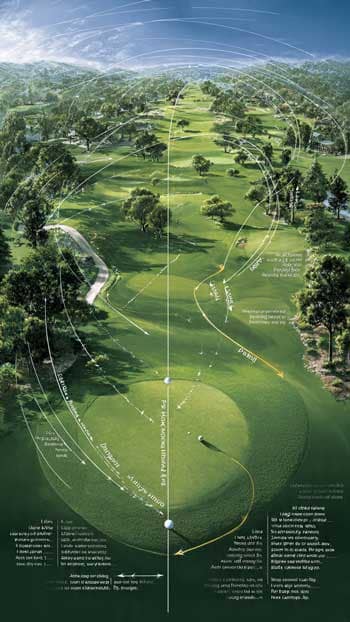
To truly score well, mid-handicap players need to make elite course management decisions on these specific holes:
The Ultimate Risk/Reward – Hole 14: Measuring just 344 yards from the back tees, this lakeside par 4 is visually stunning and incredibly tempting.
- Low Handicap: A slight fade with the driver takes the left-side lake out of play and sets up an eagle chip.
- Mid & High Handicap: Put the driver away! Five bunkers and a massive lake stand between you and the green. Hit a hybrid or 5-wood to the widest part of the fairway, leaving a crisp 9-iron into the green. Taking the water out of play almost guarantees you won’t make worse than a bogey.
Welcome to the Green Mile – Hole 16: This 500+ yard par-4 begins the toughest three-hole stretch in golf.
- Course Management: A massive lake guards the left side of the green. For mid and high-handicappers, the strategic play is to aim completely away from the water, favoring the right side of the fairway and the right bailout area near the green. Do not hunt the pin here. A bogey on 16 is a highly respectable score.
The Peninsula Terror – Hole 17: A par-3 requiring a forced carry over water, with a sheer rock wall intimidating you from the tee box.
- Course Management: High handicappers inevitably pull the ball under pressure. The target here is the right side of the green. Statistics show that the 3- to 6-foot putting range is a major separator – scratch players make 76% of them, while higher handicaps make just 48%. Hit it safely to the fat part of the green, trust your lag putting, and happily walk away with your two-putt.
Click the link below to download the complete Course Strategist Guide from GolfCourseIntel absolutely free!
Projected Scores by Handicap
If you stick to your game plan, choose the right tees, and putt defensively on the fast Bermuda surfaces, here is what you can realistically expect to shoot at Quail Hollow:
- Low Handicap (0-5): Assuming you keep penalty strokes to a minimum and capitalize on your short game, an expected score ranges from 74 to 78.
- Mid Handicap (10-15): By avoiding hero shots, laying up on the 14th, and navigating the Green Mile with smart bogeys, you should target a score between 84 to 89.
- High Handicap (20+): With an average of around 37 putts per round and occasional penalty strokes, your primary goal is to keep the ball in play. A successful day at Quail Hollow will land you between 96 to 105.
If These Articles Help,
Running Golf Course Intel takes real time, real effort, and – yep – real golf balls. If you’ve enjoyed the guides, the strategy breakdowns, or the myth‑busting articles, hitting that Buy Us Golf Balls button is the easiest way to help keep the site online and the content flowing. Every donation, big or small, genuinely fuels the next round of smarter golf insights.
Thanks for helping us keep this thing rolling!
Ready to Take Your Game to the Next Level?
Knowing the strategy of a PGA Tour-level golf course is only half the battle; executing the shots is the rest.
Request your Golf Course Intel Strategy Guide today! This comprehensive, personalized guide goes far beyond generic tips. We will help you identify personalized drills and golf-specific stretches to increase your mobility and power. Plus, we provide tailored recommendations for the perfect golf ball and clubs suited to your unique swing speed, alongside a repeatable framework for on-course management.
Stop guessing on the tee box and start playing the best golf of your life.