
The 12 Mid-Handicap Mistakes Your Scorecard Is Hiding
Playing in the 10–20 handicap range is one of the most exciting places in golf. Your game has enough consistency to produce genuinely good stretches, and real scoring breakthroughs are well within reach. The gap between your current index and the single digits often comes down to a handful of specific, repeatable habits. Today’s shot-tracking technology makes those habits easier to identify than ever before.
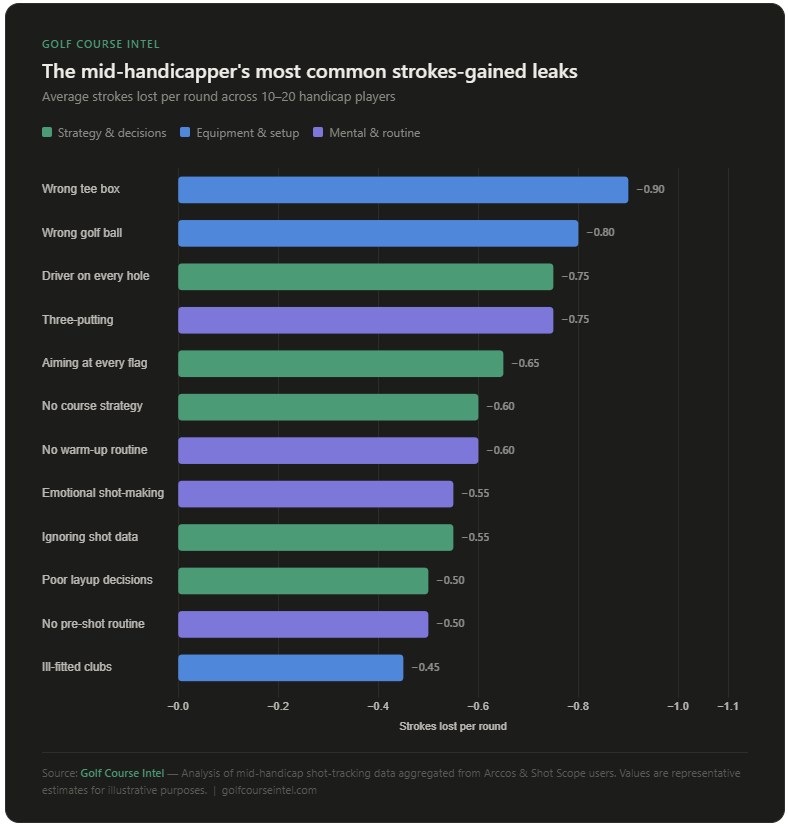
Here are the 12 most common mid-handicap mistakes, backed by data, with practical fixes for each.
Mistake #1: Playing Tees That Don’t Match Your Game
Ego plays a bigger role in tee selection than most golfers want to admit. The data makes a compelling case for moving forward. The PGA of America’s Tee It Forward initiative recommends matching your tee to your average driving distance using a simple formula: multiply your average driver distance by 28 to find your ideal course yardage. A golfer averaging 220–230 yards off the tee belongs on a course playing ~6,160–6,440 yards – not 6,900.
Playing overly long yardages slows play for everyone, inflates scores artificially, and produces bad data to train from. Find the tees that give you actual birdie and par opportunities and watch the fun – and your handicap – improve together.
Mistake #2: Playing the Wrong Golf Ball

This one stings because it costs strokes quietly, across every round. Mid-handicappers sit right at the crossroads of ball selection. At this level, a three-piece urethane-covered ball delivers genuine “spin separation” – low spin off the driver for distance and accuracy, high spin off wedges for control around the greens. The difference between a two-piece ionomer ball and the right urethane option shows up most dramatically on short-game shots.
Golf Course Intel’s guide How to Choose the Right Golf Ball for Your Swing walks through compression, cover type, and construction to match a ball to your actual swing speed and tendencies. The right ball for a 15-handicapper is very different from what a scratch player needs.
💡 Quick Fix: If your swing speed is between 85–100 mph, start with a mid-compression, three-piece urethane ball. Popular options include the Srixon Q-Star Tour, Callaway Chrome Soft, and TaylorMade Tour Response.
Mistake #3: Pulling Out the Driver on Every Non-Par 3
Shot-tracking data from Arccos and Shot Scope is consistent on this point: mid-handicappers lose far more strokes from penalty areas and OB than they gain from extra driver distance. Before reaching for the big stick, ask a more useful question: What does this hole actually require from the tee?
On tight driving holes, a fairway wood or hybrid lands you in the fairway at 200–210 yards – often a better position than a driver in the rough at 240. Club selection off the tee should be based on where you want to be for your next shot, not simply how far you can hit.
Mistake #4: Aiming at the Flag on Every Approach
PGA Tour players miss their target green roughly 40% of the time. Mid-handicappers miss considerably more often. Aiming at a tucked pin with water short-right is an aggressive decision that turns potential bogeys into doubles. A center-green target gives you the full width of the putting surface as a buffer, keeps you out of short-side trouble, and leaves manageable two-putt opportunities.
Study where the danger is on each green before you choose your target. The pin is a goal, not always an aim point.
Mistake #5: Skipping the Pre-Round Warm-Up
Shot-tracking data consistently shows that opening hole scores are disproportionately high for golfers who walk straight from the parking lot to the first tee. A 10-minute warm-up – focused on chips, lag putts, and a handful of half-swings – dramatically reduces those early blowup holes that inflate your scorecard before the round even finds its rhythm.
Golf Course Intel’s 10 Warm-Up Drills That Make You Play Better in 10 Minutes gives you a portable, practical routine designed around efficient preparation, not just beating balls.
Mistake #6: Ignoring Your Shot-Tracking Data

Most golfers assume their short game is the problem. Their data usually tells a different story. Strokes-gained analysis across mid-handicap players consistently reveals that approach play – specifically, the distance and dispersion of 100–160 yard shots – accounts for more dropped shots than putting or chipping combined.
If you’re already using Arccos, Shot Scope, or a launch monitor, your improvement roadmap is already sitting in your data. Golf Course Intel’s personalized strategy guides translate that raw information into clear, actionable priorities so you practice what actually matters.
Mistake #7: Poor Layup Decisions on Par 5s
The most common par-5 mistake isn’t trying to reach in two – it’s making a careless layup after a good drive. Reaching for a fairway wood to maximize distance often leaves an awkward 60-or-70-yard shot that demands precision most mid-handicappers haven’t built for those distances.
Work backward instead: decide your preferred approach distance (typically 90–110 yards for a full wedge), subtract from the remaining total, and hit to that yardage. Controlled layup + a full wedge beats a hero layup + a half-shot every time.
Mistake #8: Three-Putting from Lag Distance
Three-putts don’t usually start with a missed four-footer – they start with a poorly controlled first putt from distance. From 30 feet and beyond, the goal shifts from making it to leaving a tap-in. Commit to landing your first putt within a three-foot circle around the hole, and your three-putt rate drops dramatically.
Just 15 minutes per practice session dedicated to putts from 30–50 feet produces faster measurable results than almost any other short-game drill.
Mistake #9: Emotional Decision-Making After a Bad Shot
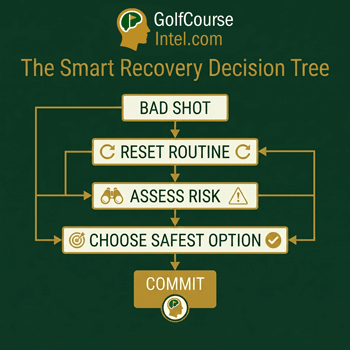
One bogey becomes a double when the next decision is driven by frustration.
A pulled drive into the rough rarely calls for a recovery attempt over trees – it calls for a clear-eyed assessment of the safest path back to the fairway.
Building a simple reset routine – one breath, one new target, one decision – keeps a single bad shot from turning into a scorecard-damaging stretch.
Mistake #10: No Course-Specific Strategy
Walking onto a new course without any hole-by-hole context is a real scoring disadvantage. Knowing which side of a fairway opens up the best approach angle, where the hidden trouble is, and which greens demand a specific quadrant for your approach can save several strokes per round without changing your swing at all.
Golf Course Intel’s hole-by-hole strategy guides – including the complete post-round analysis featured in Battling Duke University Golf Course – show exactly how this kind of preparation translates into real scoring improvement. The personalized Elite Performance and Course Strategist guides build this blueprint for any course in the world, customized to your specific game.
Mistake #11: An Inconsistent Pre-Shot Routine
Research on amateur golfers shows a measurable link between pre-shot routine consistency and tighter shot dispersion. Golfers who follow the same routine – target selection, alignment, a specific trigger to begin – produce more consistent results than those who vary their approach from shot to shot.
Your routine doesn’t need to be elaborate. It needs to be repeatable: one clear look at the target, one practice motion if helpful, and a deliberate move into your stance before every swing.
💡 Birdie has posted an excellent article about this: Master Your Game: The Ultimate Golf Pre-Round, Pre-Shot, and Post-Round Routines
Mistake #12: Playing Clubs That Don’t Fit Your Swing
A shaft that’s too stiff for your swing speed costs you distance and feel. One that’s too flexible costs you accuracy and consistency. Loft and lie angles that don’t match your impact dynamics introduce errors that no amount of practice corrects. A single club-fitting session – even a basic one – identifies these mismatches and can produce immediate scoring results.
Golf Course Intel’s Fairway Fundamentals guide includes unbiased, data-driven club and ball recommendations tailored to your specific swing profile, without the sales pressure of a retail environment.
The Takeaway
Every one of these mistakes is correctable. The encouraging part is that most of them don’t require swing changes: they require smarter decisions, better data habits, and a clear plan built around how you actually play.
Ready to find your specific leaks? Golf Course Intel’s personalized strategy reports transform your shot-tracking data into a clear improvement roadmap. Explore the guides here →
If These Articles Help,
Running Golf Course Intel takes real time, real effort, and – yep – real golf balls. If you’ve enjoyed the guides, the strategy breakdowns, or the myth‑busting articles, hitting that Buy Us Golf Balls button is the easiest way to help keep the site online and the content flowing. Every donation, big or small, genuinely fuels the next round of smarter golf insights.
Thanks for helping us keep this thing rolling!
Related reading on Golf Course Intel:

- How to Choose the Right Golf Ball for Your Swing
- Never Blow Up At Your Public Golf Course Again!
- The Best Quail Hollow Golf Strategy For Amateurs
- How to Tame the Snake Pit With Your 18 Handicap
- Win Big With This Harbour Town Strategy
- The Ultimate Augusta National Strategy Guide