The Data Behind “Course Fit” and What to Do About It
You warmed up. Your swing felt great. But by the 4th hole, the wheels came off. Sound familiar? The culprit probably wasn’t your technique – it was your course fit.
Course fit in golf is the often-overlooked science of matching your specific game to the specific demands of the course in front of you. When the fit is off, no amount of talent or practice saves your scorecard. When the fit is right, you play smarter, shoot lower, and watch your handicap trend in the right direction.
Here’s the data-backed breakdown of every factor that goes into course fit, and exactly how each one can help or hurt you.
Tee Selection: The Single Biggest Fit Variable
Most golfers play the wrong tees. That’s not an insult, it’s a statistical reality. The USGA’s own data shows that amateur golfers routinely add 5 to 12 strokes per round simply by playing a distance that doesn’t match their driver distance.
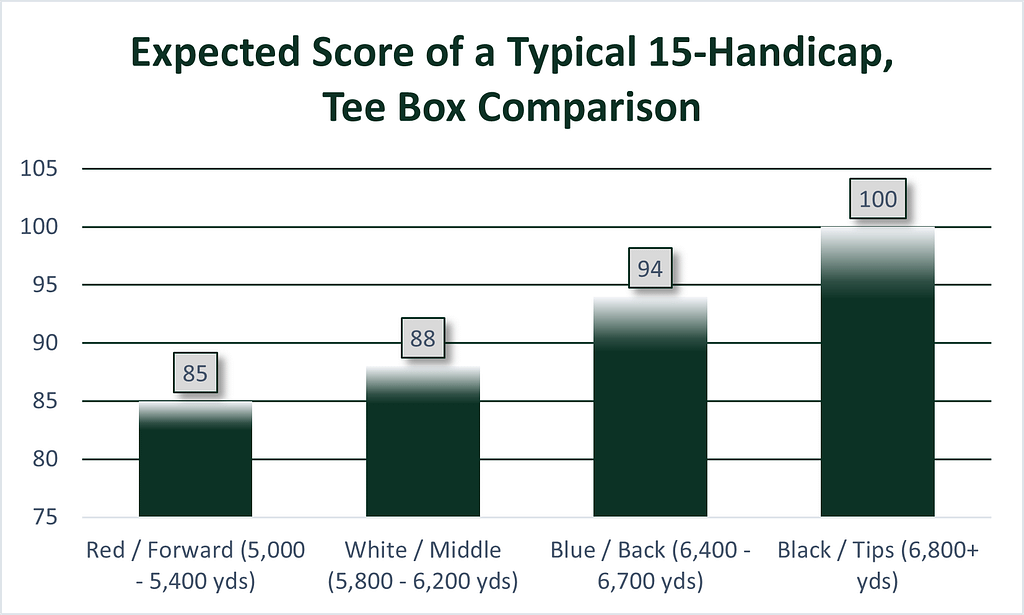
A quick rule of thumb: take your average driver distance and multiply it by 28. That’s roughly the total yardage that fits your game. If you average 220 yards off the tee, a course around 6,160 yards is your sweet spot.
Here’s why tee selection matters so much for course fit in golf:
- Scoring opportunities increase when approach shots come from manageable distances.
- Confidence stays high when par-4s feel reachable instead of heroic.
- Risk decreases because shorter courses have fewer forced carries over water and hazards.
- Handicap improves as your differential drops from better Course Rating alignment.
Want a deeper dive into the math? Check out Golf Course Intel’s tee selection guide for a full breakdown.
Course Slope and Rating: What Those Numbers Actually Mean
The Slope Rating and Course Rating stamped on your scorecard are more than bureaucratic numbers – they’re predictive tools for your round.
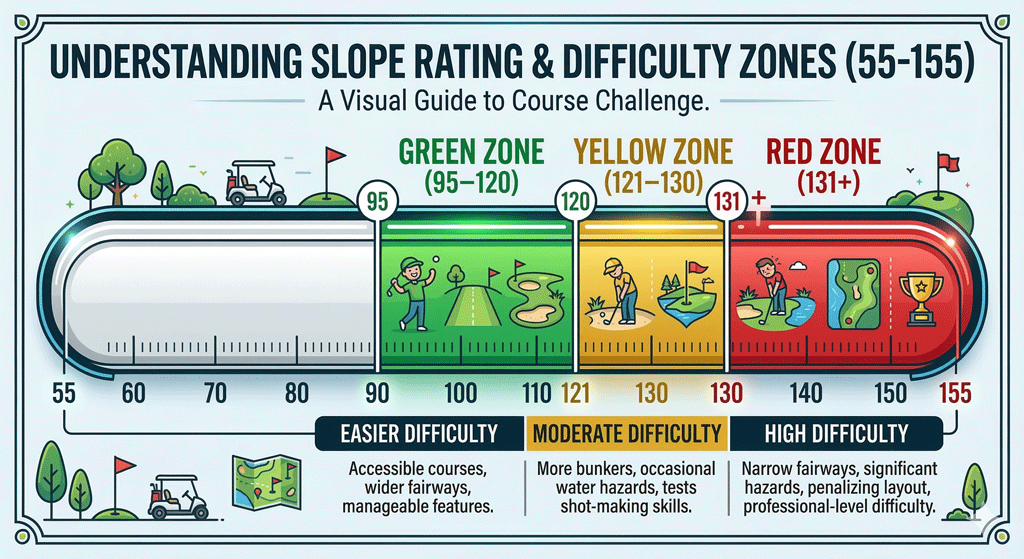
Course Rating reflects the expected score for a scratch golfer under normal playing conditions. Slope Rating (55–155, with 113 as “average difficulty”) measures how much harder the course gets for a bogey golfer compared to a scratch golfer. The higher the Slope, the more the course punishes inconsistency.
For course fit in golf, here’s what this means practically:
- High Slope (130+): Courses where errant shots carry severe consequences – forced layups become necessary, not optional.
- Low Slope (under 115): More forgiving layouts where bogey golfers can recover and score competitively.
- Handicap strokes: Your exact number of handicap strokes per round is calculated using Slope Rating – mismatching yourself to a high-Slope course inflates your score beyond what your index predicts.
- Stroke Index holes: Use the handicap hole rankings to decide where to take risks and where to play conservatively.
Course Type: Links, Parkland, Desert – One Size Does Not Fit All
The architecture of a course shapes what skills get rewarded and punished. Course fit in golf starts with honestly asking: does my game match this type of layout?
- Links courses (firm, fast, wind-exposed) reward low ball flights, bump-and-run creativity, and course management.
- Rewarded: players who shape shots and embrace ground game.
- Punished: high-ball hitters who can’t adjust.
- Parkland courses (tree-lined, soft fairways, elevated greens) favor high approach shots that hold the green.
- Rewarded: players with lofted irons and controlled distances.
- Punished: those who struggle with accuracy into greens.
- Desert or Mountain courses often feature dramatic forced carries, environmental hazards, and penalty areas that heavily penalize over-swinging.
- Rewarded: disciplined course managers.
- Punished: gamblers.
- Executive / Short courses are ideal for fit-testing your short game, offering the highest return per practice minute for mid-to-high handicappers.
Club Selection Per Shot: Data Over Ego
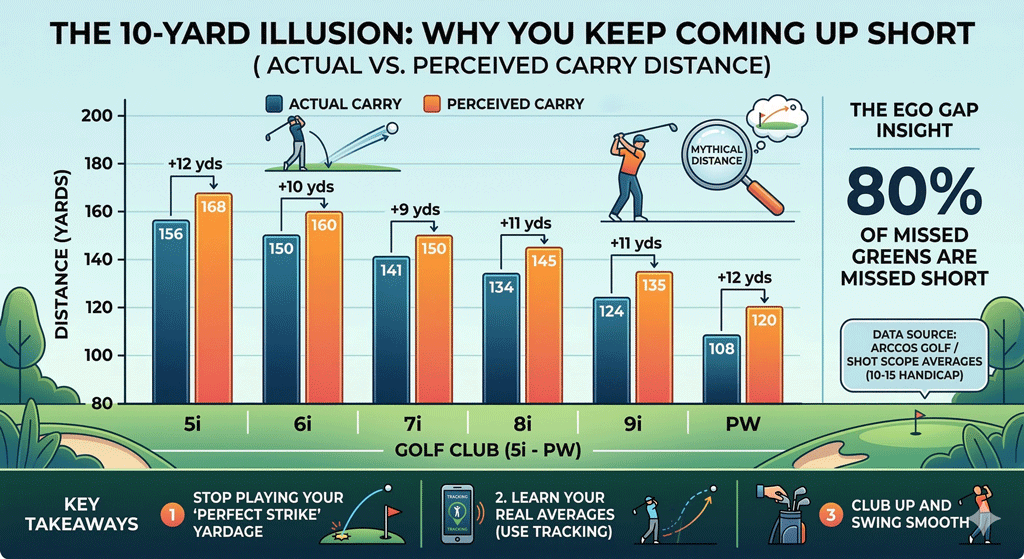
One of the most measurable improvements in course fit is simply using the right club. Studies from Arccos Golf and Shot Scope tracking data show that amateur golfers overestimate their carry distances by an average of 10–15%. That gap causes consistent misclubs – and misclubs cause unnecessary bogeys and doubles.
Course fit-friendly club selection habits:
- Know your real carry numbers, not your best-day numbers. Use a launch monitor or a GPS/rangefinder app like Garmin Approach or Bushnell.
- Add a gap wedge or utility iron to fill distance voids in your bag. A gap in your set is a gap in your course fit.
- Try a hybrid instead of a long iron on courses with tight fairways – launch angle and forgiveness give you more realistic scoring opportunities.
- Use club selection data from previous rounds to identify your true ‘go-to’ distances. Determine where you’re most accurate, not most powerful.
For help building the right set for your game, see our Golf Course Intel club fitting framework. Also consider the Garmin Approach R10 Launch Monitor for at-home data collection.
Golf Ball Selection: Your Unsung Course Fit Variable

Golf balls aren’t one-size-fits-all. The compression, cover material, and spin profile of your ball either match your swing speed and course conditions or they don’t.
- Low swing speed (under 85 mph): Low-compression balls like the Callaway Supersoft deliver more distance and a softer feel, improving shot-stopping ability on short shots.
- Mid swing speed (85–100 mph): Mid-compression balls like the Titleist Tour Soft or Srixon Q-Star Tour offer a balance of distance and greenside spin.
- High swing speed (100+ mph): Premium urethane balls like the Titleist Pro V1 or TaylorMade TP5 reward fast swingers with maximum short-game control and workability.
- Firm, fast courses (links-style): A harder-cover ball rolls out more predictably on bump-and-runs.
- Soft, parkland courses: High-spin urethane balls grip greens and hold approach shots close to the flag.
Not sure which ball suits your game? Golf Course Intel’s golf ball selection guide walks you through the decision in minutes.
Recovery From Errors: Fit Means Planning Your Misses
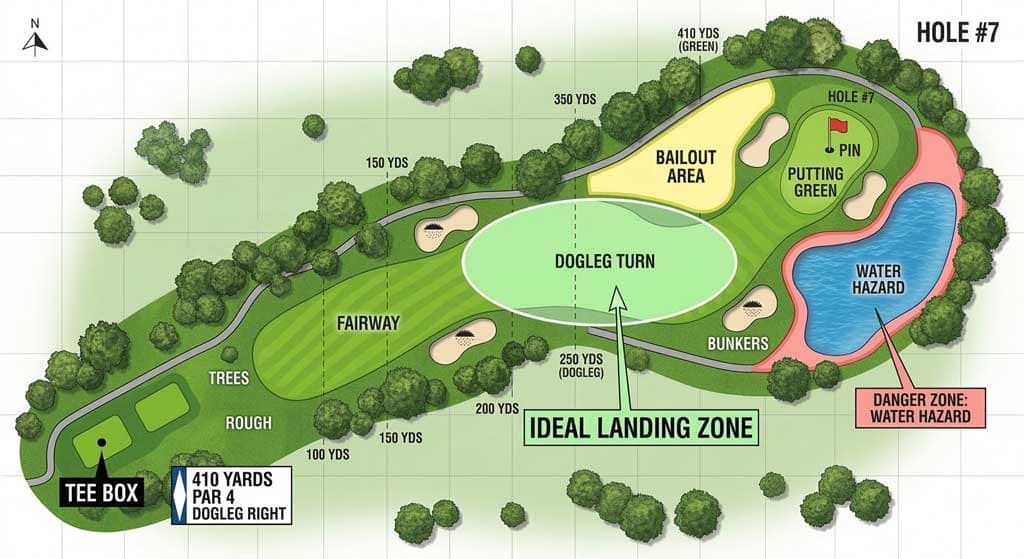
Every golfer misses shots. Course fit in golf is about making sure your misses cost you one stroke, not three. Pre-round preparation means identifying the safe miss zones on every hole and committing to them before you ever step onto the tee box.
- Identify bailout zones: wide areas that leave a straightforward pitch or chip, rather than a penalty drop.
- Study the short side vs. fat side: missing the green on the short side of a pin almost always means a tougher up-and-down than missing long or wide.
- Accept the bogey train: a disciplined bogey is worth more to your handicap than a heroic double-or-birdie gamble that goes wrong.
- Use a layup strategy on high-risk par-5s: leaving 80–100 yards (your most practiced wedge distance) consistently outperforms risky 3-wood approaches to tight greens.
Time of Day and Season: Environmental Course Fit
The same course plays completely differently depending on when you tee off. Ignoring environmental course fit is leaving easy strokes on the table.
- Morning rounds (dew factor): Wet greens are slower and hold better – favor more aggressive approach angles. Fairways are softer, reducing roll-out off the tee.
- Afternoon rounds (wind and firmness): Greens firm up and get faster. Ball runs out more on fairways. Club up on approaches and aim for the fat part of greens.
- Winter play: Cold air reduces ball compression and carry distance by 5–10 yards per club. Factor in at least one additional club on every approach shot.
- Summer heat: Firm fairways produce extra roll. This can help weaker drivers but creates tricky distance control on wedge shots.
- Wind management: Play into the wind with a half-swing using more club. Downwind, use less club and accept the run-out. Crosswind: factor the full distance adjustment, not just a half measure.
Green Reading and Putting Surface Fit
Greens are where strokes go to disappear. Course fit means understanding the putting surfaces before you play them, not figuring them out on hole 14.
- Grain direction: Bermuda greens (common in warm climates) have strong grain that affects break significantly. Bent grass greens (cooler climates) are truer and faster.
- Green speed (Stimpmeter): Most public courses run at 9–10.5. Private and tournament greens can reach 13+. Arriving 20 minutes early to putt on the practice green is the best course fit investment you can make.
- Elevation in putts: Uphill putts can be played more aggressively (dying ball still falls in). Downhill putts require a feather touch and speed control becomes more important than line.
Mental Fit: Course Personality vs. Your Personality

There is such a thing as a course that psychologically doesn’t fit your game. Some players freeze on narrow tree-lined courses. Others crumble when water comes into play on consecutive holes. Recognizing this is a legitimate data point.
- If water intimidates you: Develop a pre-shot routine that focuses on your target line, not the hazard. Use a tee box alignment strategy to aim to the safe side automatically.
- If bunkers derail your confidence: Practice sand shots before the round or deliberately carry one less hybrid to stay short of bunker carry distances.
- If elevation change messes with distance perception: Use a rangefinder with slope adjustment enabled (legal for recreational play). If you’re serious about it, consider the Bushnell Pro XE – one of the top-rated slope-adjusting rangefinders available.
Walking vs. Riding: Fatigue as a Course Fit Factor
Physical fatigue is an underrated destroyer of course fit. A 7,000-yard walk over hilly terrain affects swing mechanics by the back nine in ways that flat rides simply don’t.
- If you’re walking: Budget one extra club by holes 14–18. Fatigue reduces swing speed and ball speed measurably.
- If you’re riding: Quick cart rides between shots can disrupt your pre-shot routine. Build in consistent pre-shot trigger points to maintain rhythm.
- Stretching mid-round: A 90-second hip flexor and shoulder stretch at the turn is one of the highest-ROI habits in golf. It restores range of motion lost in the first nine holes.
The Course Fit Scorecard Impact – Summary
- ✅ Correct tee selection: Save 3–8 strokes per round
- ✅ Ball matching your swing speed: Save 1–3 strokes per round
- ✅ Accurate club distance data: Save 2–4 strokes per round
- ✅ Smart error recovery strategy: Save 2–5 strokes per round
- ✅ Environmental adjustments (wind, temp, time): Save 1–3 strokes per round
- ✅ Green speed and putting surface prep: Save 1–3 strokes per round
- Combined realistic improvement: 10–26 strokes per round – without changing your swing.
If These Articles Help,
Running Golf Course Intel takes real time, real effort, and – yep – real golf balls. If you’ve enjoyed the guides, the strategy breakdowns, or the myth‑busting articles, hitting that Buy Us Golf Balls button is the easiest way to help keep the site online and the content flowing. Every donation, big or small, genuinely fuels the next round of smarter golf insights.
Thanks for helping us keep this thing rolling!
Get Your Personalized Golf Course Intel Strategy Guide

Ready to stop leaving strokes on the course? We’ll put together a personalized Golf Course Intel Strategy Guide built specifically around your game, your swing, and the courses you play.
Here’s exactly what you’ll get:
- Personalized drills and stretches matched to your specific swing tendencies, fitness level, and the physical demands of your home course.
- The perfect golf ball recommendation based on your swing speed, ball flight, and scoring patterns – no more guessing at the rack.
- Custom club selection advice that fills the gaps in your bag and eliminates the misclubs costing you the most strokes.
- A course management framework you can apply to any course you play – a repeatable pre-round routine that locks in your course fit before you tee off.
Golf Course Owners and Managers:
Give your patrons a competitive edge at their favorite local track! Request a bespoke, highly detailed guide for your course to share in your pro shop or online, with members, guests, and the public.
Contact us for a quote: