The Putting Paradox: Why Golfers Trust It Most and Practice It Least
Picture this scenario: You’re standing on the 18th hole with your regular weekend group, the match is tied, and you have to execute one perfect shot to secure the victory and earn bragging rights. I start sweating just thinking about it.
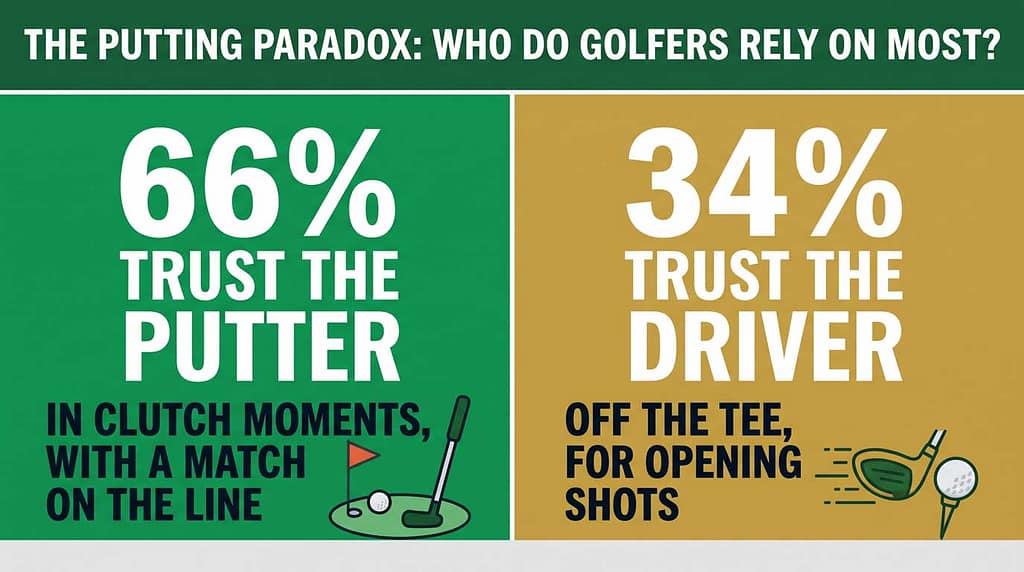
According to recent surveys, 66% of golfers would prefer to have their putter in their hands over their driver in this high-pressure moment. Players inherently rely on their short game when everything is on the line.
Oddly enough, though, when those same players are asked to rank their biggest weaknesses on the course, putting ranks a distant fifth. Only 9% of amateurs believe their time on the greens is holding them back. These fascinating golf putting statistics reveal a massive gap between what we rely on to score and what we actually think needs improvement. Something clearly doesn’t add up.
Unpacking the Practice-Time Disconnect
Take a stroll down any local practice facility. You will hear the rhythmic, booming sounds of titanium striking urethane. The overwhelming majority of golfers dedicate their entire bucket of balls to the driver and full-swing iron shots. We all want to be the person on the range turning heads with a towering drive.
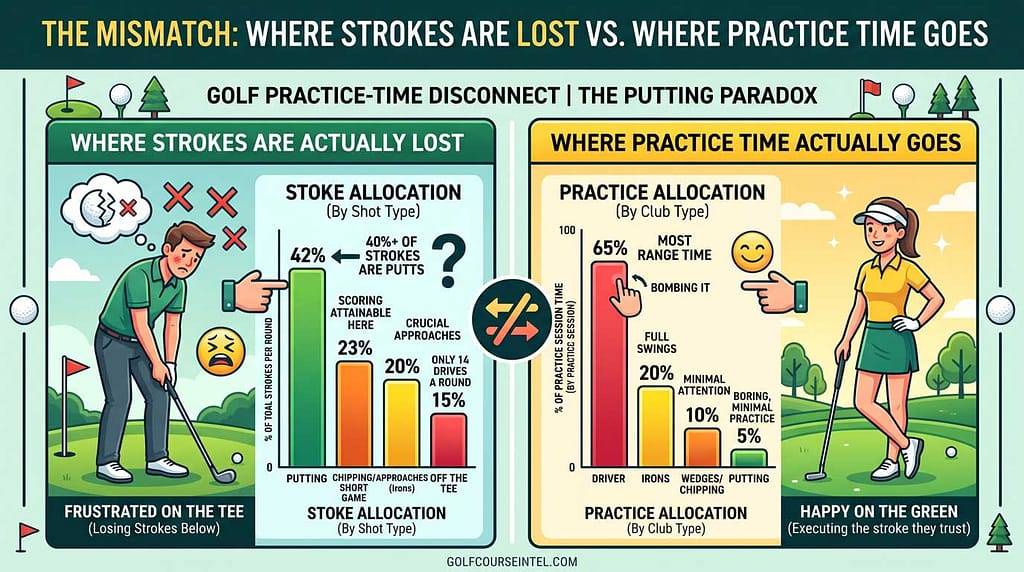
Data analytics paint a completely different picture of where scores actually happen. A large share of strokes occur inside 100 yards. Roughly 40% of all swings in an average round are putts. If a player shoots a 90, they likely took 36 or more strokes with a single club – their putter. The math is incredibly straightforward.
Yet, looking at how people spend their range time, the allocation is heavily skewed toward the longest clubs in the bag. We dedicate hours to perfecting a tee shot we might hit 14 times a round, completely ignoring the flatstick we lean on constantly. That irony is thicker than U.S. Open rough.
Why We Gravitate Toward the Long Ball

This behavior makes complete sense from a psychological perspective: Driving range culture rewards power. Stepping up to the mat and launching a drive 250 yards into the horizon delivers an immediate rush of dopamine. You see the ball fly, you watch it land, and you get instant, satisfying feedback.
Putting practice offers a much quieter experience. Rolling a small ball ten feet across a flat surface lacks the visual explosion of a well-struck drive. Spending an hour on the practice green requires patience, focus, and a willingness to embrace repetitive, subtle movements. The feedback loop is entirely different. A missed putt by an inch feels frustrating, whereas a drive that misses the fairway by ten yards still feels like a decent rip.
We naturally gravitate toward the activities that provide the highest immediate satisfaction. Smashing a driver feels like a workout. Rolling putts occasionally feels like watching paint dry.
Building a Rebalanced Practice Framework
To unlock better scores, we simply need to align our training with our actual on-course realities. A great approach is adopting a 70/30 practice split, heavily weighting your time toward the short game.
Imagine you have two hours to practice this week. Try dividing that time to reflect the actual scoring probabilities:
- Warm-Up (15 Minutes): Loosen your muscles with a few wedges and mid-irons to establish a smooth rhythm.
- The Scoring Zone (45 Minutes): Head directly to the practice green. Focus on lag putting from 30 feet to improve your speed control. Shift your attention to sinking three-footers to build unwavering confidence for those crucial par saves.
- Short Game Touch (30 Minutes): Practice chipping from various lies around the fringe. Give yourself different angles and slopes to simulate real-course conditions.
- Full Swing (30 Minutes): Finish your session by hitting targeted drives and approach shots, imagining specific holes you frequently play.
This routine ensures you dedicate your energy to the areas that truly dictate your scorecard.
The Self-Awareness Gap

Golfers possess great instincts. The initial 66% trust stat shows that players already know the putter matters most when the pressure is on. We inherently understand the value of a reliable stroke on the green.
The challenge lies purely in self-awareness and discipline. Acknowledging your reliance on the short game is the first step toward shooting lower scores. When you align your practice schedule with the clubs you actually trust to win a match, you will see immediate improvements in your handicap. Practicing what you already believe matters is the true unlock for better golf.
Take Your Strategy to the Next Level
Optimizing your practice time is just one piece of the puzzle. To truly maximize your potential on the course, you need a comprehensive plan. We highly recommend checking out the insights in our purposeful practice guide to structure your sessions perfectly.
For those looking to completely revamp their on-course decision-making, the team at GolfCourseIntel.com offers incredible resources:
- The comprehensive “Ultimate Beginner Golf Strategy: Think Your Way to Better Golf” guide provides fantastic frameworks for choosing the right clubs and managing risk. We specifically break down how to approach different yardages and why you should base your club selection on your average hit, saving you strokes immediately.
- Players heading to North Carolina will also benefit from detailed breakdowns like our “Hillandale Golf Course Strategy Made Simple,” which outlines how elevation changes and penalty avoidance dictate your final score.
By trusting the data and putting in the right kind of work, you will turn that 66% trust into 100% confidence on the greens!
If These Articles Help,
Running Golf Course Intel takes real time, real effort, and – yep – real golf balls. If you’ve enjoyed the guides, the strategy breakdowns, or the myth‑busting articles, hitting that Buy Us Golf Balls button is the easiest way to help keep the site online and the content flowing. Every donation, big or small, genuinely fuels the next round of smarter golf insights.
Thanks for helping us keep this thing rolling!






0 Comments