
Master the Golf Shot Selection Matrix
Or How the Eisenhower Matrix Helped Fix My Scorecard
Golfers regularly step up to their ball, grab their favorite club, and swing with the timeless “hit-and-hope” mindset. But applying a structured decision-making process yields vastly superior results on the scorecard.
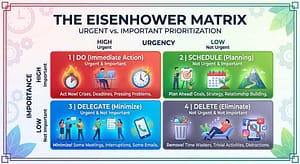
Drawing from my career in Lean Six Sigma and operations management, I developed a simple framework to optimize course strategy. A great tool I use is the Eisenhower decision matrix, a highly effective four-quadrant grid that categorizes tasks by their urgency and importance to successfully streamline daily workflows.
Taking that same logical approach to the fairways, I developed a practical framework to optimize course strategy. Much like that famous productivity model brings clarity to complex office projects, using a shot selection matrix helps players of all ages and abilities lower their scores by objectively evaluating the reality of every situation before making a swing.
As a golfer playing mostly around North Carolina, I spent years trying to lower my 20-some handicap. My bag is dialed in with incredibly forgiving gear. The swing mechanics I rely on were generally stable. Reviewing my data from a recent round at Duke University Golf Club revealed a massive opportunity for improvement. Embracing high-percentage layups and strategic targets completely transformed my scoring average.
Navigating Course Hazards
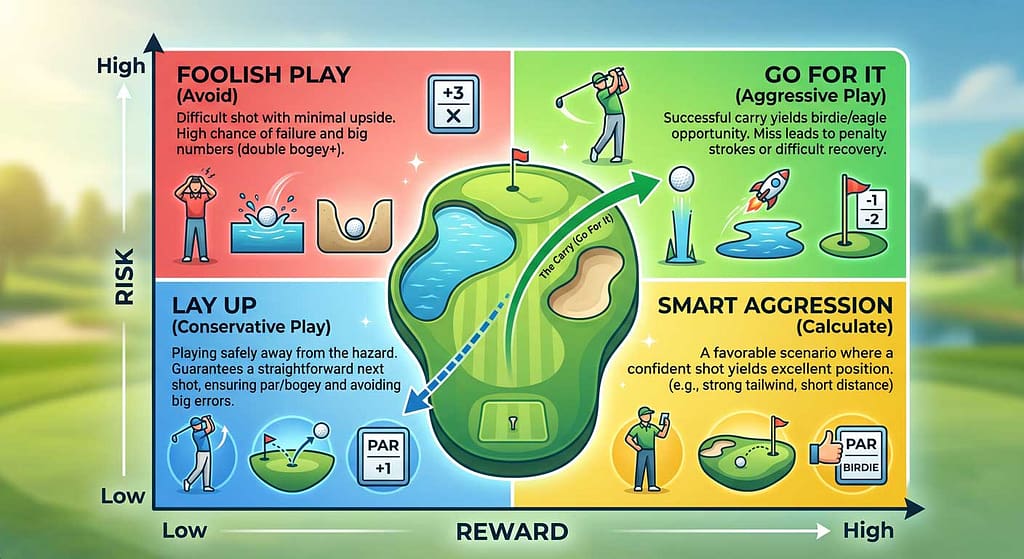
Here’s an example of the Eisenhower Decision Matrix adapted to your golf game – the original Importance & Urgency headings have simply been altered to Risk & Reward.
Water features and deep bunkers require cold, calculated math to navigate successfully. Your decision must account for the required carry distance and your historical success rate with the chosen club.
Selecting a conservative layup area yields a better average score on heavily guarded greens. Taking the hazard completely out of play ensures you avoid agonizing penalty strokes. Playing safely away from trouble keeps your momentum rolling smoothly through the round.
Evaluating the Fairway Lie

A clean lie in the short grass provides maximum control and predictability. You can confidently target the green with an optimal launch angle and consistent spin rate.
Assess the turf firmness, local slope, and prevailing wind direction to calculate the true yardage:
- Hitting off a tight lie favors sweeping the ball with a fairway wood.
- A slightly fluffy lie encourages an aggressive, descending iron strike.
- Standing on a flat surface yields your standard, stock distances.
- Uphill or downhill slopes require clubbing up or down to compensate for altered trajectories.
Reading the fairway correctly guarantees you maximize the advantage of a great drive.
Managing the Rough Lie

Thick grass drastically alters ball flight and rollout. The long blades wrap around the hosel, shutting the clubface and reducing crucial backspin. Your ball will typically launch lower and roll out significantly farther upon landing.
Assess exactly how deep the ball sits in the grass to determine your play:
- A ball resting on top of the rough plays remarkably similar to a standard fairway lie.
- Deeply buried lies demand a steep angle of attack with a highly lofted club to guarantee a clean exit.
- Grabbing a wedge to pitch safely into the short grass ensures you maintain forward progress toward the hole.
We discussed managing thick turf in our Your TPC Sawgrass Stadium Course Survival Guide, where taking your medicine guarantees you avoid massive blow-up numbers.
Optimizing Your Playing Angles
Course management relies heavily on planning one full shot ahead of your current position.
Approach the current situation by identifying the absolute best location for your next swing. Leaving yourself a full wedge shot from the center of the fairway produces spectacular results on tight par-fours. Hitting to the fat side of the green maximizes your margin of error and creates stress-free two-putts.
Avoiding Critical OB Areas
Out-of-bounds stakes ruin scorecards faster than any other course obstacle. The stroke-and-distance penalty represents the most severe punishment in the game.
Aiming well away from white stakes remains the highest priority on any challenging tee box. Choose a club that physically cannot reach the OB line if you accidentally pull or push the ball. Hitting a reliable hybrid off the tee keeps the ball in play when the landing zone narrows considerably.
Factoring in Your Skill Level
Honesty serves as the absolute foundation of elite golf strategy!
Your club distances must be based on average strikes, factoring in your typical miss and natural ball flight. A mid-handicapper aiming for the center of every single green yields a high volume of easy pars and bogeys.
Knowing your typical shot shape allows you to aim confidently down the correct side of the fairway. Playing to your actual strengths guarantees a more enjoyable and relaxed journey around the links.
Letting Data Drive Decisions

Tracking your rounds provides objective, undeniable feedback on your true performance. Apps like Arccos and Golf Pad GPS log every single swing, revealing your accurate yardages and identifying your most common tendencies.
Taking the time to analyze this data highlights exactly where you gain strokes against the course.
My stats clearly showed my old wedge setup was leaving me consistently short on approach shots. Reviewing those numbers led me to confidently dial in my 50-degree approach wedge for perfect distance gapping. Use your data to shape your strategy and ensure completely objective club selection.
Adapting to Course Conditions
Weather and turf conditions dictate how the course plays on any given day. Firm, fast fairways provide extra rollout, while wet conditions demand longer airborne carry distances. Wind direction shifts your target line and alters club selection by several full increments.
Reading the environment allows you to adjust your baseline yardages accurately and confidently.
Wrapping Up the Matrix
Implementing a structured matrix approach to every swing completely changes your relationship with the sport.
Evaluating the lie, hazards, and your personal data ensures you make high-percentage choices consistently. Every golfer will improve their course management by committing to a systematic, repeatable routine. Lowering your scores becomes a natural byproduct of making intelligent, analytical decisions on the turf!
If These Articles Help,
Running Golf Course Intel takes real time, real effort, and – yep – real golf balls. If you’ve enjoyed the guides, the strategy breakdowns, or the myth‑busting articles, hitting that Buy Us Golf Balls button is the easiest way to help keep the site online and the content flowing. Every donation, big or small, genuinely fuels the next round of smarter golf insights.
Thanks for helping us keep this thing rolling!