
Practice With Purpose: Golf Drills That Actually Work
Every driving range around the world sounds the same: the steady thwack of golfers grinding through bucket after bucket of balls.

Most of that noise doesn’t turn into lower scores.
Hitting shots without a target, a goal, or a way to measure progress is just exercise. Real improvement comes from practicing with purpose, and that means every swing you take should teach you something.
But you don’t need more time at the range. You need a better plan for the time you already spend there.
Here’s how to build one, club by club.
Start with a Baseline, Not a Guess
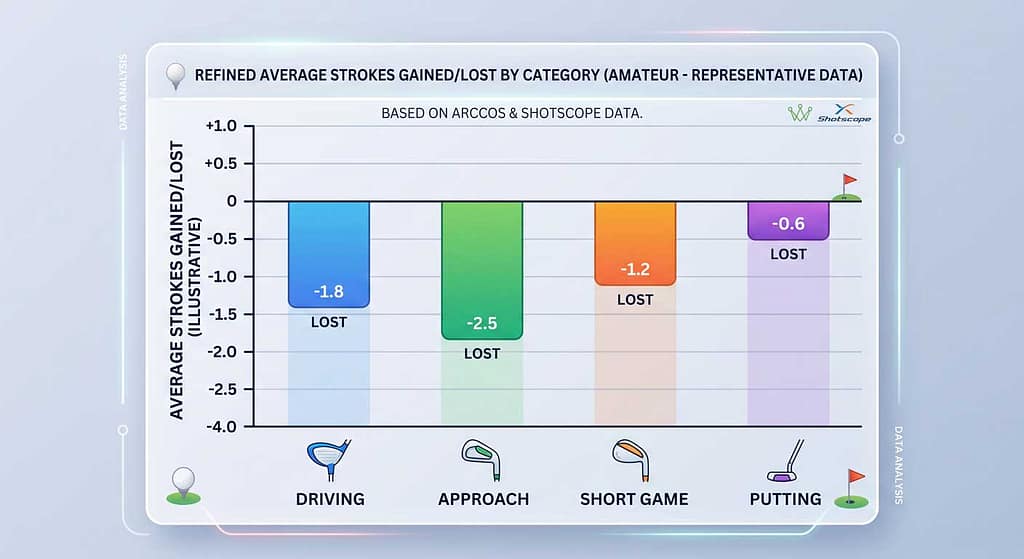
Before picking a single drill, know where your strokes are actually going.
Tracking your rounds, even with a simple notebook, reveals whether your driver, irons, wedges, or putter are costing you the most shots. Our guide on Strokes Gained analytics breaks down how to measure this properly, so you’re training the parts of your game with the biggest payoff instead of the ones that feel good to practice.
Driving Drills That Build Real Confidence
Off the tee, accuracy matters more than raw distance for most amateurs.
Try the Gate Drill: set two alignment sticks just wider than your clubhead a few feet in front of the ball, forming a gate your swing path needs to travel through. This trains a repeatable path and builds confidence for tight fairways.
Add the Fairway Finder Game: Create a simple fairway corridor on the range using two distant targets. Pick a specific tall tree on the left side and a maybe a bright yardage sign on the right. Hit ten consecutive drives and give yourself a point for every successful drive that lands inside your imaginary boundaries. Track your score over time and try to beat it each session.
Iron Drills for Consistent Contact
Ball-striking consistency starts with low-point control.
The Towel Drill works well here: place a small towel a few inches behind the ball. Hitting the towel on your downswing signals you’re bottoming out too early, a common cause of thin and fat shots.
Pair this with a Distance Ladder: hit five balls with the same iron to three different targets at increasing distances, focusing on solid contact over swinging harder.
Wedge Drills to Tighten Your Scoring Zone
Scrambling and approach precision inside 100 yards separate good rounds from great ones.
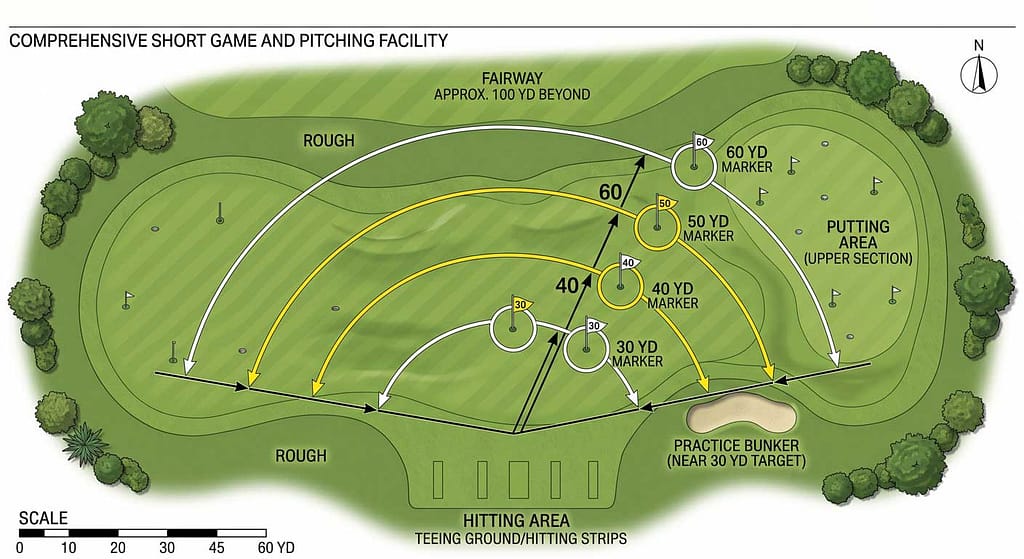
The Ladder Drill, featured in our How To Play Bethpage Black, Hole by Hole, Shot by Shot post, has you hitting wedge shots to targets set at 10-yard increments (30, 40, 50, 60 yards). This eliminates the frustrating pattern of hitting a shot short, then overcorrecting long on the next one.
The classic Up and Down Challenge works perfectly for short-game sessions. Drop five golf balls in varying lies around the practice green. Chip each one smoothly toward the pin and putt out. Track your conversion rate over time as you improve your technique. Short game creativity blossoms beautifully when you practice from the rough, the fringe, and tight fairway lies alike.
Putting Drills for Fewer Three-Putts
Putting eats up more strokes than most golfers realize.
The Gate Drill applies here too: place two tees just wider than your putter head at the start line of a putt, and roll balls through the gate to groove a square strike.
Combine this with the Clock Drill, placing balls at 3, 5, and 7 feet around a hole to build pressure-tested confidence from short range.
Try the Fringe Drill to refine your lag feel and touch today: Putt several balls toward the edge of the green from 20, 30, and 40 feet away. Your primary goal is having the ball stop as close to the fringe cut as possible without rolling off the putting surface
Simulating Course Conditions
Hitting off perfectly flat range mats feels fantastic and helps groove your mechanics. But real golf courses naturally present uneven lies and constantly shifting winds. Bringing course-like scenarios to the practice facility builds tremendous resilience and adaptability.
Play a mental nine holes while standing on the driving range.
Go through your complete pre-shot routine for every single swing to stay entirely focused. Switch clubs constantly just like you would during an actual round.
Planning your strategy hole-by-hole keeps your mind highly engaged and completely ready for action.
Equipment and Tracking Matter Too

Purposeful practice extends beyond drills. Playing the right golf ball for your swing speed changes how a well-struck shot performs, and our guide on choosing the right golf ball walks through matching compression and spin to your game.
A player like Hannah, who carries a ~24 handicap, benefits enormously from looking directly at her miss tendencies. Recognizing a consistent miss to the right helps her dedicate her next range trip specifically to better clubface control.
Tracking your rounds helps confirm your practice is paying off; our guide for high-handicap golfers shows which stats matter most and how to benchmark your own progress.
Commit to the Process
Purposeful practice doesn’t require hours of extra time. Set one specific goal per session, track a simple metric, and finish knowing exactly what improved. Small, measured sessions compound into real progress on the course, and that’s how a practice habit turns into a lower handicap.
Consistent, targeted effort builds a beautiful swing you can trust completely under pressure.
Head out there, execute your plan, and enjoy the journey to better golf.
If These Articles Help,
Running Golf Course Intel takes real time, real effort, and – yep – real golf balls. If you’ve enjoyed the guides, the strategy breakdowns, or the myth‑busting articles, hitting that Buy Us Golf Balls button is the easiest way to help keep the site online and the content flowing. Every donation, big or small, genuinely fuels the next round of smarter golf insights.
Thanks for helping us keep this thing rolling!