
Ready to Conquer Shinnecock Hills?
Playing a historic venue like Shinnecock Hills Golf Club – the club hosting the 126th U.S. Open on June 18–21, 2026 – offers an unforgettable experience.
Golfers worldwide dream of walking the majestic, wind-swept fairways in Southampton.
Our mission at Golf Course Intel is to take complex data and transform it into a clear, actionable roadmap for lower scores. A well-planned approach makes tackling world-class architecture like Shinnecock incredibly rewarding, helping you play with more confidence and purpose.
Golfers who love mastering challenging layouts should also explore our guides created for the Belfry, Bethpage Black, Quail Hollow, Harbour Town, and Augusta National for additional strategic inspiration.
Read on for our latest addition to this growing list: How to Conquer Shinnecock Hills!
Selecting the Optimal Starting Point
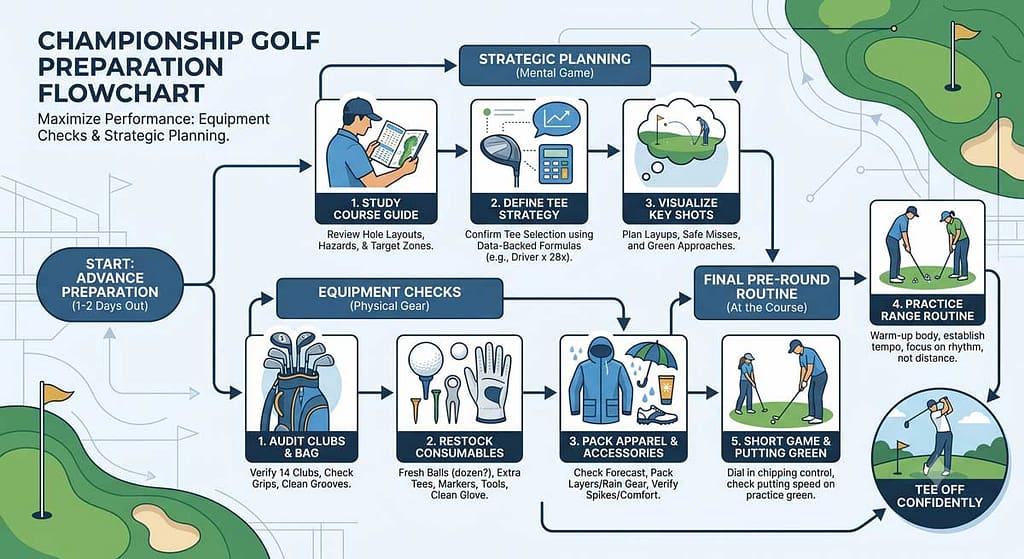
Every golfer deserves to play a distance that highlights their unique strengths, and choosing the correct tee box sets a positive tone for your entire day. To choose the right distance for your game, taking your average driver distance multiplied by twenty-eight provides an incredibly accurate yardage recommendation.
Applying this mathematical formula ensures you have manageable approach shots into the highly elevated greens at Shinnecock. Data shows the average driver distance for male amateur golfers is around 215 yards, while female golfers average 170 yards.
- Low-handicap men averaging ~250 yards off the tee will find the Red Tees at 6,940 yards perfect for their game.
- Mid-handicap males driving ~225 yards should opt for the Blue Tees at 6,136 yards.
- Higher-handicap players hitting ~185 yards should try the White Tees at an accessible 5,396 yards.
Female golfers also benefit immensely from this tailored approach.
- Skilled women driving ~210 yards match up beautifully with the Blue/White Tees at 5,613 yards.
- Average and developing female players can confidently play the White Tees to maximize their round.
Setting yourself up for success is a foundational element of strategic play.
For more insights on course fit and design, check out our piece on Course Fit: Why Some Courses Destroy You.
Choosing the Right Golf Ball

Coastal winds define the strategic challenge on the eastern edge of Long Island. A low-spin golf ball helps penetrate the stiff maritime breezes effortlessly. Piercing the wind keeps your drives securely in the short grass.
Greenside control remains equally vital on these firm, fescue-based putting surfaces. Selecting a premium urethane-covered ball provides the necessary friction to stop approach shots quickly.
Playing with customized golf ball and golf club recommendations suited for your specific swing speed makes holding the greens much easier.
Evaluating your bag frequently leads to noticeably lower scores. Proper gear elevates your confidence on every single swing.
For more info on choosing the proper golf ball for your game, check out How to Choose The Right Golf Ball For Your Swing.
Understanding the Fescue Impact
The native grasses framing every hole provide a stunning visual contrast against the blue sky, but hitting into the thick fescue requires a specific recovery technique to avoid compounding errors.
Taking a highly lofted wedge and chopping aggressively down on the ball ensures a safe exit. Leaving your pride in the bag and pitching out sideways often saves multiple strokes. Lush golden grasses look amazing in photographs but demand total respect during actual play.
The Importance of Pre-Round Warmups
Arriving early gives you the perfect opportunity to acclimate to the daily course conditions.
- Spending dedicated time on the practice green calibrates your hands for the lightning-fast putting speeds.
- Chipping from the closely mown collection areas helps you grasp the firm turf interaction.
- Hitting a few low-flighted iron shots on the driving range prepares your body for the coastal breezes.
- Building specific pre-round and pre-shot routines calms the nerves before stepping onto the historic first tee.
General Course Strategies
William Flynn crafted this layout to test trajectory control and spatial awareness, and local Shinnecock Nation stewards have maintained the land lovingly for decades:
- Widened fairways offer generous landing areas that hide a brilliant “delayed penalty” concept.
- Hitting the short grass represents only the first step in solving the architectural puzzle. Securing the proper angle of approach matters immensely.
- Utilizing the ground game allows you to run the ball safely onto open greens. Keeping your shots below the hole prevents treacherous downhill putts on severely pitched surfaces.
Mastering these fundamentals creates a massive difference in your final tally.
Hole Highlights for Low-Handicap Golfers

Scratch players face a thrilling decision on the demanding par-4 tenth hole, affectionately known as “Eastward Ho”.
- Elite men and women can bomb a driver over the massive ridge into the valley for a short wedge approach.
- Laying back with a fairway wood guarantees a flat lie while leaving a challenging downhill mid-iron into a shallow saddle green.
- Executing the aggressive line rewards skilled players with a prime birdie opportunity.
On the par-5 sixteenth, power hitters must precisely navigate the S-curve fairway. Securing the right-side approach angle is absolutely critical to avoiding the deep cross-bunkers.
Hole Highlights for Mid-Handicap Golfers

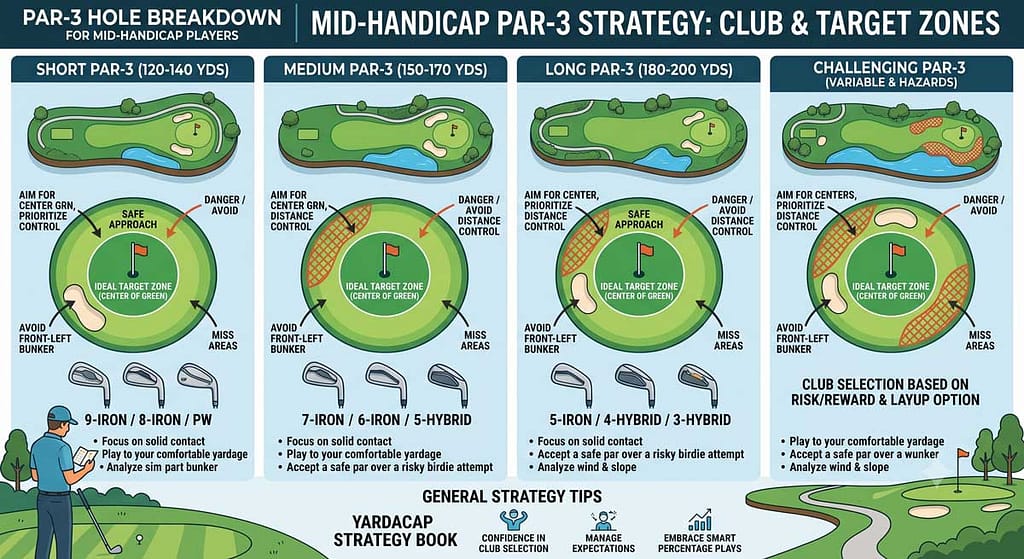
Average players must embrace the terrain on the legendary par-3 seventh hole.
- Aiming directly at the flagstick invites danger from the cavernous front-left bunker. Targeting the front-right collar allows the natural slope to feed the ball beautifully toward the hole.
- Trusting the ground contours yields excellent results for mid-handicap golfers.
The fourteenth hole offers another great scoring chance. Driving the ball down the right-side dune ridge fights the natural leftward cant of the fairway. A well-placed tee shot leaves an uphill iron into a forgiving, saucer-shaped green.
Hole Highlights for High-Handicap Golfers
Navigating the hardest hole on the property (the par-4 sixth) requires immense patience:
- The water hazard on the right side of the sixth hole terrifies players attempting long approaches.
- Driving safely to the visible left fairway sets up a smart lay-up shot.
- Playing this par-4 as a three-shot hole completely removes the pond from contention. Walking away with a bogey feels like a major victory here.
Similarly, the second hole demands a highly conservative game plan. Landing the ball well short of the heavily guarded putting surface keeps you safely out of the deep sand traps.
Get Your Complete Course Strategist Guide for Shinnecock Hills
To take your preparation to the highest level, download our complete Course Strategist guide for Shinnecock Hills!
Mastering the Final Stretch
Completing a round at this championship venue demands mental fortitude!
The closing hole features a dramatic amphitheater setting directly below the iconic clubhouse. Keeping your approach shot below the hole on the eighteenth green is absolutely essential. Putts rolling from above the cup gather tremendous speed.
Fans will undoubtedly witness spectacular finishes here during the 2026 championship. Standing in the exact spot where legends have triumphed adds a special magic to your day. Securing a two-putt par provides an incredible feeling of accomplishment!
This historic venue rewards preparation, patience, and smart decision-making. Applying these data-driven strategies will elevate your performance from the first tee box to the final putt.
If These Articles Help,
Running Golf Course Intel takes real time, real effort, and – yep – real golf balls. If you’ve enjoyed the guides, the strategy breakdowns, or the myth‑busting articles, hitting that Buy Us Golf Balls button is the easiest way to help keep the site online and the content flowing. Every donation, big or small, genuinely fuels the next round of smarter golf insights.
Thanks for helping us keep this thing rolling!
Be sure to book a tee time to secure your complete Elite Performance guide.
This personalized report elevates your on-course decision-making by transforming your raw golf data into a clear, actionable roadmap. You will receive a tailored, hole-by-hole, shot-by-shot plan designed specifically for your unique game.
The Elite Performance package also includes the Fairway Fundamentals MAX report, providing you with customized drills, warm-ups, and unbiased equipment recommendations. Securing this comprehensive guide ensures you arrive at the first tee fully prepared to play your smartest golf.
Your best golf is waiting, and it’s powered by intelligence. Embrace the challenge and enjoy the beautiful journey!

Golf Course Owners and Managers:
Give your patrons a competitive edge at their favorite local track! Request a bespoke, highly detailed guide for your course to share in your pro shop or online, with members, guests, and the public.