
Female Golf Analytics: The Real Numbers to Boost Your Game
For many female golfers, stepping onto the tee box brings a mix of excitement and anticipation. Golf gives us a wonderful chance to enjoy the outdoors while testing our athletic skills.
But many players often wonder how their yardages compare to others enjoying the links. We now have access to amazing tracking tools that reveal exactly what happens during a typical round – sensors tucked inside club grips provide a massive treasure trove of information regarding female golf distances.
Female Golfer Driver Distances by Handicap
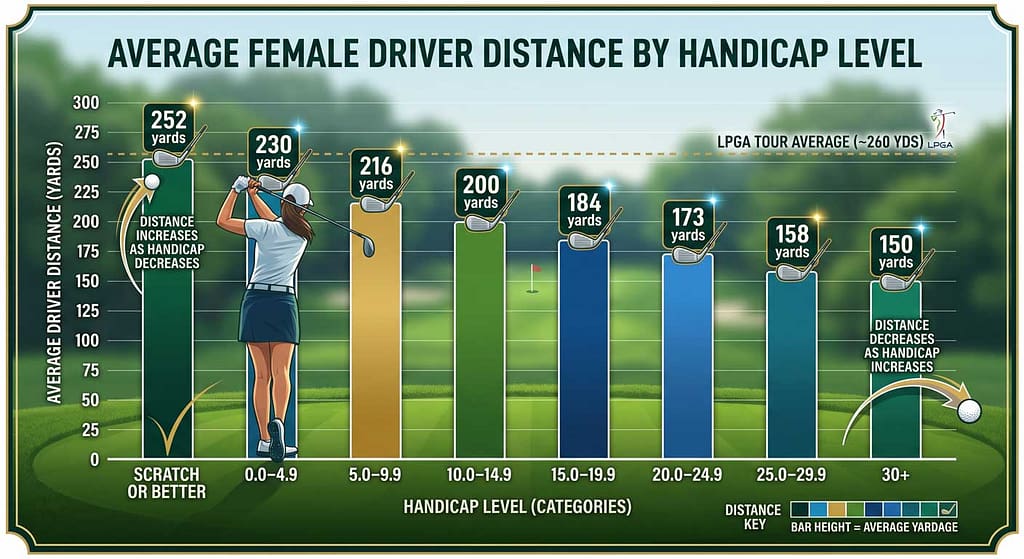
Everyone loves hitting a fantastic drive straight down the middle of the fairway. Data shows a clear link between lower scores and longer tee shots.
Scratch women golfers launch their driver an impressive 237 yards on average. A player with a 15-handicap will typically hit her driver 185 yards. Beginners sitting around a 30-handicap usually see tee shots traveling roughly 152 yards.
That variance heavily influences how a person maps out the rest of the hole. Shorter hitters need to rely heavily on strong fairway woods just to reach the green in regulation.
But don’t compare your game to the players you see on TV: LPGA professionals swing their big sticks at nearly 96 miles per hour to generate massive power. Recreational players swing closer to 78 miles per hour.
To dial in your distance, a handy and widely accepted formula is to multiply your swing speed by 2.3.
Clearing Up the Fairway Wood and Hybrid Traffic Jam
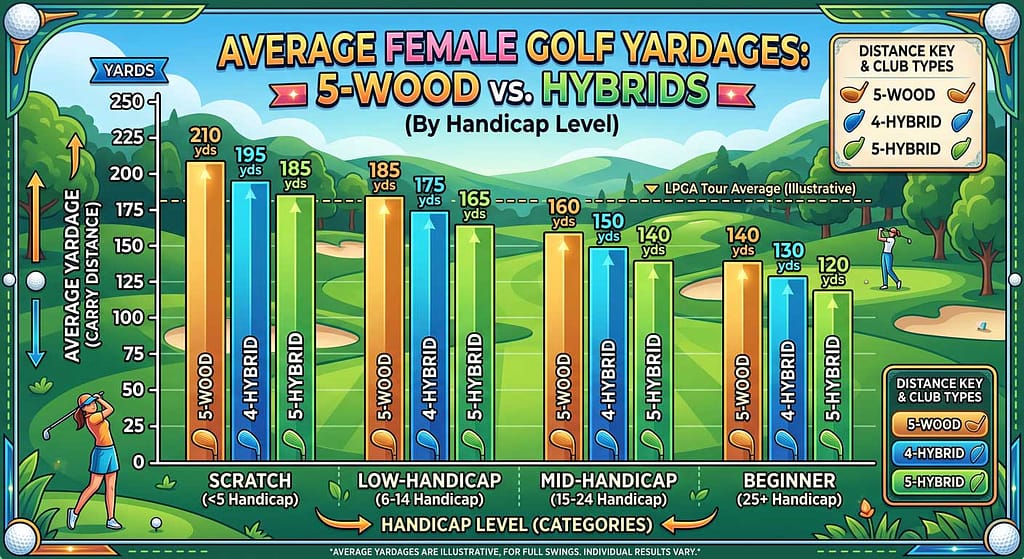
Take a quick peek inside your golf bag right now. Many players carry a three-wood, five-wood, four-hybrid, and five-hybrid. Those clubs sound completely different on paper.
Telemetry data tells a very funny story about how they perform for recreational golfers:
- For a thirty-handicap player, a four-hybrid travels 118 yards.
- Her five-hybrid goes about 116 yards.
Carrying both of these clubs creates totally unnecessary overlap. Higher handicaps should definitely rethink their setups to drop redundant equipment.
Spacing out your lofts ensures every single club serves a highly specific purpose. Try jumping straight from a high-lofted wood to a six-hybrid to see immediate scoring benefits.
Dropping down to the mid-irons reveals similar realities regarding distance compression:
- Scratch players launch a seven-iron 156 yards.
- A twenty-handicapper hits that same seven-iron 107 yards.
Building a bag tailored to your exact swing speed guarantees you have the right tool for every single shot.
The Magic of Wedges and Approach Play
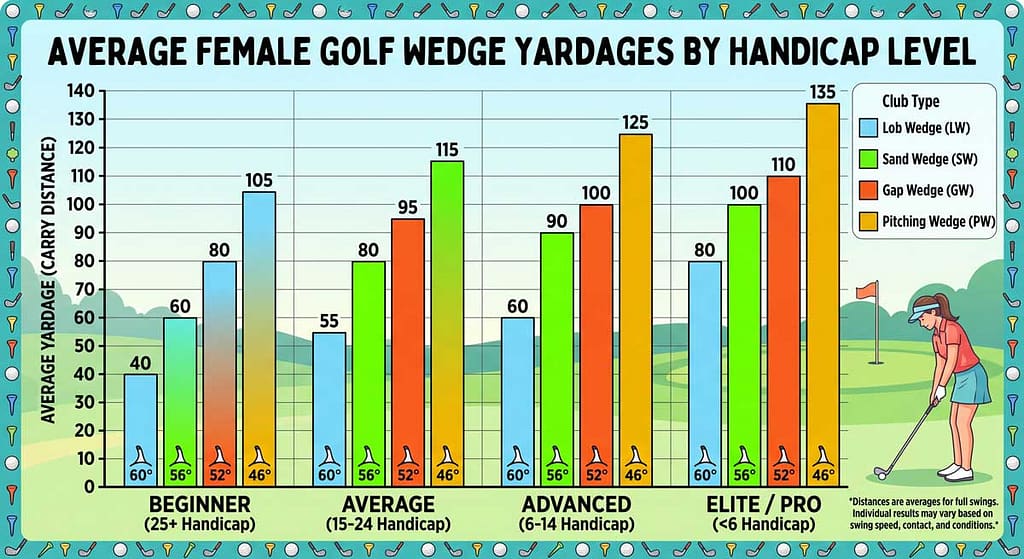
Hitting greens in regulation requires a solid understanding of your shortest clubs. Elite players utilize pitching wedges and sand wedges to attack the pin aggressively. Scratch female golfers hit their pitching wedge 129 yards.
High handicappers experience a completely different reality near the green. A thirty-handicap player hits a pitching wedge roughly 63 yards.
Sand wedge distances also show massive variations based on skill level: Zero-handicap players launch their sand wedge 94 yards, but beginners max out their sand wedge around 42 yards.
Recreational players often struggle to generate the precise downward strike required for heavily lofted clubs. Practicing partial swings with mid-irons offers a highly effective alternative strategy for approach shots. Mastering those delicate chips entirely transforms your scorecard.
The Reality of Age and Yardage
Birthdays bring wisdom, cake, and slightly slower swing speeds.
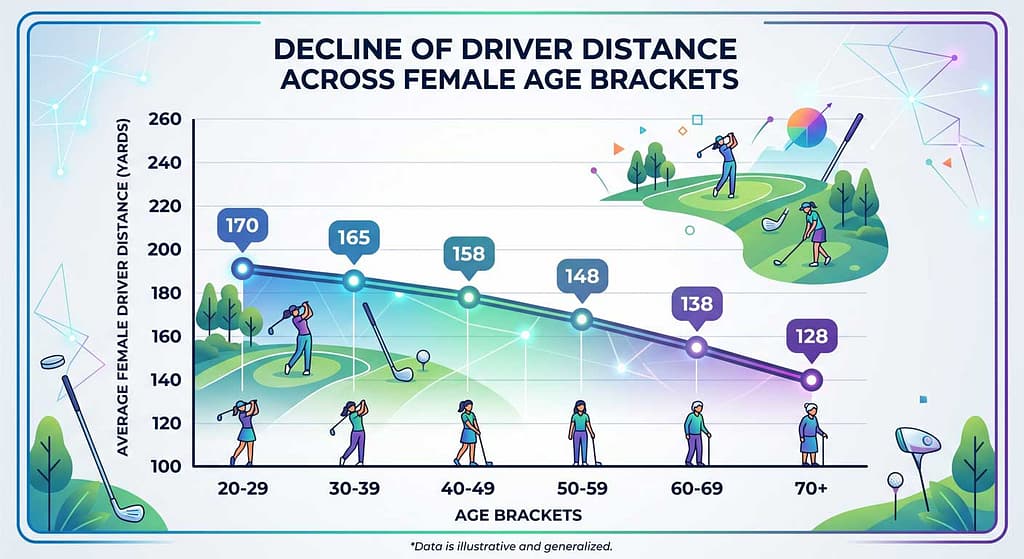
Statistics paint a very clear picture regarding chronological age and physical power:
- Women under thirty average 170 yards off the tee.
- Golfers in their forties see that number gently slide to 158 yards.
- Players in the fifty to fifty-nine bracket average 148 yards with the big stick.
Biology dictates a natural reduction in fast-twitch muscle fibers over time. Knowing these numbers helps you set highly realistic expectations for your game. Moving to forward tees aligned with your current power output makes the game incredibly enjoyable.
Staying flexible through daily stretching routines keeps you hitting the ball beautifully for decades.
The Great Equalizer on the Greens

Smashing a drive feels amazing, but rolling in a tough putt completely saves the round.
Time wonderfully sharpens the short game! Telemetry proves that women in the fifty to fifty-nine age group are the absolute best putters on the course.
Younger demographics struggle heavily with distance control on the greens. Twenty-somethings average nearly three and a half three-putts every single round.
Older players bring incredible emotional temperance to the dance floor. Decades of reading slopes translates into highly refined lag putting skills. A seasoned golfer routinely taps in for easy pars.
Focusing your practice time on the putting green yields massive improvements!
Embracing Your Unique Golf Journey

Numbers provide a fantastic baseline to help you understand your unique athletic abilities. Evaluating your bag composition guarantees you have the right tools for your specific swing speed.
Adjusting your expectations as the years pass keeps frustration entirely out of the picture. Focusing intensely on your short game pays massive dividends regardless of your power level.
Remember to laugh at the bad shots and celebrate the glorious ones! Golf remains a beautiful puzzle we get to solve alongside our favorite people!
Grab your clubs, hit the links, and play your absolute best today!
If These Articles Help,
Running Golf Course Intel takes real time, real effort, and – yep – real golf balls. If you’ve enjoyed the guides, the strategy breakdowns, or the myth‑busting articles, hitting that Buy Us Golf Balls button is the easiest way to help keep the site online and the content flowing. Every donation, big or small, genuinely fuels the next round of smarter golf insights.
Thanks for helping us keep this thing rolling!





0 Comments