
Golf at The Challenge, With Strategies for Every Handicap
If you have ever stood on the first tee of this track in Graham, North Carolina, looking out over the rolling hills toward the Haw River, you know one thing for certain: The Challenge Golf Club lives up to its name.
With 21 water hazards, 21 contoured bunkers, and 18 distinct elevation changes, this layout tests every club in your bag. However, you do not need a scratch swing to post a great number here. You just need a smarter game plan.
At Golf Course Intel, we believe that data-driven course management beats raw power every single time. Whether you are a low-handicap striker, a weekend warrior looking to achieve a personal milestone, or a high-handicapper aiming to keep the ball dry, this guide will help you conquer The Challenge.
A Brief History of The Challenge Golf Club
Opened in 1997 and designed by architect Barry Brantley of Shape Masters, The Challenge was carved out of undulating farmland in the Piedmont of North Carolina, right along the Haw River. The natural topography creates dramatic ravines, tight tree-lined chutes, and scenic water features.
Its architectural pedigree earned immediate praise. Upon opening, it was named the 2nd Best New Course in North Carolina by the NC Golf Magazine Panel and Best New Public Course of the Piedmont by Carolinas Magazine. It also boasts a prestigious Four-Star rating from Golf Digest and regularly hosts Carolinas Golf Association (CGA) events.
In late 2014, previous owner Richie Belton led a massive modernization effort, upgrading the irrigation system and converting the greens from bentgrass to ultradwarf Champion Bermuda. In 2019, Golf Advisor ranked it the 24th Most Improved Golf Course in America. Acquired by Raleigh-based Piedmont Links in March 2023, the course remains one of the premier semi-private tracks in the Piedmont region.
The Agronomic Factor: Taming Champion Bermuda
Before you even pull a club, you have to understand the turf under your feet. Because the course sits right in the Haw River basin, the local micro-climate influences wind, moisture, and turf firmness.
The fairways feature tight, firm Bermuda grass that rewards crisp ball-striking. Meanwhile, the Champion Bermuda greens thrive in the Carolina heat, rolling fast and firm all summer long.
What this means for your game:
- Account for rollout: Expect 3 to 5 yards of forward rollout when your approach shot lands on the green.
- Use the ground: Tightly mown Bermuda fringes make the bump-and-run chip shot your highest-percentage play around the greens.
- Stay below the hole: Downhill putts on Champion Bermuda are lightning-fast. Leave your approach shots below the pin whenever possible to avoid three-putts.
(Want to learn more about reducing putting variance? Check out Why Trusting Your Golf Putting Wins More Matches)
Proper Tee Selection: Why Mid-Handicappers Must Choose Wisely
The biggest mistake amateurs make at The Challenge happens before they even swing a club: picking the wrong tee box.
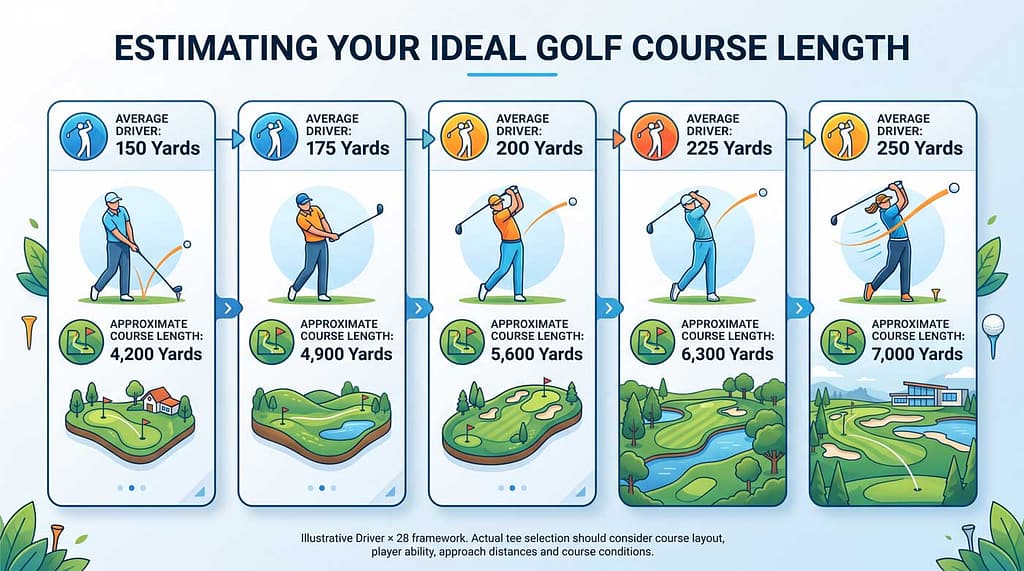
According to recent Arccos and ShotScope data, the average male amateur drives the ball 224.1 yards, while the average female amateur averages 175.7 yards. Using the proven industry formula (Optimal Course Length = Average Driver Distance × 28), here is where you should tee it up:
- Low-Handicap Men (~3.0 Index | 250–261 yd Drive): Gold Tees (6,828 yards | Course Handicap: 5)
- Mid-Handicap Men (~15.0 Index | 224–236 yd Drive): Blue Tees (6,401 yards | Course Handicap: 17)
- High-Handicap Men (25.0+ Index | 194–204 yd Drive): White Tees (5,755 yards | Course Handicap: 24)
- Low-Handicap Women (~4.0 Index | 175–200 yd Drive): Ladies White Tees (5,755 yards | Course Handicap: 6)
- Mid-Handicap Women (~16.0 Index | 150–175 yd Drive): Ladies Black Tees (5,088 yards | Course Handicap: 16)
- High-Handicap Women (28.0+ Index | <150 yd Drive): Ladies Red Tees (4,771 yards | Course Handicap: 25)
A Special Note for the Mid-Handicap Golfer
If you are a 15-handicap golfer, statistics show you hit roughly 47% of fairways and 23% of greens in regulation. Even more telling? A 15-handicapper saves par from greenside bunkers only 18% of the time.
Playing the Blue Tees (Men) or Ladies Black Tees (Women) puts your tee shots right where Barry Brantley intended. Move back too far, and forced carries over ravines turn into automatic penalty strokes. Play the right tees, and you can use smart club selection to take the worst hazards completely out of play.
Core Course Management Directives for Every Handicap
Before diving into specific holes, keep these three universal strategies in mind for every level of player:
- Low-Handicappers (0–5 Index): Use 3-woods and long irons off downhill tees to stay short of pinch points. Attack par 5s cautiously, and rely on high-spin wedges to hold the shallowest greens.
- Mid-Handicappers (10–18 Index): Eliminate the “short-side” miss. With an 18% sand save rate and a 10% three-putt rate, aim for the fattest part of every green and treat forced carries with respect.
- High-Handicappers (20+ Index): Play for damage control. With only a 10% bunker save rate, avoid sand and water at all costs. Turn long, uphill Par 4s into three-shot Par 5s, use hybrids for easy launch, and lean on your putter from the fringe.
Featured Holes: Mid-Handicap Course Management in Action
Every hole at The Challenge asks a strategic question. Here is how a mid-handicap golfer should navigate six of the course’s most demanding tests:
Deceptive Hole 4: Par 3 (Blue 115 yds | White 108 yds | Red 98 yds)

- The Setup: A dramatic drop-shot Par 3 over a massive waste area that demands a strict carry. The shallow, 22-yard-deep angled green slopes right toward the Haw River, with ambient traffic noise from I-40 humming directly behind the tee.
- The Mid-Handicap Decision: Do not get cute with a finesse swing. Take a full Pitching Wedge, block out the highway noise, and commit to clean contact. A chunked shot ends up in an unrecoverable waste bunker. Aim left of the flag and let the natural slope feed your ball toward the pin.
The Ravine Crossing: Hole 6: Par 4 (Blue 352 yds | White 341 yds | Red 299 yds)
- The Setup: A slight downhill tee shot into a narrow chute of trees. The fairway ends abruptly 110 yards from the green, plunging into a ravine and creek 60 yards out. A nasty pot bunker guards the front-center of a severely sloped back-to-front green.
- The Mid-Handicap Decision: Leave the driver in the bag! Hit a hybrid or fairway wood off the tee to guarantee you stop short of the 110-yard drop-off. For your uphill 155-yard approach, take an extra club (7- or 8-iron) and aim center-right to bypass the front pot bunker. Above all, do not miss long – chipping down this steep green is a recipe for double bogey.
Intimidating Hole 7: Par 5 (Blue 473 yds | White 438 yds | Red 339 yds)
- The Setup: A lake runs down the entire left side and cuts directly across the fairway 80 yards short of a deep, 32-yard green. Worse yet, the fairway acts like a “half-pipe” that funnels balls left toward the hazard.
- The Mid-Handicap Decision: Aim your driver up the right side so the slope feeds your ball back to the middle. Instead of forcing a risky long wood over water on your second shot, lay up with a comfortable 7-iron to the 90-yard mark. From there, knock a full Pitching Wedge onto the deep green and walk away with an easy par or stress-free bogey.
Interesting Hole 14: Par 4 (Blue 402 yds | White 364 yds | Red 300 yds)

- The Setup: One of the most unique holes in North Carolina. It plays slightly uphill and features a retaining wall running right down the center of the fairway from 120 yards to 35 yards out, splitting the landing zone in two.
- The Mid-Handicap Decision: Favor the right tier of the split fairway off the tee. A fade stays safely in play, but a pulled tee shot hooks straight into the left trees and the Haw River beyond. From 166 yards uphill, take an extra club (a smooth 5-iron) and aim right-center to avoid the greedy greenside bunker sitting just 5 yards off the left fringe.
River’s Edge Hole 16: Par 4 (Blue 419 yds | White 333 yds | Red 273 yds)
- The Setup: Flat, long, and visually intimidating. The Haw River lurks along the entire left side, and a pond guards the front of a narrow 31-yard green from 80 to 50 yards out.
- The Mid-Handicap Decision: Aim your tee shot right-center away from the river. Next comes the ultimate discipline test: if you face a 180+ yard approach and lack confidence with a 5-iron over water, lay up short of the 80-yard pond with a wedge. Pitching on from 70 yards takes the big number out of play and preserves an easy bogey.
Downhill Hole 18: Par 5 (Blue 524 yds | White 490 yds | Red 437 yds)

- The Setup: A thrilling downhill finisher back to the clubhouse. Water crosses the fairway 160 yards from the green, a massive cross-bunker sits 90 yards short-right, and a fast, multi-tiered 35-yard green awaits on the far side of another crossing creek.
- The Mid-Handicap Decision: After a center-cut drive, resist the urge to try to carry the water with a 3-wood. Hit a controlled 180-yard hybrid to stop safely short of the 160-yard water hazard. That leaves a full 108-yard Pitching Wedge into the green. Stay below the hole on this multi-tiered surface to close out your round with a two-putt.
Projected Scores by Handicap
When you replace ego with strategy at The Challenge, your scorecard transforms. By selecting the mathematically correct tee box, respecting the firm Champion Bermuda greens, and steering clear of penalty hazards, here is what you can expect to shoot:
- Low-Handicap Players (Gold / Ladies White Tees): Projected Score: 73-76. By taking advantage of the par 5s and scrambling at a 50–55% clip from the tight Bermuda fringes, low-handicappers will play right to their Course Handicap of 5 or 6.
- Mid-Handicap Players (Blue / Ladies Black Tees): Projected Score: 85-88. By avoiding the 21 water hazards, playing away from greenside bunkers, and accepting bogey on tough forced-carry holes, mid-handicappers will comfortably hit their Course Handicap of 16 to 17.
- High-Handicap Players (White / Ladies Red Tees): Projected Score: 96-102. High-handicappers average 2.5 to 3.5 penalty strokes per round on heavy-hazard courses. By laying up short of forced water carries (like Holes 7 and 16) and treating long Par 4s as Par 5s, you will eliminate blow-up holes and break 100 with discipline to spare.
Grab Your Complete Strategy Guide / Caddie Book

Ready to bring every yardage, carry distance, and hole-by-hole club recommendation right to the course with you?
Download the complete, 20-page “Course Strategist: A Performance Blueprint for The Challenge Golf Club” Caddie Book right now on BuyMeACoffee.com!
Best of all, it features a “pay what you think is fair“ price tag – so you can grab tour-level data analytics for your next round in Graham at whatever price works for your budget.
If These Articles Help,
Running Golf Course Intel takes real time, real effort, and – yep – real golf balls. If you’ve enjoyed the guides, the strategy breakdowns, or the myth‑busting articles, hitting that Buy Us Golf Balls button is the easiest way to help keep the site online and the content flowing. Every donation, big or small, genuinely fuels the next round of smarter golf insights.
Thanks for helping us keep this thing rolling!






0 Comments