Summary:
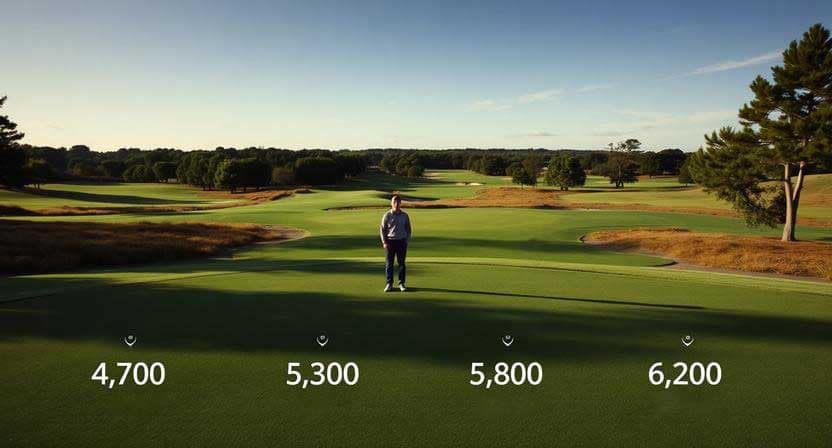
Matching course setups to individual player abilities and changing environmental conditions is a major challenge in golf. Adaptive Golf addresses this by tailoring playing distances, tee selections, and strategies to specific player data, such as driving distance and ball dispersion, rather than relying solely on traditional tee markers.
Integrating real-time weather, course conditions, and operational data enables personalized recommendations that improve player strategy and course flow. This data-driven approach helps course operators manage pace of play while ensuring players of all skill levels, ages, and physical capabilities encounter appropriate, enjoyable strategic challenges.
Contents
- Adaptive Golf: The Toughest Problem to Solve
- The Real Challenge: Matching the Golfer to the Course
- The Biggest Opportunity May Be Personalized Golf
- What Would Adaptive Golf Look Like?
- So What Is Golf’s Toughest Problem?
- A Note for Golfers, Course Managers and Operators
Adaptive Golf: The Toughest Problem in Golf to Solve
Golf has a lot of difficult problems:
A 20-foot downhill putt with six feet of break qualifies. So does a 40-yard pitch from a tight lie when the pin is tucked behind a bunker. Then there is the 30-yard chip that somehow travels 50 yards.
Every golfer knows that feeling.
Yet the toughest problem in golf may have very little to do with hitting the golf ball. It may be the challenge of creating a golf experience that works beautifully for different golfers, different abilities, different physical capabilities, different weather and different course conditions – often at the same time.
That is where Adaptive Golf enters the conversation.
And it could become one of the most important ideas in recreational golf.
“The future of golf may depend on making the golf course better at adapting to the golfer.“
What Is the Toughest Problem in Golf?
Ask ten golfers what makes golf difficult and you will probably get ten answers.
- One golfer will blame the driver.
- Another will blame three-putts.
- Someone will mention slow play before ordering a second cup of coffee.
- A course superintendent may point toward weather and turf conditions.
- A starter may have a few thoughts about the group that arrived seven minutes after its tee time.
- A course architect sees a completely different set of challenges.
All of them have a point.
Golf is an unusual sport because the playing environment itself changes dramatically from course to course and from day to day. A golfer may face a 150-yard approach on Tuesday and a completely different shot on Saturday because the wind, turf firmness, pin position or temperature has changed.
The golfer hasn’t necessarily changed, the game around the golfer has. That creates a fascinating question that is the central problem of Adaptive Golf:
How can golf continually match the challenge of the course to the capabilities of the person playing it?
“Golf has plenty of hard problems. The biggest may be creating a course experience that adapts to the golfer, the weather, the conditions and the pace of play.“

Golf Has a Lot of Problems to Solve
The list gets surprisingly long when you consider everything that can influence a round:
- Driving distance
- Driving accuracy
- Fairway width
- Rough height
- Approach-shot distance
- Green size
- Green speed
- Putting skill
- Bunker placement
- Water hazards
- Out-of-bounds
- Elevation changes
- Course setup
- Pin locations
- Weather
- Wind
- Temperature
- Rain
- Ground firmness
- Player age
- Physical ability
- Handicap
- Equipment
- Course knowledge
- Rules
- Ball searches
- Pace of play
- Course traffic
- Walking distance
- Cart restrictions
- Player confidence
- Decision-making
That’s quite a job for 18 holes of golf. Oh, and somewhere in the middle of all that, we’re supposed to remember to keep our head down.
The Real Challenge: Matching the Golfer to the Course
This is where the idea of “Adaptive Golf” becomes particularly interesting. Traditional golf often begins with a relatively simple question:
Which tees should you play?
The answer frequently comes down to colored tee markers. That system is easy to understand.
Except it isn’t. Tee colors vary widely from course to course. For example, here in Durham NC, there are three university courses situated within ~20 miles of each other:
- The Duke University Golf Course doesn’t have either a light blue or red marker.
- The UNC Finley Golf Course has neither a dark blue nor a red marker.
- The NC State Lonnie Poole course doesn’t have any shade of blue markers, but definitely has a red marker (at just under 6500 yards).
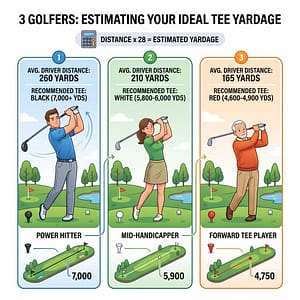
A golfer’s appropriate playing distance depends on considerably more than age or gender (or tee marker color). Driving distance matters, and so does dispersion. A golfer who drives 190 yards but keeps the ball in play may experience a course very differently from someone who drives 240 yards and regularly sends the ball into the neighboring county.
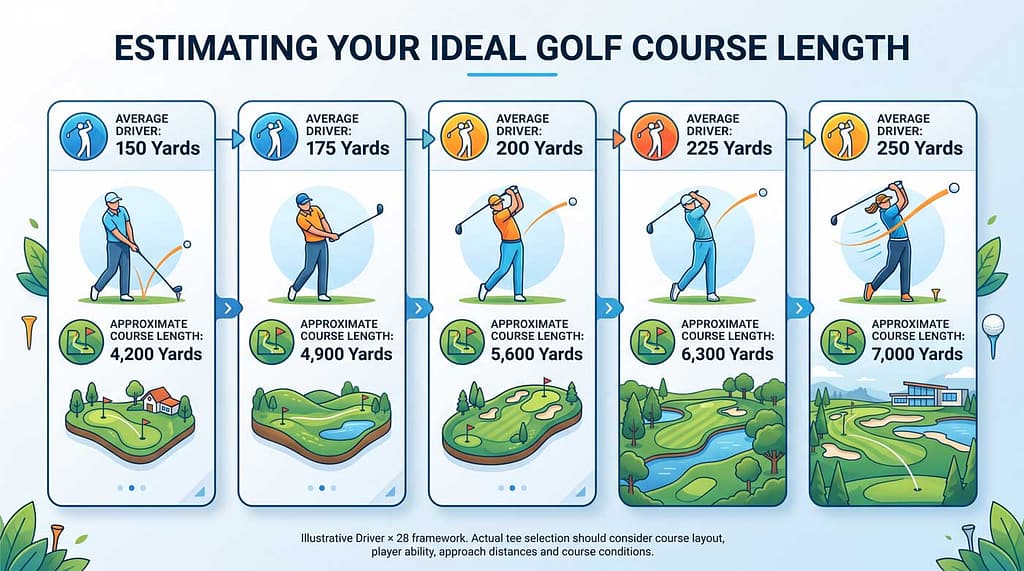
GolfCourseIntel’s course guides have repeatedly used player-specific data to connect driving distance with an appropriate overall course length. Our guides use the widely-recognized Driver × 28 framework as a starting point for tee selection.
That concept is powerful because it changes the conversation. Instead of asking:
“Which tee is right for me?”
the player can ask:
“Which playing distance gives my game the best version of this golf course?”
That’s a much more useful question.
Why Tee Selection Is Much Bigger Than Yardage
Imagine two golfers:
- The first golfer hits the driver 220 yards but has a relatively high ball flight and struggles from uneven lies.
- The second golfer hits 180 yards and is exceptionally accurate.
Give both golfers the same 6,000-yard course and their experiences could be dramatically different.
- Now add a third golfer who has a 160-yard driver and some difficulty walking long distances.
The scorecard still says 6,000 yards. The golf experience does not. This is why tee selection can become a gateway to better course management.
That is where golf gets interesting: The right tee can turn a forced carry into a strategic decision, but the wrong tee can turn the same challenge into an exercise in survival.
Driving: Distance Is Only Half the Story
Golf has spent decades talking about distance for good reason: Distance creates options.
A longer drive can shorten an approach. It can change which hazards are reachable. It can open different angles into a green.
Yet distance without dispersion creates its own problems. A 250-yard drive that finishes behind a tree may be less useful than a 210-yard drive sitting in the middle of the fairway.
That makes the driver problem more complicated:
How far can this golfer hit the ball, and where is that ball likely to finish?
A genuinely Adaptive Golf system would know both. It might recommend driver on one hole and a hybrid on another of similar length. That recommendation could change because the fairway narrows, the wind shifts or the golfer needs a particular approach distance. That sounds remarkably simple.
Golfers know better.
Fairways: How Wide Is Wide Enough?
Fairway width is one of the most underappreciated elements of golf design. A 35-yard-wide fairway can feel enormous to one golfer and it can feel like a bowling lane to another – the answer depends on dispersion.
Consider a golfer whose typical driver dispersion covers 35 yards:
- A 25-yard-wide fairway creates a serious problem.
- A 45-yard-wide fairway gives that same golfer a much more playable target.
Course design therefore becomes part of the Adaptive Golf equation. A fairway isn’t simply wide or narrow, its effective width depends on the golfer standing on the tee.
Approach Shots Create Another Layer
Getting the ball into the fairway is only the beginning. Now the golfer has to get it onto or near the green.
A 135-yard approach may be comfortable for one player, but for another golfer, that might require a fairway wood. That distinction matters enormously. A course can feel fair when most par-4s produce manageable approach shots. Move the golfer too far back and the same holes can become a procession of long irons, hybrids and fairway woods.
The scorecard hasn’t changed. The golfer’s experience certainly has.
Putting: The Smallest Club Creates a Giant Problem
Putting looks like the simplest part of golf: The ball is sitting still, the target is sitting still. There is no 25-mph wind blowing across the putting green.
Then you stand over a five-footer for bogey. Suddenly physics becomes personal.
Putting depends on:
- Green speed
- Slope
- Grain
- Moisture
- Distance
- Starting line
- Speed control
- Green-reading ability
- Confidence
A green running at 8 on the Stimpmeter presents a very different challenge from one running at 12, so the golfer needs to adapt. So does the course. The goal should be a putting surface that provides predictable challenge.
That gives golfers an opportunity to improve their skill without making every missed putt feel like the green designer personally moved the hole.
Course Conditions Change the Game
A golf course is never completely static.
- Rain changes firmness.
- Heat changes turf.
- Wind changes club selection.
- Moisture changes ball behavior.
- Grass growth changes rough.
- Maintenance changes putting surfaces.
A course can play noticeably differently from one week to the next.
GolfCourseIntel’s own strategy guides explicitly acknowledge that weather, ground firmness, rough length and green speed can affect the viability of strategic recommendations.
That observation points toward an important future development: Golf strategy should become increasingly condition-aware.
A yardage alone doesn’t describe the shot – a better calculation might consider:
Distance + elevation + wind + temperature + lie + firmness + player tendencies.
That begins to resemble the way experienced caddies think. Technology simply gives recreational golfers a chance to access some of that intelligence.
Weather May Be Golf’s Ultimate Wild Card
Weather can transform a course. A 400-yard par 4 into a 20-mph wind can feel completely different from the same hole with a helping breeze. Rain introduces another variable. Temperature changes ball flight. Cold mornings can make a course feel longer. Firm fairways can produce extra roll, while soft fairways remove it. Wind can turn a comfortable par 3 into a guessing game.
For golfers, weather becomes part of strategy.
For course operators, weather becomes part of course management.
But for adaptive golf, weather becomes data.
Hazards Should Create Decisions
Water is beautiful. Water is also remarkably effective at making golfers question their life choices.
The best hazards create strategic decisions. One golfer sees the water and thinks:
“I can carry it, but should I?”
That’s an interesting strategy decision.
Another golfer sees the water and thinks:
“I have no realistic shot.”
That’s a different experience.
Good hazard placement gives stronger golfers opportunities to attack while providing safer alternatives for golfers who prefer conservative play. This is one of the great achievements of course design – the same hole can offer different solutions.
Course Design Has a Massive Responsibility
Course architects face a difficult balancing act – they need to create interest for accomplished golfers while maintaining reasonable playing options for recreational players.
That doesn’t require every golfer to experience exactly the same challenge; its quite the opposite – a well-designed hole can offer several strategic routes:
- One golfer may challenge a bunker.
- Another may lay back.
- A third may choose a different route entirely.
That is Adaptive Golf hiding inside traditional golf architecture.
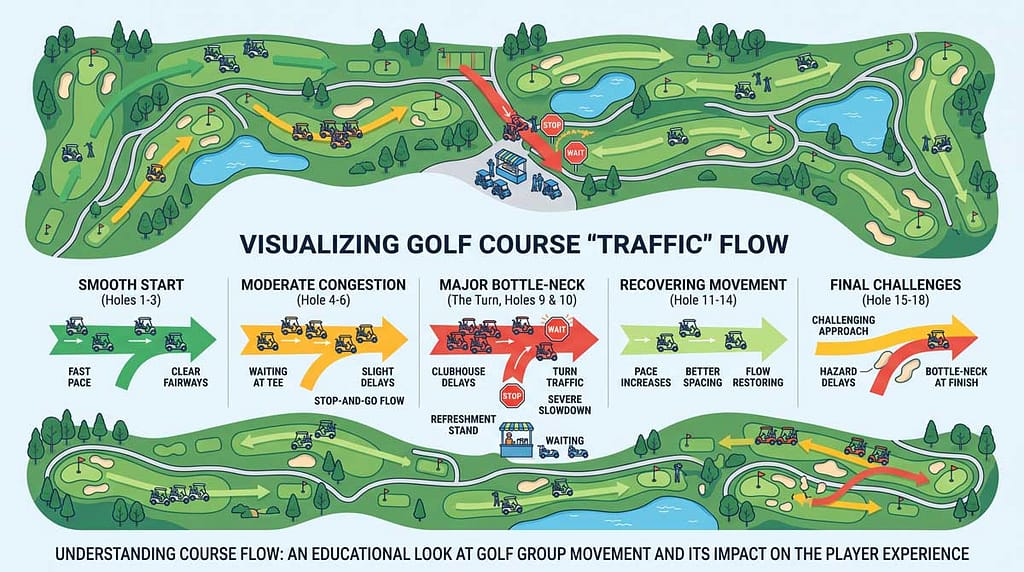
Slow Play Is a Systems Problem
Few topics generate more frustration than pace of play. Golfers have strong opinions about it. Course operators certainly do. Starters live in the middle of it.
Yet slow play is rarely caused by a single behavior. It can result from:
- Difficult course setup
- Wrong tee selection
- Crowded tee sheets
- Long searches for golf balls
- Excessive practice swings
- Poor cart positioning
- Players waiting too long before making decisions
- Groups losing contact with the group ahead
This makes pace of play partly a traffic-management problem.
A golf course has finite capacity. Every additional minute spent by one group can affect the groups behind it. That means course operators should think about pace as part of the entire golf experience.
Fast Play Has Its Own Challenges
There is another side to pace: some golfers love moving quickly while others enjoy a leisurely round. A group that finishes in three hours may feel fantastic but the foursome ahead may feel like they were being stalked by a pack of wolves.
Good pace management gives groups room to maintain their preferred rhythm while preserving reasonable spacing.
That is another place where technology could help:
Imagine a course system that knows where every group is (via golf cart GPS or a small bag tag provided to each golfer at the start of the round) and identifies developing gaps before they become serious backups. The starter could receive a simple alert:
Group 7 is eight minutes behind the expected pace.
That’s much more useful than discovering the problem after four groups are waiting on the next tee.
Rules Need to Work for Real Golfers
The Rules of Golf provide an essential framework for competitive fairness.
Recreational golfers operate in a different environment. A weekend golfer dealing with an embedded ball, cart path, penalty area or lost-ball situation may not remember every procedural detail.
Technology could help here too. Imagine a GPS application recognizing the player’s location and presenting:
Ball entered penalty area
then providing the appropriate relief options. That could make the rules easier to follow while preserving their purpose.
Player Ability Changes Everything
This might be the most important variable of all – Golfers differ enormously.
- One player can carry a driver 260 yards.
- Another hits 150.
- One golfer can comfortably carry a bunker.
- Another needs to lay up.
- One golfer can stop a 6-iron on a firm green.
- Another needs the ball to run along the ground.
These differences aren’t flaws, they’re simply different golf games. A useful golf experience should accommodate that range.
GolfCourseIntel’s player-specific guides demonstrate the potential of this approach by incorporating a golfer’s distances, tendencies and course characteristics into strategic recommendations.
That is where personalized golf strategy becomes particularly powerful.
Physical Ability Belongs in the Conversation
Golf has enormous potential as a lifelong sport, and that makes accessibility important. A golfer may have limited hip mobility or may have a knee problem. Someone else may simply find walking 18 holes exhausting.
A course can make the experience easier through:
- Appropriate tee placement
- Forward tee options
- Cart access
- Reasonable distances between greens and tees
- Rest opportunities
- Clear course information
The goal is to keep golfers engaged with the game for as long as possible. That benefits both players and courses.
The Biggest Opportunity May Be Personalized Golf
Imagine arriving at a course and entering a few pieces of information in a kiosk:
Average driver: 195 yards
Average 7-iron: 135 yards
Typical handicap: 24
Preferred round length: 4 hours
Walking ability: Moderate
The system analyzes the course and responds:
Today’s Recommended Playing Setup
- Total yardage: 5,860 yards
- Tee: Forward/combination
- Expected round: 4:05
- Priority: Keep approaches inside 120 yards
- Three holes requiring special attention: 4, 11 and 16
- Weather adjustment: Club up on exposed approaches
Now the golfer isn’t simply receiving yardages, they’re receiving a game plan.
That’s a very different product.
What Would Adaptive Golf Look Like?
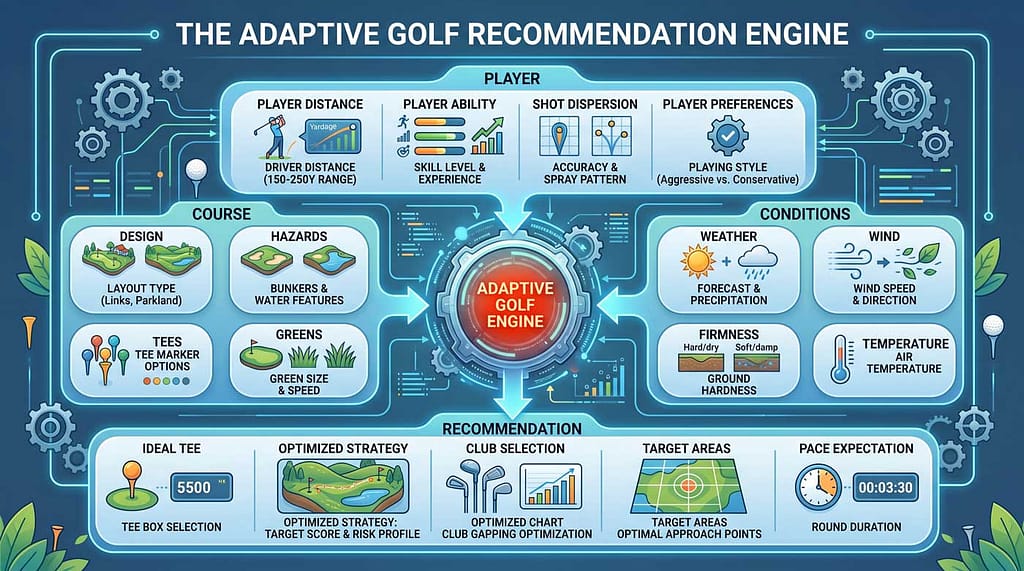
A mature Adaptive Golf system could combine several data streams:
Player Data
(entered at an onsite kiosk, or when booking a tee time online)
- Driver distance
- Club distances
- Dispersion
- Handicap
- Putting performance
- Typical miss
- Physical considerations
- Walking preference
Course Data
(entered during initial system setup)
- Tee locations
- Hole lengths
- Fairway widths
- Hazards
- Green dimensions
- Elevations
- Pin locations
- Course rating
- Slope
Condition Data
(updated automatically, via connected weather app)
- Wind
- Temperature
- Rain / precipitation
- Turf firmness
- Green speed
- Rough height
Operational Data
(automatically updated in the system throughout the day)
- Tee-sheet density
- Group spacing
- Expected round duration
- Course congestion
- Cart availability
Then the system could create an individualized playing plan for each golfer, and potentially improve pairings among singles or twosomes.
This Could Change the Role of the Starter
The starter has traditionally been the person who gets golfers onto the course. The future starter could become something more useful: The first course strategist of the day.
Instead of simply saying:
“You’re off the white tees.”
the starter might say:
“Based on your distances and course conditions, the combination tees will give you the best experience today. The wind is also making holes 6 and 14 play longer.”
That is valuable information, and it takes only a few seconds. It could improve the round before the golfer hits the first shot.
Course Owners Should Pay Attention
For course owners and operators, Adaptive Golf could represent something much bigger than a technology upgrade – it could become a customer-experience strategy.
A golfer who enjoys the round is more likely to:
- Return
- Recommend the course
- Play more frequently
- Bring friends
- Spend more time at the facility
- View the course as welcoming
The best customer experience may begin before the first tee.
The Goal Isn’t to Make Golf Easy
Golf needs difficulty; that’s part of the attraction. Golfers enjoy solving problems.
- A well-designed par 5 should make you consider whether to attack or lay-up.
- A demanding par 3 should require thoughtful club selection.
- A fast green should reward good speed control.
- A narrow fairway should create a decision.
The goal of Adaptive Golf is to make those challenges appropriate. That distinction matters – a 150-yard driver doesn’t need a 150-yard version of a championship course. That golfer needs a version of the course where the architecture still asks interesting questions.
The Best Golf Course Might Be Different for Every Golfer
Think about that for a moment – the perfect course setup for a 30-year-old scratch golfer might be completely wrong for a 53-year-old recreational golfer. The ideal setup for a 65-year-old golfer might also be wonderful for a beginner.
A 220-yard driver might want one set of tee locations while a 150-yard driver might need another. Same course, same architecture, different experience.
That’s the opportunity.
So What Is Golf’s Toughest Problem?
After looking at driving, fairways, approaches, putting, hazards, weather, course conditions, rules, player ability, physical limitations, course design and pace of play, I keep coming back to one answer:
Golf needs to become better at adapting to the golfer.
That is the toughest problem, and it’s also one of golf’s biggest opportunities. Adaptive Golf could connect the player with the course in a much more intelligent way.
- It could help a course manager manage traffic.
- It could help a starter make better tee recommendations.
- It could help a golfer select a sensible playing distance.
- It could help an older player continue enjoying the game.
- It could help a beginner avoid an unnecessarily unpleasant first experience.
- It could give accomplished golfers a more meaningful challenge.
The technology already exists to measure many of the variables; the bigger opportunity is putting those variables together.
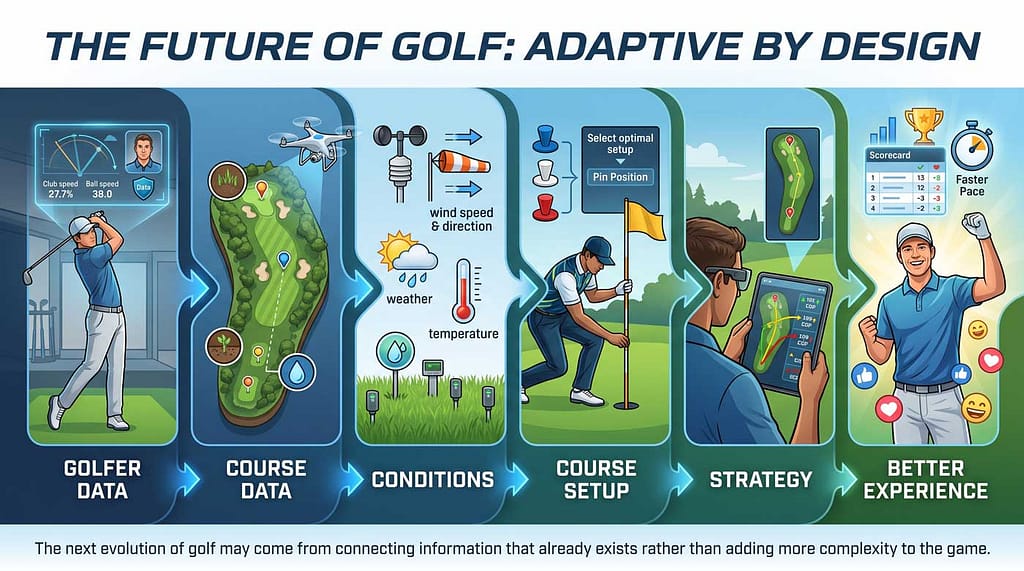
Golf’s Next Big Idea May Be Sitting on the First Tee
For generations, golfers have been expected to adjust themselves to the course. Maybe the next generation of golf will take a different approach, where
- The course knows the player.
- The player knows the conditions.
- The technology understands both, and
- The playing setup changes accordingly.
That doesn’t take the challenge out of golf, it gives golfers a better chance to enjoy the challenge.
And maybe that is the real objective.
Because nobody remembers the round where every shot was perfect – they remember the round where they had fun. They remember the great recovery shot. Some remember the birdie that came from nowhere. Others remember laughing with their playing partners after somebody hit a provisional ball that somehow became the worse shot.
Golf has plenty of hard problems.
Making the game fit the golfer may be the biggest one worth solving.
A Note for Course Managers, Golfers and Operators
- If you manage a golf course, pay attention to the golfers who consistently struggle with pace, tee selection and difficult holes.
- If you are a golfer, start paying attention to the distance you actually hit the ball rather than the distance you wish you hit it.
- If you design or operate courses, consider whether every hole provides a reasonable strategic option for every cohort of golfers using your facility.
The answers may look different at a private club, a municipal course, a resort or a daily-fee facility, but the underlying question remains the same:
How can we give more golfers a version of the game that fits the player standing on the tee?
That may be the next great problem for golf to solve.
If These Articles Help,
Running Golf Course Intel takes real time, real effort, and – yep – real golf balls. If you’ve enjoyed the guides, the strategy breakdowns, or the myth‑busting articles, hitting that Buy Us Golf Balls button is the easiest way to help keep the site online and the content flowing. Every donation, big or small, genuinely fuels the next round of smarter golf insights.
Thanks for helping us keep this thing rolling!
